Gemini 4 Models: Argon, Carbon, Hydrogen and Neon Compared
Explore Google's Gemini 4 models: Argon, Carbon, Hydrogen and Neon. Compare benchmarks, API pricing, speed and capabilities to find the right model for coding, research, AI agents and everyday workloads.

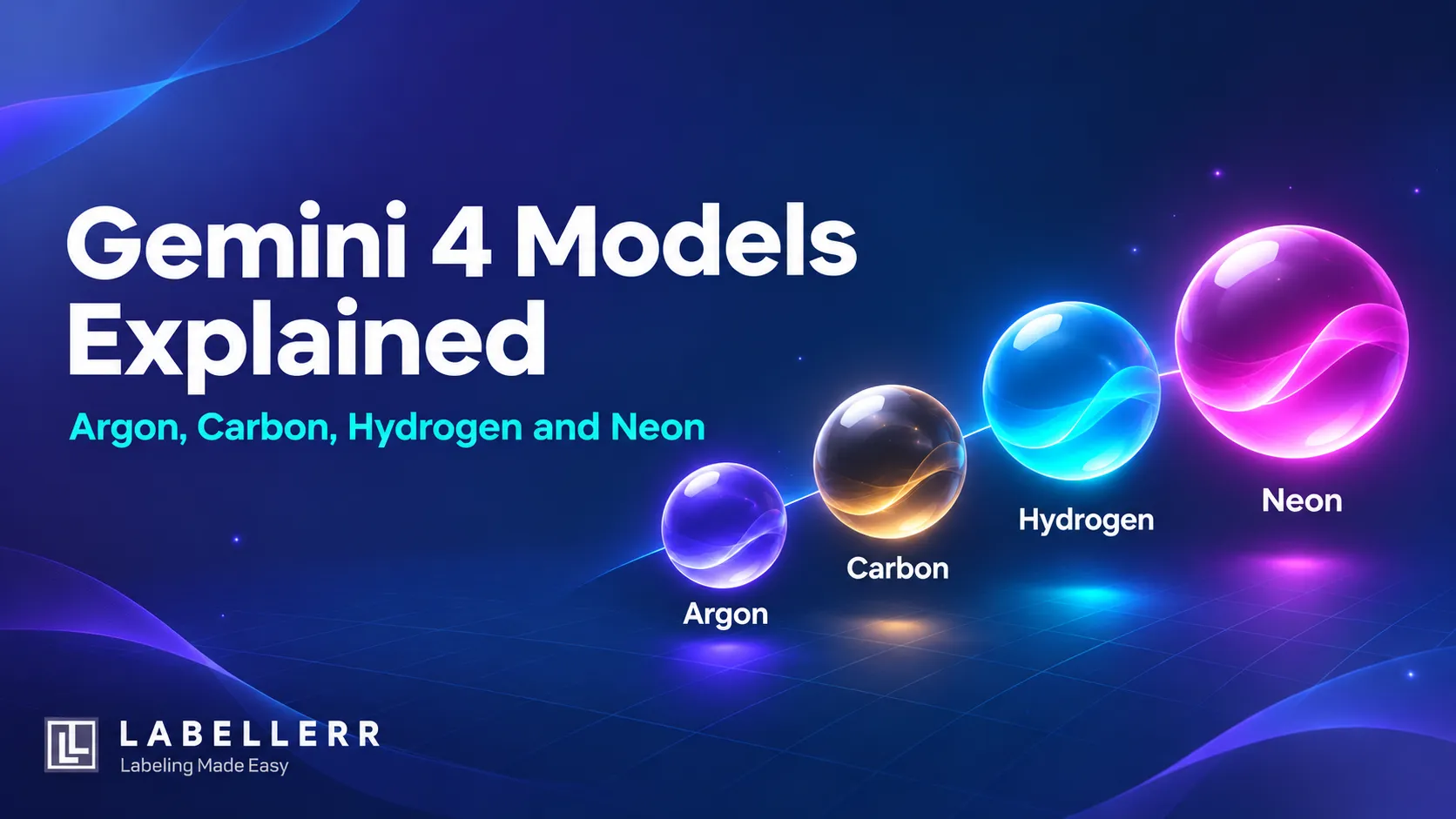
Google shipped four frontier models in seven weeks, which is more Gemini releases than most teams can test, let alone adopt.
The newest one, Gemini 4 Neon, arrived on November 18, 2026. On launch day, it became the default model for new conversations in Google Antigravity for paid users, and it began rolling out in GitHub Copilot. It also costs less than half as much per token as OpenAI's GPT-6.2 Astra and Anthropic's Claude Fable 5.2.
So which Gemini 4 model should you use, and why is Neon getting so much attention? This guide breaks down all four models with verified benchmarks, prices and clear use cases.
Key Takeaways
- Gemini 4 Argon launched first and suits stable production pipelines.
- Gemini 4 Carbon is Google's strongest model for the hardest, long-horizon problems.
- Gemini 4 Hydrogen is the fastest and cheapest of the four, and the only one with a free API tier.
- Gemini 4 Neon balances near-frontier intelligence with a $3 input and $15 output price per million tokens.
- All four models share a 1 million token context window.
What Is the Gemini 4 Model Family?

Gemini 4 family timeline
Gemini 4 is Google DeepMind's latest generation of AI models. Instead of the old Pro and Flash labels, Google now names each model after a chemical element, and each name maps to a specific role, from fast everyday work to deep research.
Here is the release timeline:
| Model | Announced | Generally Available | Role |
|---|---|---|---|
| Gemini 4 Argon | September 30, 2026 | October 13, 2026 | Stable coding and office work |
| Gemini 4 Carbon | October 28, 2026 | November 10, 2026 | Hardest, long-horizon problems |
| Gemini 4 Hydrogen | November 12, 2026 | November 12, 2026 | Fast, high-volume everyday tasks |
| Gemini 4 Neon | November 18, 2026 | November 18, 2026 | Complex, high-frequency tasks |
All four share the same API shape and tools. You can swap between them by changing one model ID, such as gemini-4-neon or gemini-4-hydrogen.
Gemini 4 Argon: The First Release
Argon opened the Gemini 4 era. Google first released it to trusted cyber defenders through its Fairwind Program, then made it broadly available on October 13, 2026.
Argon raised the output limit from 64,000 to 1 million tokens. At launch, Google reported a 77.9% score on DeepSWE v1.1 for long-horizon software engineering. On the Artificial Analysis Intelligence Index, Argon scores 50 at high thinking.
Argon also hallucinates the least of the four models, with a 95.7% non-hallucination rate measured by Artificial Analysis. It also leads the family on Vals legal work-product tasks.
Best for: existing pipelines that already work well on it, and careful legal drafting.
Gemini 4 Carbon: The Hardest Problems
Google positions Carbon as its pick for the hardest problems. It became generally available on November 10, 2026, to developers, businesses and Google AI Ultra subscribers.
Carbon spends more tokens exploring options and checking its own answers. That extra effort helps on difficult work such as complex debugging and open-ended scientific research. It scores 60 on the Artificial Analysis Intelligence Index and leads the family on Terminal-Bench 4.0 at 65.2%.
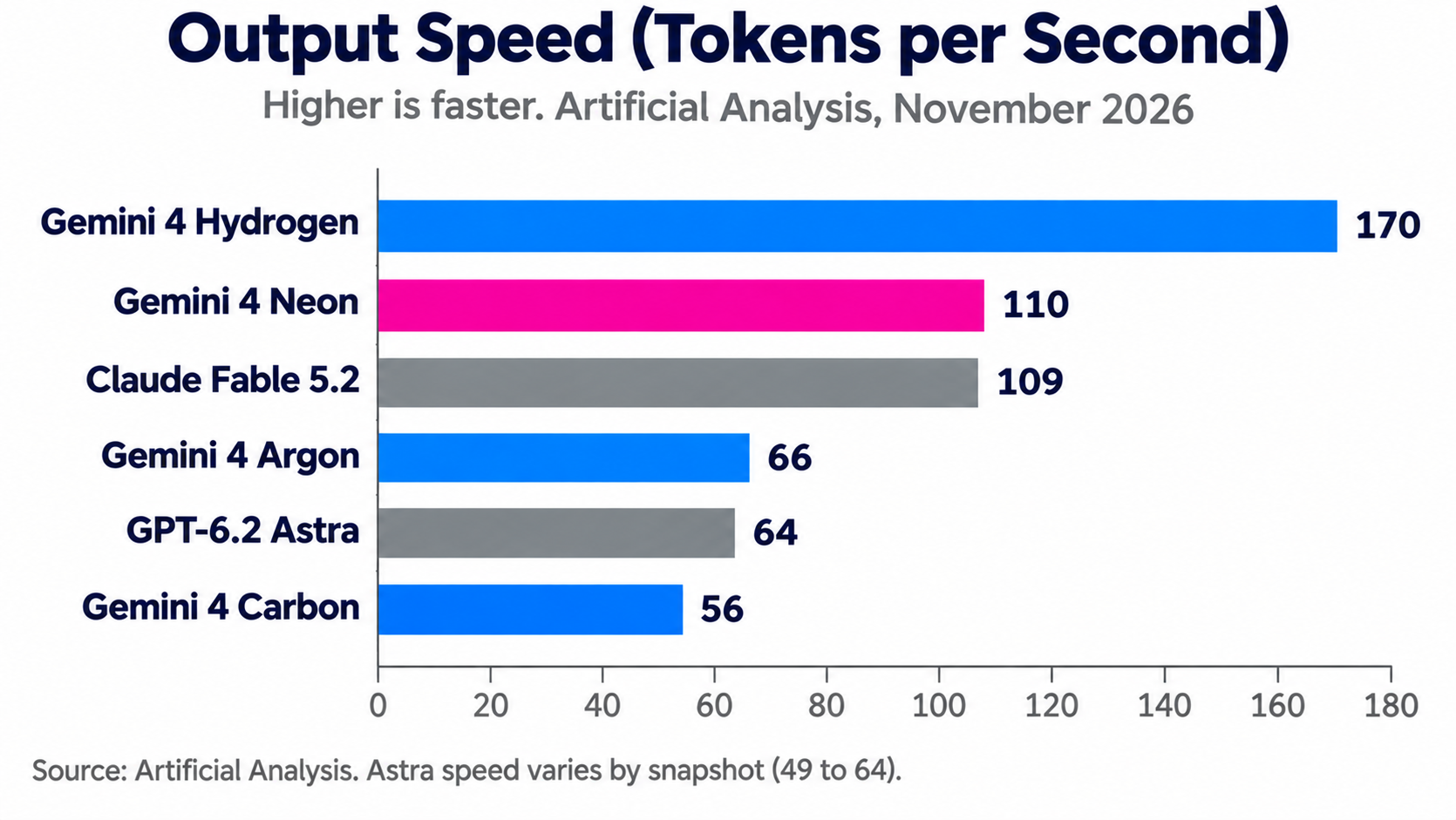
The trade-off is speed, because Carbon generates about 56 tokens per second at high thinking, roughly half the speed of Neon.
Best for: long-horizon research, hard debugging and tasks where accuracy matters more than speed.
Gemini 4 Hydrogen: Fast and Affordable
Hydrogen replaced Gemini 3.8 Flash on November 12, 2026. It serves as the speed tier of the family, and it now powers AI Mode in Google Search.
Google says Hydrogen finishes tasks 2.5 times faster than 3.8 Flash at its default setting. Artificial Analysis measured it at about 170 tokens per second, the fastest in the family. It scores 51 on the Intelligence Index at high thinking, slightly above Argon's 50.
Hydrogen costs $1.50 per million input tokens and $7.50 per million output tokens. It is also the only Gemini 4 model with a free tier in the Gemini Developer API.
Best for: routine coding, chat, high-volume automation and budget-sensitive apps.
Gemini 4 Neon: The Balanced Choice
Neon sits between Hydrogen and Carbon. Google describes it as a model that "balances depth and efficiency" for complex coding, analytical reasoning and enterprise workflows.
The benchmark results support that positioning. Neon scores 61 on the Artificial Analysis Intelligence Index at xhigh thinking, and 60 at high, matching Carbon at the same setting. It ranks first on the Artificial Analysis Coding Agent Index at 58.6, and second on the Vals Index at 70.87%. On Zapier's AutomationBench, it leads at 56.3%.
Google also reports that Neon costs 32% less per task than Carbon at the default high setting. It runs at about 110 tokens per second, roughly twice as fast as Carbon.
Best for: complex daily engineering, research, writing and production agents.
Benchmark Comparison: Gemini 4 vs Fable, Astra and Opus
Intelligence benchmark bar
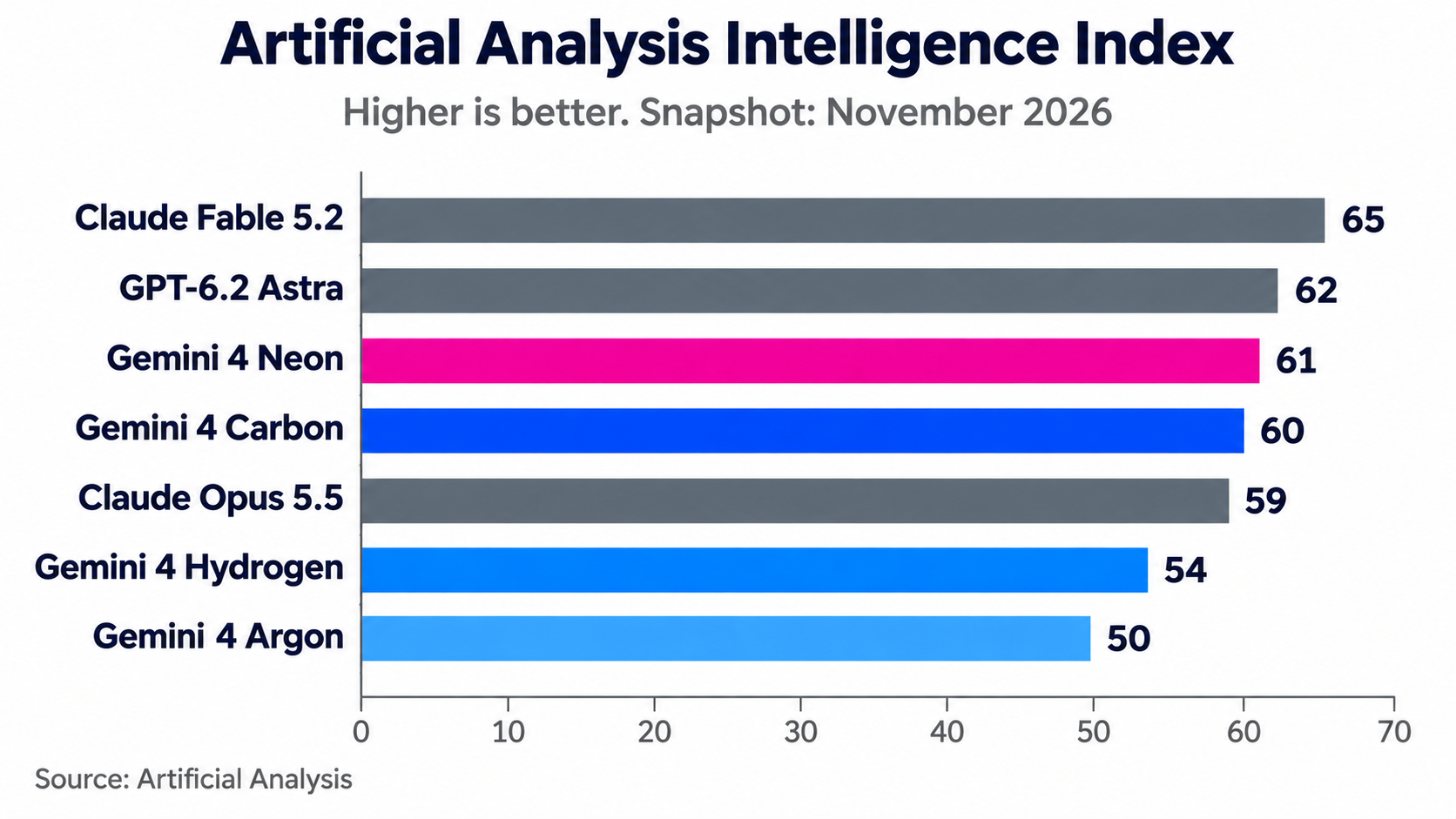
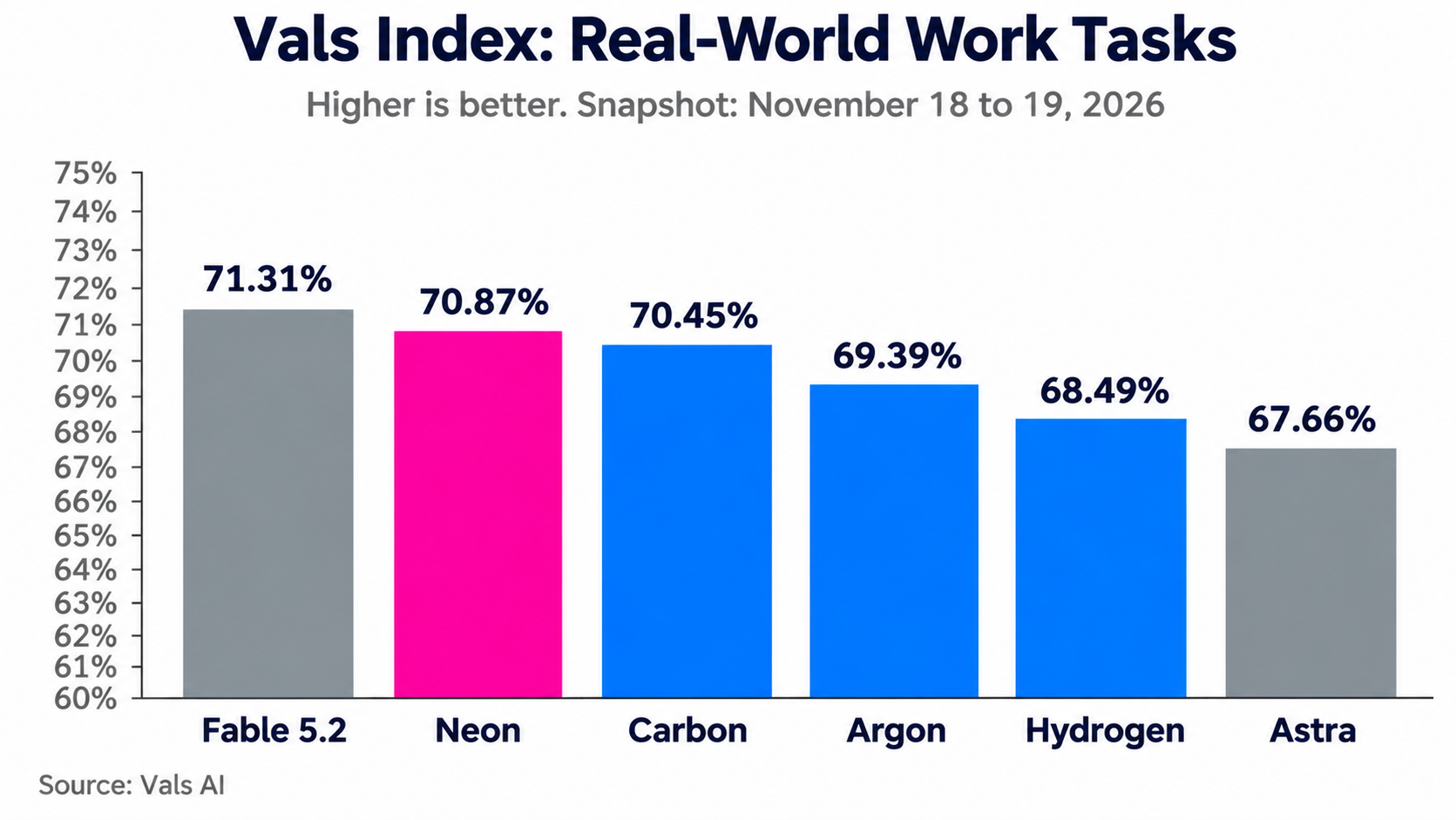
How does the Gemini 4 family stack up against the top models from OpenAI and Anthropic? The table below uses the Artificial Analysis Intelligence Index and the Vals Index, both checked around November 18 to 19, 2026.
| Model | AA Intelligence Index | Vals Index |
|---|---|---|
| Claude Fable 5.2 | 65 | 71.31% |
| GPT-6.2 Astra | 62 | 67.66% |
| Gemini 4 Neon | 61 | 70.87% |
| Gemini 4 Carbon | 60 | 70.45% |
| Claude Opus 5.5 | 59 | Not listed |
| Gemini 4 Hydrogen | 54 | 68.49% |
| Gemini 4 Argon | 50 | 69.39% |
Each model was tested at its own top or default thinking level, so treat small gaps with caution.
Vals Index bar
Price Comparison: Gemini 4 vs Fable, Astra and Opus
API price comparison
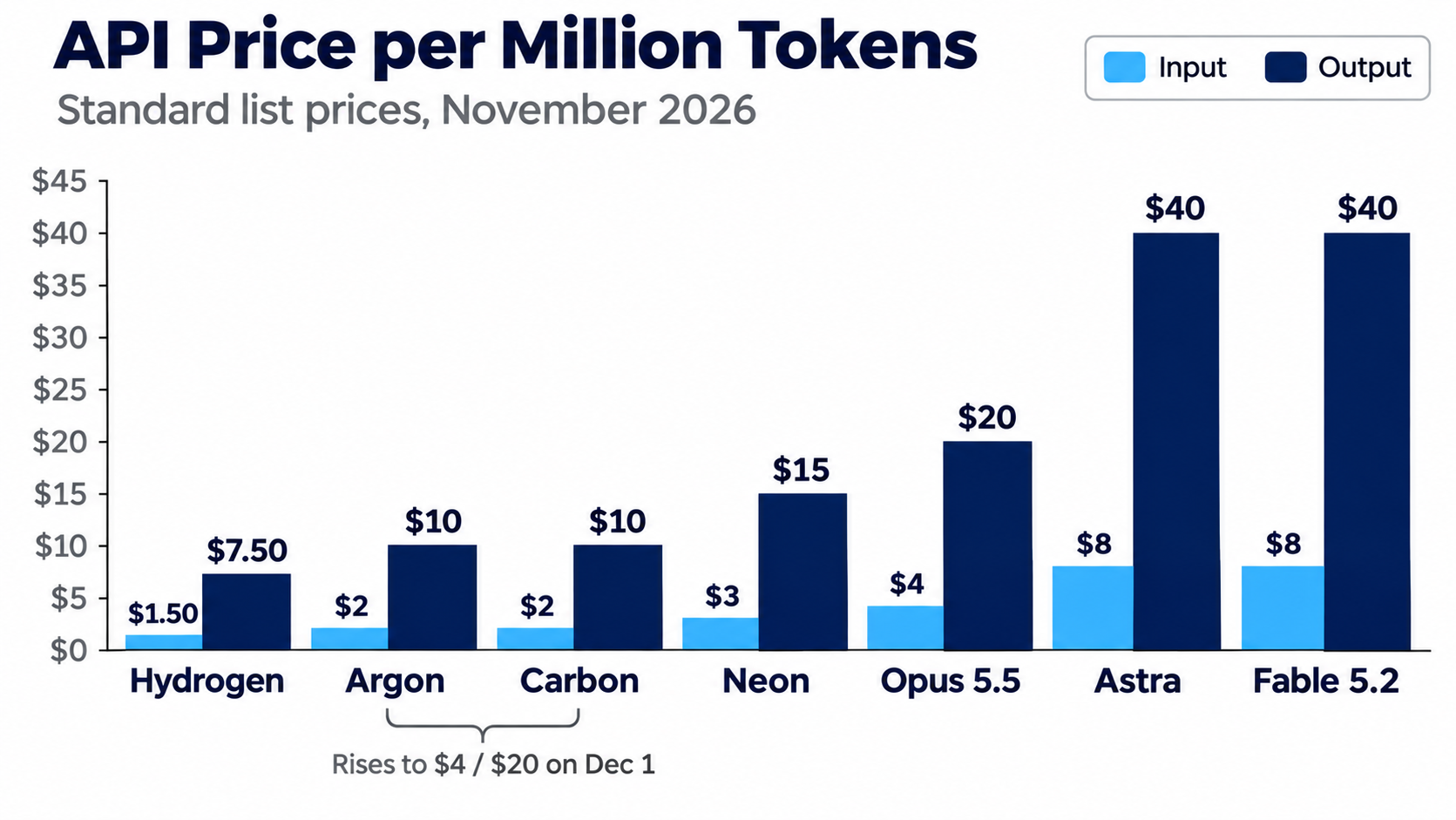
List prices tell only part of the story, but they set the baseline. Here are the standard API prices per million tokens.
| Model | Input | Output |
|---|---|---|
| Gemini 4 Hydrogen | $1.50 | $7.50 |
| Gemini 4 Argon | $2 (rising to $4 on December 1) | $10 (rising to $20 on December 1) |
| Gemini 4 Carbon | $2 (rising to $4 on December 1) | $10 (rising to $20 on December 1) |
| Gemini 4 Neon | $3 | $15 |
| Claude Opus 5.5 | $4 | $20 |
| GPT-6.2 Astra | $8 | $40 |
| Claude Fable 5.2 | $8 | $40 |
Argon and Carbon launched at an introductory price. From December 1, 2026, both move to $4 and $20, which makes Neon 25% cheaper than Carbon on both input and output.
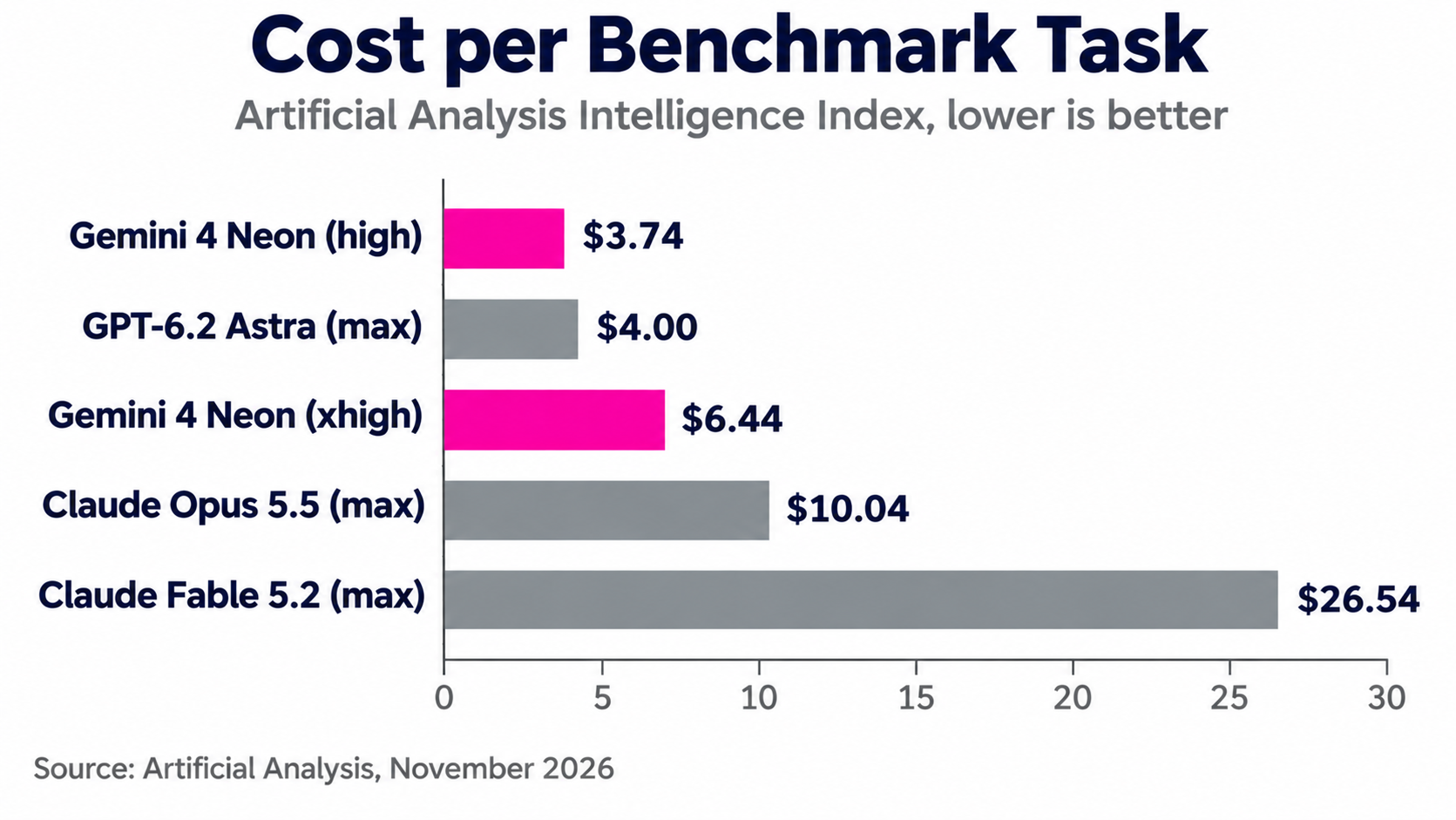
Cost per task matters even more, because models use very different numbers of tokens. On the Artificial Analysis Intelligence Index, Neon costs $3.74 per task at high thinking and $6.44 at xhigh. GPT-6.2 Astra costs $4.00, Claude Opus 5.5 costs $10.04, and Claude Fable 5.2 costs $26.54 at max settings.
Cost per task
Why Are Developers Choosing Neon Over Astra and Fable?
Output speed
Google has not published Neon usage numbers yet, so there is no hard data on switching. Still, five clear reasons explain why Neon is drawing attention away from GPT-6.2 Astra and Claude Fable 5.2.
1. Near-frontier quality at a lower price. Neon scores 61 on the Intelligence Index, close to Astra's 62. Yet its list price is $3 and $15 per million tokens, compared with $8 and $40 for both Astra and Fable. That is about 62% lower on both input and output.
2. Strong real-world task scores. On the Vals Index, Neon scores 70.87%, just behind Fable 5.2 and ahead of Astra. It also leads AutomationBench and the Artificial Analysis Coding Agent Index.
3. Faster output. Artificial Analysis measured Neon at about 110 tokens per second, while Astra measured between 49 and 64 tokens per second across snapshots. Fable 5.2 runs at a similar speed to Neon, but at a much higher price.
4. Built-in distribution. Neon became the default model for new conversations in Google Antigravity on launch day. GitHub also made it generally available in Copilot on November 18 for Pro+, Max, Business and Enterprise plans.
5. Mixed early reviews for Astra. GPT-6.2 Astra launched on November 17 with strong benchmark results, including a reported first 100% score on ARC-AGI-3. However, some early users reported that it pauses long tasks with odd questions and sometimes loops.
Neon is not the best at everything. Fable 5.2 still leads both indexes above, and Astra costs less per task than Neon at its xhigh setting. In one independent hands-on test, Claude Opus 5.5 was faster and cheaper than Neon on short coding tasks, while Neon won on a large 100,000 token search task.
Which Gemini 4 Model Should You Use?
Pick the model by the job, not by the name:
- Choose Hydrogen for chat, quick coding fixes and high-volume tasks where speed and cost matter most.
- Choose Neon for daily engineering, research and agents that need strong reasoning at a fair price.
- Choose Carbon for the hardest problems, where accuracy beats speed.
- Choose Argon if your existing pipeline already performs well on it.
Google's Antigravity also offers an Orchestrator mode that pairs Neon for planning with Hydrogen for faster execution. That combination gives many teams the best of both tiers.
Conclusion
The Gemini 4 family gives developers a clear choice for every job. Hydrogen handles speed, Carbon handles depth, Argon keeps existing pipelines stable, and Neon covers the wide middle ground where most real work happens.
That middle ground explains the buzz around Neon. It delivers near-frontier scores, fast output and a price well below GPT-6.2 Astra and Claude Fable 5.2. For many teams, that trade-off is hard to ignore.
Still, benchmarks are only a starting point. Run your own representative prompts through two or three models, compare cost per task, and let your results decide. The best model is the one that solves your problem at a price you can sustain.
Frequently Asked Questions
Q1. What are the four Gemini 4 models and how are they different?
Gemini 4 includes Argon, Carbon, Hydrogen and Neon. Argon focuses on stable production workflows, Carbon handles complex long-horizon problems, Hydrogen prioritizes speed and affordability, while Neon balances intelligence, speed and cost.
Q2. Which Gemini 4 model is best for coding and AI agents?
Gemini 4 Neon is a strong choice for daily coding, research and production AI agents. Carbon is better suited to difficult debugging and long-horizon engineering tasks, while Hydrogen works well for routine coding and high-volume automation.
Q3. How much does Gemini 4 cost, and which model offers a free API tier?
Gemini 4 pricing varies by model. Hydrogen costs $1.50 per million input tokens and $7.50 per million output tokens. Neon costs $3 and $15, respectively. Hydrogen is the only Gemini 4 model with a free tier in the Gemini Developer API.
Sources:
- Google: Introducing Gemini 4 Neon
- Google: Gemini 4 Argon, our next era of frontier intelligence
- Digital Trends: Gemini 4 Neon vs Opus 5.5 and GPT-6.2 Sol
- Valyu: Gemini 4 Neon vs Carbon vs Hydrogen vs Argon
- Neurohive: Gemini 4 Neon benchmarks and pricing
- GitHub Changelog: Gemini 4 Neon in GitHub Copilot
- Enjoy: Gemini 4 Neon is now Antigravity's default
- Anthropic: Claude Fable 5.2

Simplify Your Data Annotation Workflow With Proven Strategies