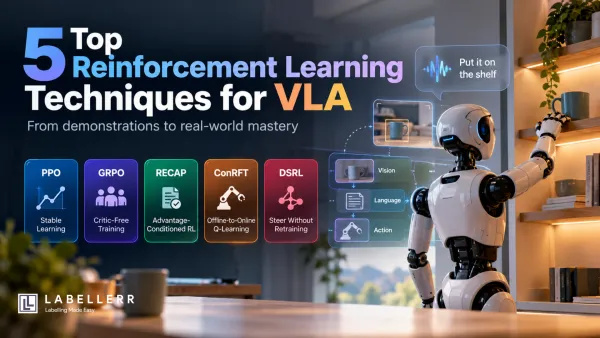
Vision-Language-Action 5 Top Reinforcement Learning Techniques to Train VLA Models Explore five reinforcement learning techniques for vision-language-action models: PPO, GRPO, RECAP, ConRFT, and DSRL, with results, training approaches, and practical use cases.
Claude Sonnet 5.5 Claude Sonnet 5.5 vs Sonnet 5: Benchmarks, Pricing & More Claude Sonnet 5.5 delivers a dramatic leap over Sonnet 5 across coding, knowledge work, computer use, and visual tasks. Explore benchmark results, real-world testing, pricing, performance, and what changes for developers.
computer vision model training 10 Top Computer Vision Model Training Service Providers 2026 Discover the top computer vision model training platforms in 2026 that streamline annotation, automate QA, and enable fast deployment. Compare tools built for scalable, production-ready AI workflows.
Claude Opus 5.5 Claude Opus 5.5 vs Opus 5: Key Differences Claude Opus 5.5 is Anthropic’s latest frontier AI model, designed for advanced agentic coding, reasoning, knowledge work, and complex long-running tasks. It delivers stronger performance, faster output, improved safety, and lower costs than Opus 5.
Multimodal Annotation 7 Best Multimodal Annotation Service Providers in 2026 Explore the seven best multimodal annotation platforms in 2026 and learn how they handle video, audio, text, LiDAR, 3D data, AI automation, quality workflows, and enterprise annotation needs.
Gemini Robotics 2 Gemini Robotics 2: The AI That Gives Robots a Brain Gemini Robotics 2 combines reasoning, vision-language-action, and on-device models to help robots plan, adapt, and perform complex physical tasks across humanoid and multi-robot platforms.
Kimi K2.6 Kimi K2.6 Is Open to Everyone - And It's a Big Deal Kimi K2.6 is a fully open-source agentic AI model built for long-running tasks, multi-agent coordination, and real-world coding performance. It rivals top closed models while enabling autonomous execution at scale.
Muse Glimmer Muse Glimmer 30B: The New Local AI Agent Muse Glimmer 30B brings capable agentic AI to consumer hardware, offering local tool use, reasoning, multimodal input, and failure recovery without cloud dependency. Explore its architecture, benchmarks, hardware requirements, and deployment options.
Qwen3.8 Max Qwen3.8 Max vs GPT-5.6 Sol & Kimi K3: Full Comparison Explore Qwen3.8 Max, Alibaba's latest flagship AI model featuring a 2.4T-parameter MoE architecture, 1M-token context window, multimodal capabilities, official benchmark results, pricing, API integration, and how it compares with GPT-5.6 Sol, Claude Fable 5, and Kimi K3.
Robotics Frameworks 5 Top Robotics Frameworks Dominating 2026 Discover the top robotics frameworks in 2026, including ROS 2, NVIDIA Isaac ROS, Gazebo, MoveIt 2, and NVIDIA Isaac Lab. Learn how each framework powers robot simulation, perception, motion planning, and AI training in modern robotics.
Gemini 3.6 Flash Gemini 3.6 Flash vs 3.5 Flash-Lite vs Cyber Google's Gemini 3.6 Flash, 3.5 Flash-Lite, and 3.5 Flash Cyber introduce faster AI agents, lower costs, and specialized security capabilities. Learn how each model compares in speed, pricing, benchmarks, and ideal production use cases.
MolmoAct2 Why MolmoAct2 Is a Major Step for Embodied AI in 2026 MolmoAct2 is a fully open Vision-Language-Action model that brings real-time embodied reasoning to robotics. Learn how its open datasets, adaptive depth reasoning, and high-speed control enable reliable robot deployment beyond controlled lab environments.
Kimi K3 Kimi K3: World's First Open 2.8T Parameter AI Model Kimi K3 is the world's first open-weight 2.8T parameter AI model, introducing Kimi Delta Attention, Stable LatentMoE, and a 1M-token context window. Explore its architecture, benchmarks, pricing, API, and why it marks a major milestone for open-source AI.
Robostral Navigate Robostral Navigate vs Traditional Robot Navigation Discover how Mistral's Robostral Navigate enables robots to navigate using only a single RGB camera and natural language. Learn about its novel prefix-caching training, simulation-first approach, benchmark results, and what it means for the future of physical AI.
SAM3 SAM3 for Cross-Prompt Detection: A Practical Walkthrough Learn how SAM3 enables cross-prompt detection using text and exemplar prompts to segment objects across image batches. Discover its architecture, Promptable Concept Segmentation, and how it streamlines AI data annotation workflows with Labellerr.
reality gap in robotics How to Bridge the Reality Gap in Robotics Training Discover what the reality gap in robotics is, why robots fail when moving from simulation to the real world, and the latest techniques like domain randomization, system identification, and digital twins that improve sim-to-real transfer.
Claude Sonnet 5 Claude Sonnet 5 vs Sonnet 4.6: Performance, Cost & Features Compare Claude Sonnet 5 vs Sonnet 4.6 across benchmarks, pricing, coding, agentic AI capabilities, reasoning effort, and real-world performance to discover which Anthropic model is best for production AI workflows.
Unlimited OCR Unlimited OCR: How Baidu Solves Long Document OCR Discover Baidu's Unlimited OCR, an end-to-end OCR model powered by Reference Sliding Window Attention (R-SWA). Learn how it eliminates KV cache growth, maintains constant memory usage, and efficiently parses long documents with state-of-the-art accuracy.
Mixture of Experts LLM 7 Top Mixture of Experts AI Models for Developers in 2026 Explore the top open-source Mixture of Experts (MoE) LLMs in 2026, including GLM-5.2, DeepSeek V4-Pro, Kimi K2.6, Qwen3-Coder-480B, and more. Compare architecture, performance, licensing, context windows, and the best use cases.
Sakana Fugu Sakana Fugu: The Model That Outsmarts Claude Fable 5 Sakana Fugu introduces a new AI paradigm: a learned multi-agent orchestration system that coordinates multiple frontier models through TRINITY and Conductor architectures, delivering state-of-the-art performance while improving resilience, flexibility, and AI sovereignty.
GLM-5.2 GLM-5.2 Just Beat GPT-5.5 at a Sixth of the Cost GLM-5.2 is a 753B-parameter open-weight AI model with a 1M-token context window, MIT licensing, and coding performance that rivals GPT-5.5 and Claude Opus 4.8 while costing significantly less to deploy and operate.
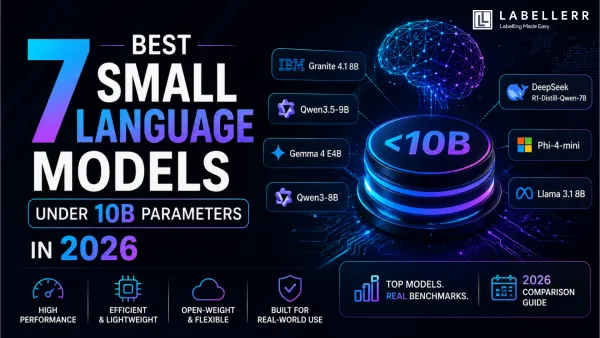
small language models 7 Best Small Language Models Under 10B Parameters in 2026 Discover the 7 best open-weight AI models under 10B parameters in 2026. Compare Granite, Qwen, Gemma, DeepSeek, Phi, and Llama across benchmarks, performance, hardware requirements, and real-world use cases.
Data Annotation Software 7 Best Data Annotation Software in 2026 Compare the best data annotation software of 2026, including Labellerr, CVAT, Label Studio, SuperAnnotate, V7 Darwin, Encord, and Labelbox. Discover features, pricing, supported data types, and how to choose the right platform for your AI projects.
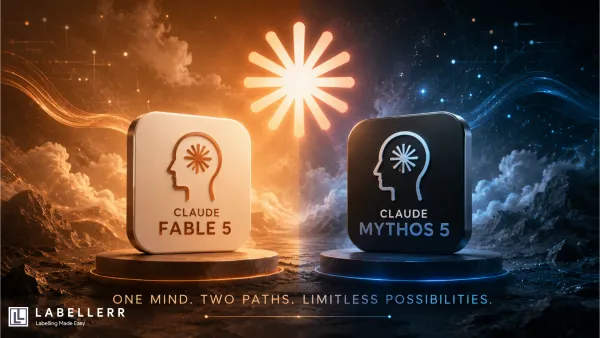
Claude Fable 5 Claude Fable 5 vs Mythos 5: Review and Benchmark Analysis Claude Fable 5 and Mythos 5 introduce Anthropic's new Mythos-class AI tier, combining breakthrough coding, reasoning, vision, and scientific capabilities with advanced safety controls designed for frontier-level AI deployment.
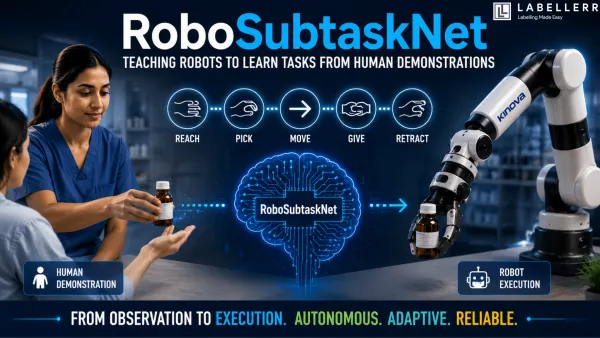
RoboSubtaskNet RoboSubtaskNet Turns Human Videos into Robot Skills RoboSubtaskNet enables robots to learn tasks directly from human demonstrations by converting video observations into executable action sequences. With a 91.25% real-world success rate, it advances autonomous robotic learning for healthcare and industrial applications.