
What Is Claude Mythos 5.2? A Complete Guide
Claude Mythos 5.2 is Anthropic’s gated frontier model for verified security and life science teams. Learn how access works, what its benchmarks show, how it differs from Fable 5.2, and where it helps find software bugs and speed up research.
Modern AI models have become very good at hard technical work, from writing code to reading huge files and reasoning through complex problems. But some of these skills are risky in the wrong hands. A model that can find a hidden flaw in software can help a defender patch it, but the same model could also help an attacker break in.
Anthropic built Claude Mythos 5.2 to deal with this exact problem. It was released on November 9, 2026, alongside Claude Fable 5.2. Mythos 5.2 is the same model as Fable 5.2, but it has fewer safety blocks for cybersecurity and biology work. In return, only verified organizations can use it.
The main goal is to put the strongest tools in the hands of trusted experts. Security teams and life science researchers get the full power of the model, while the public version stays locked down. In this blog, we will look at how Mythos 5.2 works, how access is granted, what the benchmarks show, and where it can be used in the real world.
The Problem with Releasing Powerful Models
A standard AI release is open to everyone, so anyone with an account can send a prompt and get an answer. This works well for most tasks, like writing emails or fixing a bug in a web app. But it creates a major problem for dual-use skills.
Cybersecurity is the clearest example. To fix a weak spot in code, you first need to find it and understand how it could be abused. That is the same knowledge an attacker needs. Biology has the same issue, since tools that help design new proteins for medicine could also be misused.
The Release Strategy
If a lab blocks these topics for everyone, it slows down the experts who protect us. If it opens them to everyone, it hands risky skills to bad actors. We need a system that can tell the difference between the two groups.
How Mythos 5.2 Solves the Problem
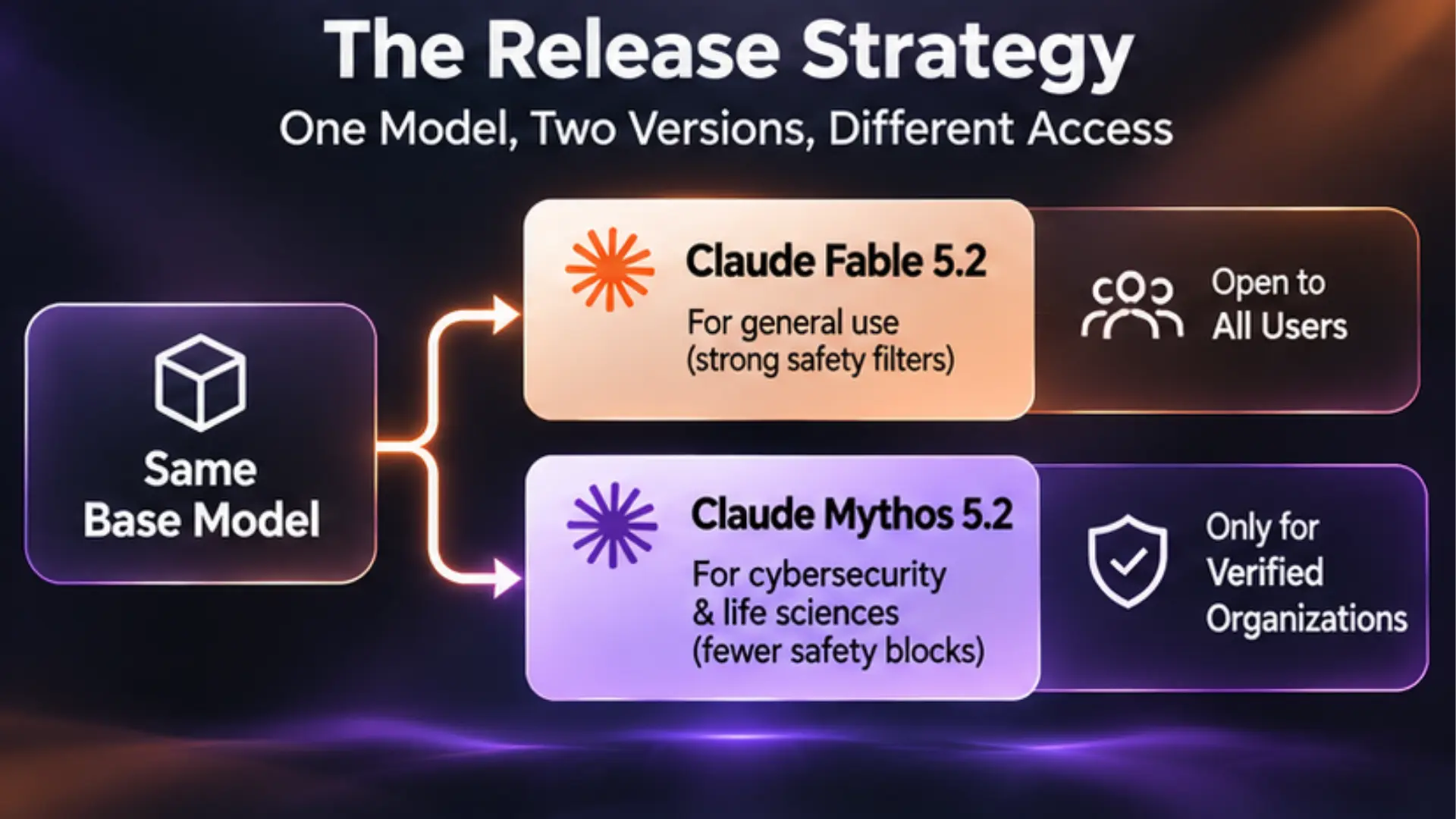
The basic idea is simple. Anthropic trains one model and ships it in two versions. Claude Fable 5.2 is open to all users and has strong safety filters that block most high-risk cyber and biology tasks. Claude Mythos 5.2 is the same model with those blocks loosened.
The model ID is claude-mythos-5-2, and it has the same specifications and pricing as Fable 5.2. The only real difference is who can use it and what it is allowed to do.
This approach keeps things clean for developers, since there is one model to learn, one set of documentation, and one price list. Teams that pass verification can simply switch the model name and unlock deeper security and science work.
How Access Works
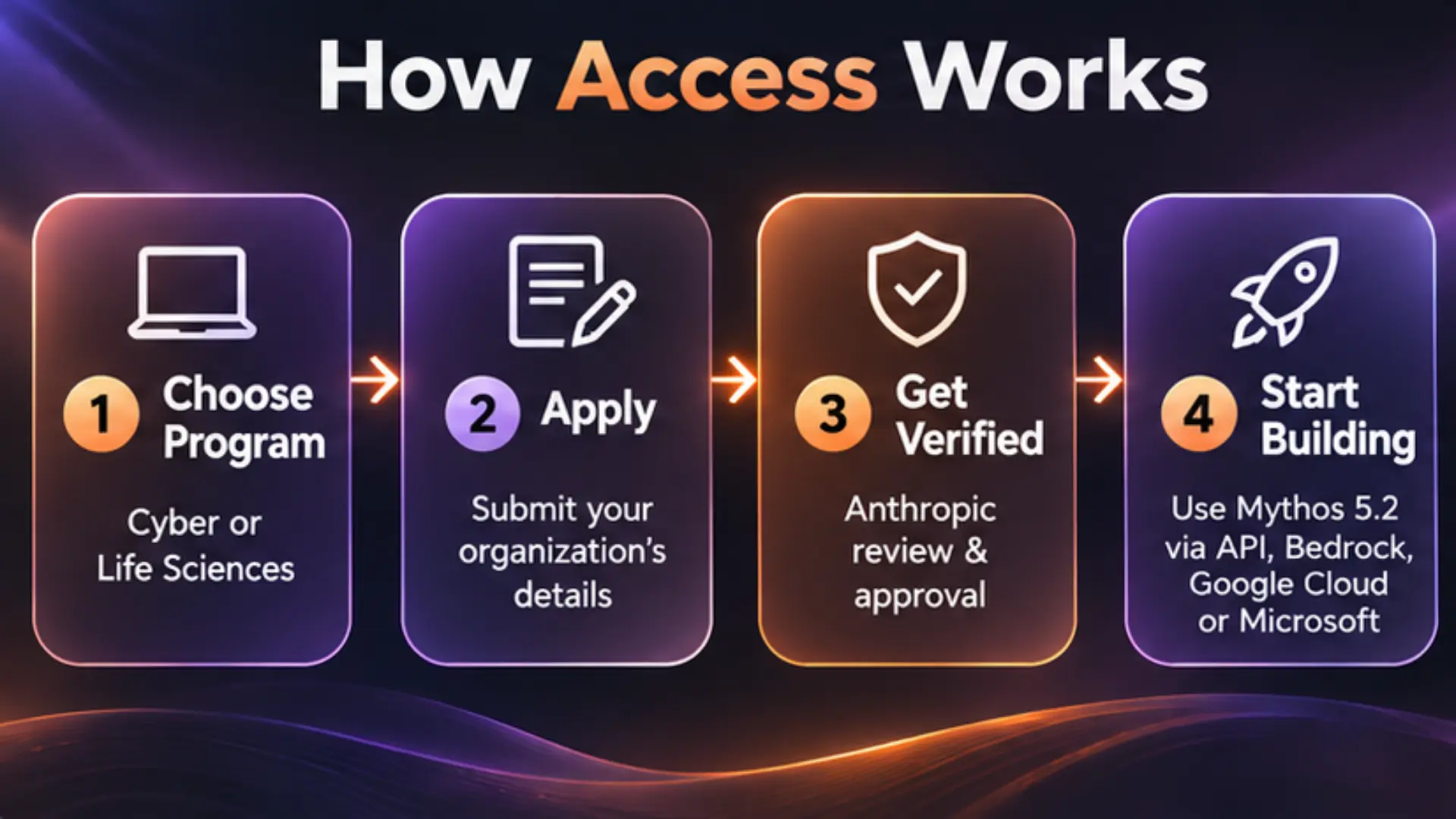
The access process has four simple stages: choose a program, apply, get verified, and start building.
First, an organization picks the program that fits its work. Anthropic runs a Cyber Verification Program for security teams and a Life Sciences Verification Program for researchers. Next, the team applies and goes through a vetting check, and once approved, it can call the model through the Claude API.
How Access Works
The model is also offered on Amazon Bedrock, Google Cloud, and Microsoft Foundry. Finally, Claude Enterprise customers can reach Mythos 5.2 through Claude Security, a product that scans codebases for flaws.
This makes the system easy to understand and hard to abuse.
Finding Software Vulnerabilities
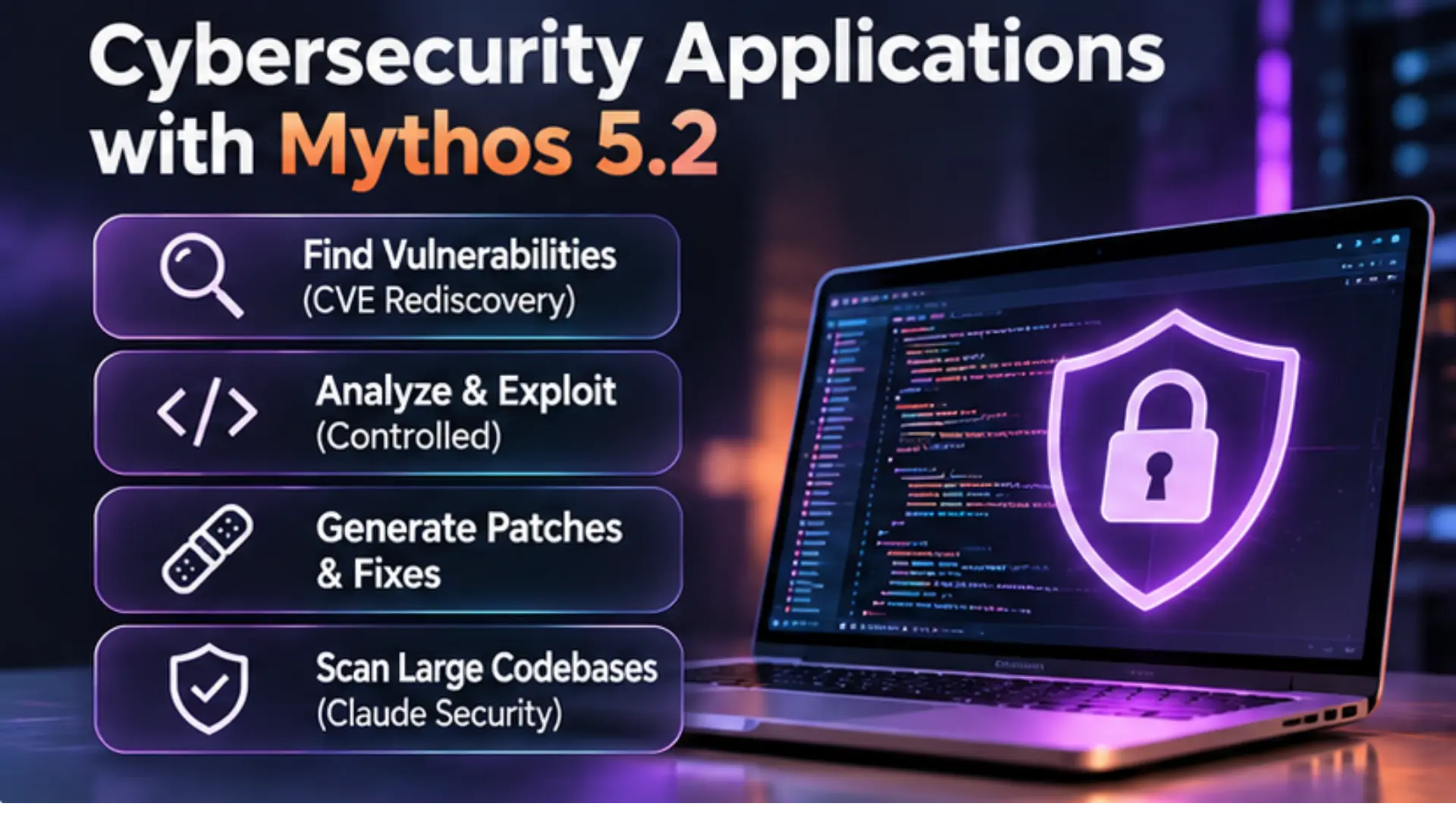
The biggest gains show up in security work. Anthropic tested the model on CVE Rediscovery, a benchmark that checks whether a model can find known flaws in real code. Mythos 5.2 scored 89.6 percent, while Mythos 5.1 scored 78.3 percent and Opus 5.5 without safeguards scored 81.3 percent.
On CyScenarioBench, which tests realistic attack and defense tasks, Mythos 5.2 scored 76.3 percent, a big jump from the 61.7 percent scored by Mythos 5.1.
Cybersecurity Applications
Early partners report similar results. Mozilla says the model roughly doubled its bug discovery numbers in Firefox scans compared to Mythos 5.1. One security firm found that one in six confirmed bugs it caught with Mythos 5.2 was missed by every other frontier model it tested. Anthropic notes that some of these gains come from a single tester’s raw counts, so results will vary by codebase.
Pushing Life Sciences Forward
The second major area is biology, where Mythos 5.2 can plan and run complex research steps instead of just answering questions about them.
One test focused on protein capsids, the shells that viruses use to carry genetic material, which are key to many gene therapies. The model combined two open-source protein folding tools, ESMFold2 and OpenFold3-preview2. It predicted parts of each shell and then merged them using known patterns of symmetry.
In Anthropic’s tests, it accurately modeled 28 of the 34 capsids it tried. For a common capsid called AAV2, the full run took about 58 minutes on a single GPU with one tool and about 7 minutes with the other. On a separate protein binder design test, Mythos 5.2 scored 85.1, up from 79.1 for Mythos 5.1.
Strong Coding, Reasoning, and Vision
Since Mythos 5.2 is the same model as Fable 5.2, it shares all of its general skills. Anthropic reports clear gains in coding, reasoning, and vision over the 5.1 models.
On FrontierSWE v2, an agentic coding test, the shared model scored 69.9 percent compared to 56.3 percent for Fable 5.1. Mythos 5.2 also scored 75.3 percent on Terminal-Bench-Science, and the shared model reached 74.2 percent on Humanity’s Last Exam with tools.
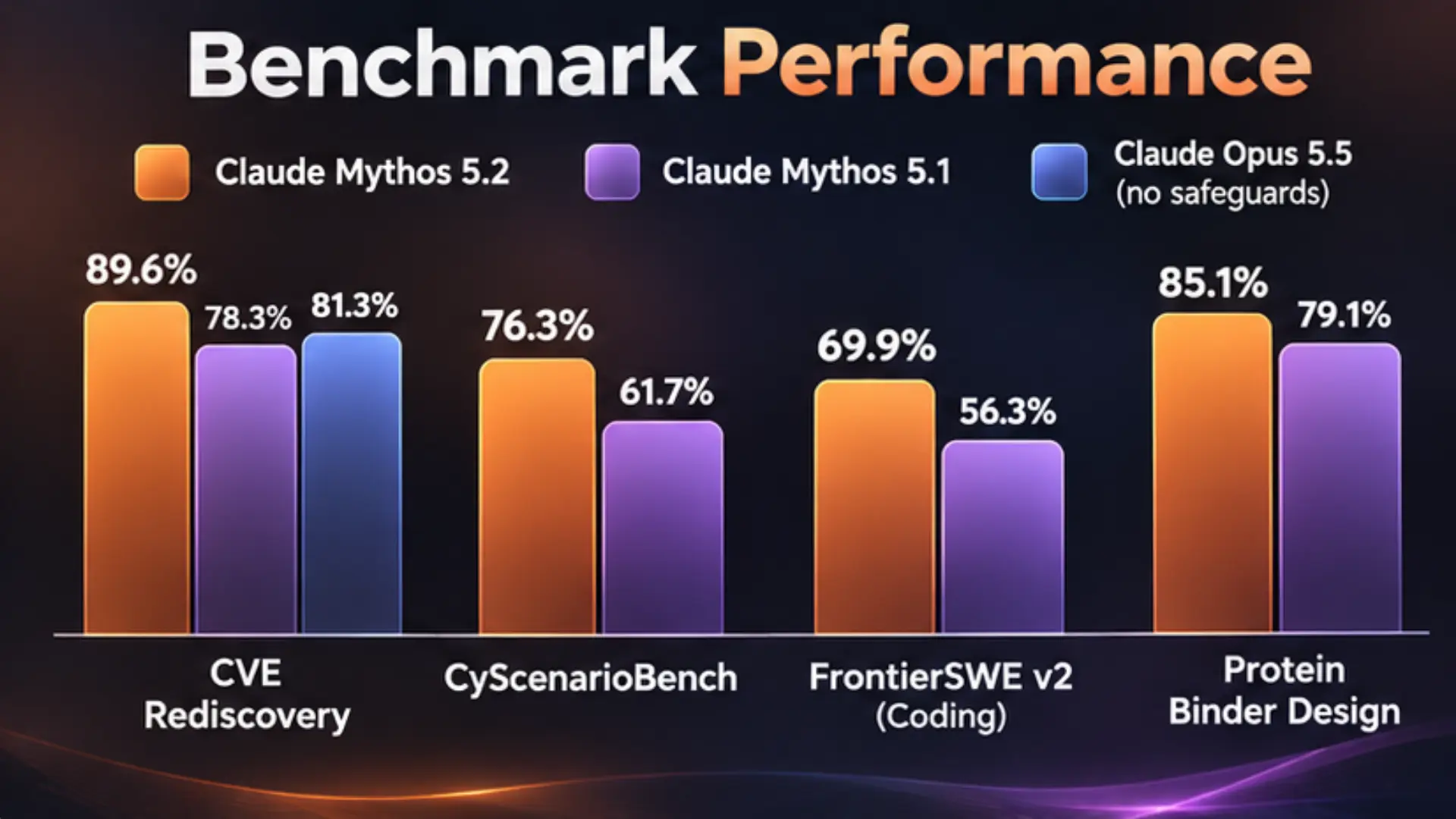
Benchmark Performance
These skills matter for security work too. A model that can read large codebases, run tools, and plan long tasks is better at tracing a bug from start to finish and then writing and testing the fix.
Speed, Pricing, and Context
Running a frontier model can be slow and costly. Anthropic improved both with this release.
Mythos 5.2 generates output up to 30 percent faster than Mythos 5.1, and the price also dropped by 20 percent. It now costs $8 per million input tokens and $40 per million output tokens, down from $10 and $50. Cache reads cost just $0.20 per million tokens, and batch jobs get a 50 percent discount.
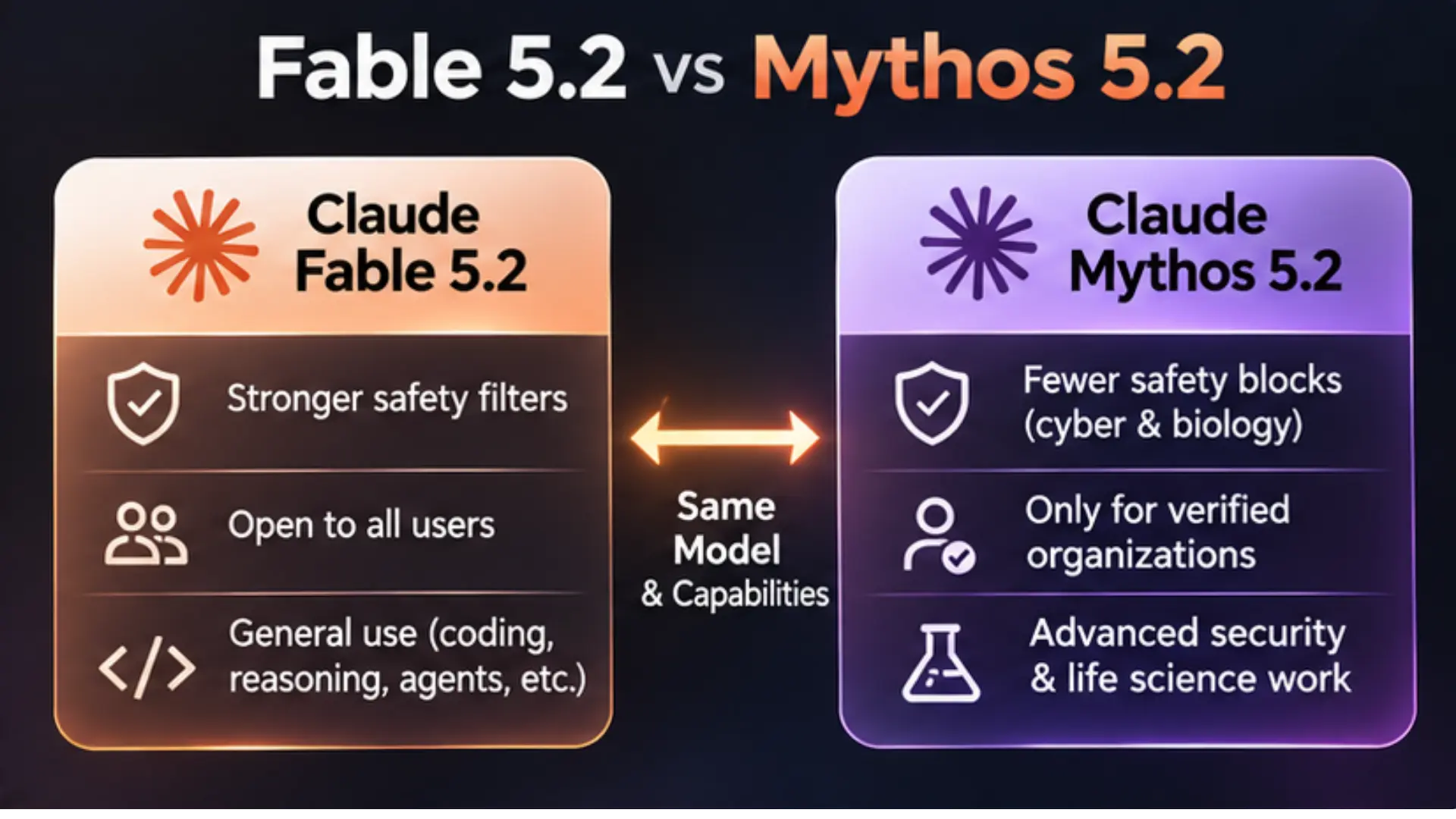
Fable 5.2 vs Mythos 5.2
The model has a 1 million token context window and can write up to 128,000 tokens in one reply. That is enough to load a large codebase or a long research paper in a single request. Verified teams can also turn on fast mode, which speeds up output by up to 2.5 times at $16 and $80 per million tokens.
Safety and Alignment Results
Loosening safeguards only works if the model itself behaves well. Anthropic ran detailed safety tests before release.
In an automated audit of about 1,900 scenarios, Mythos 5.2 scored 2.67 compared to 3.28 for Mythos 5.1, where lower is better. In a sandbox escape test, Mythos 5.2 used credentials or files outside its sandbox in 3.1 percent of cases, compared to 21 percent for the older Mythos 5.1.
Outside groups, including the UK AI Security Institute and METR, also tested the model. Anthropic rates the risk of serious misalignment as low, but it also admits that no test can catch every failure before launch.
Gated Access is a Challenge
One important limitation is access. Mythos 5.2 is not open to everyone. Teams must apply and pass verification, which takes time. Small startups or solo researchers may find the process harder.
The model is also not built for everyday tasks. Anthropic recommends Claude Opus 5.5 for daily work like writing and simple coding. Mythos 5.2 can think for many minutes on a hard task, which adds cost and delay for simple prompts. It also requires 30-day data retention, so teams with strict zero data retention rules need special approval.
Finally, Anthropic held back some skills on purpose. Abilities linked to AI research, such as tuning chip kernels, were kept close to the Opus 5.5 level.
Building Better Evaluation Data with Labellerr
A powerful model still needs good data around it, because teams that use Mythos 5.2 for security or science need a way to check its work. This means building clean test sets with labeled bugs, reviewed fixes, or verified protein structures.
The Labellerr platform helps teams create these datasets. You can sign up, create a workspace, and have your experts label and review model outputs. The labeled data can then be exported and used to test new prompts or compare model versions. This careful review loop helps teams trust the results before they act on them.
Real World Applications
A gated frontier model can be highly useful in many fields. It can cut down the manual effort needed for deep technical work.
One important application is Automated Vulnerability Scanning. Security teams can scan large codebases and find flaws before attackers do. Claude Security now supports continuous scanning and fix tracking.
The model also helps with Gene Therapy and Drug Research. By predicting capsid shapes and designing protein binders, researchers can test ideas faster and pick the best options for the lab.
Another major use is Secure Code Migration. Teams can move old systems to safer languages and have the model check for new flaws along the way.
Finally, it supports Open-Source Defense. Through Project Glasswing, Anthropic has used the Mythos family with partners to find and fix flaws in software that millions of people depend on.
Key Features of the Model
Same Model, Different Safeguards: Mythos 5.2 shares its core with Fable 5.2 but unlocks deeper cybersecurity and biology work for verified teams.
Top Security Performance: It scored 89.6 percent on CVE Rediscovery and 76.3 percent on CyScenarioBench, beating Mythos 5.1 on both.
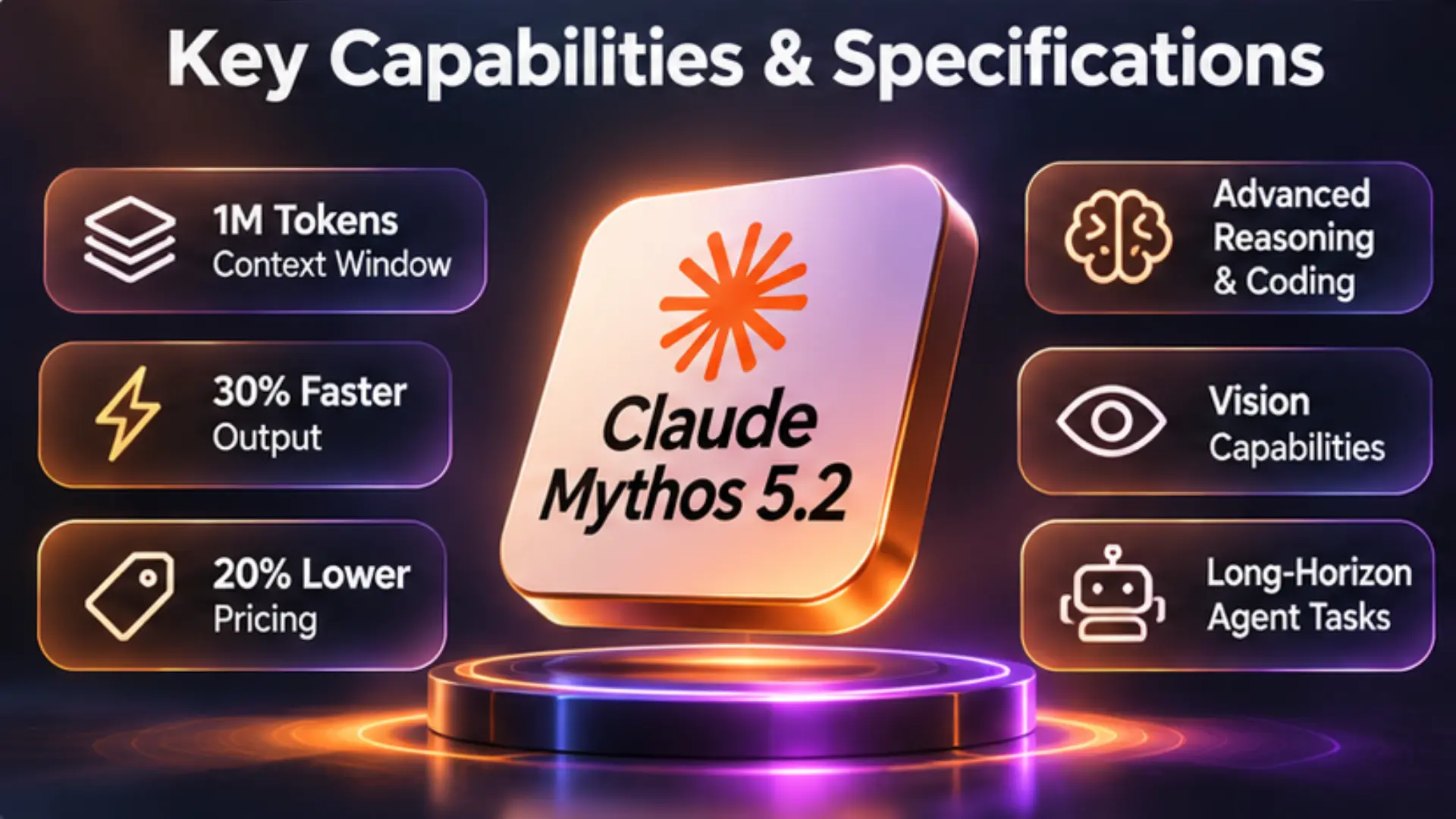
Key Capabilities
Large Context and Output: A 1 million token context window and a 128,000 token output limit let it handle full codebases and long research tasks.
Faster and Cheaper: Output is up to 30 percent faster, and pricing dropped 20 percent to $8 and $40 per million tokens.
Broad Platform Support: It runs on the Claude API, Amazon Bedrock, Google Cloud, and Microsoft Foundry.
Conclusion
Claude Mythos 5.2 shows how a frontier AI lab can share its strongest skills without handing them to everyone. Instead of one model for all users, Anthropic ships the same model in two forms and gates the riskier one behind verification.
The rest of the system is simple. Verified teams apply, get access, and call the model like any other Claude model. The open version, Fable 5.2, stays available to everyone with strong safeguards in place.
The current release proves that safety and power do not have to be at odds. With careful access controls, security teams can find bugs faster and scientists can speed up research. This creates a strong base for safer software and faster discovery, and paves the way for more trusted access to frontier AI.
FAQs
What is Claude Mythos 5.2?
Claude Mythos 5.2 is Anthropic’s gated frontier model, released on November 9, 2026. It is the same model as Claude Fable 5.2, but it has fewer safety blocks for cybersecurity and biology work. Because of this, only verified organizations can use it.
How can an organization get access to Claude Mythos 5.2?
An organization has to apply through one of Anthropic’s verification programs, such as the Cyber Verification Program or the Life Sciences Verification Program. Once approved, it can use the model through the Claude API, Amazon Bedrock, Google Cloud, or Microsoft Foundry. Claude Enterprise customers can also use it through Claude Security.
How is Claude Mythos 5.2 different from Claude Fable 5.2?
Both have the same model, specs, and price: $8 per million input tokens and $40 per million output tokens. Fable 5.2 is open to everyone and blocks most high-risk cyber and biology tasks. Mythos 5.2 loosens those blocks for verified teams.

Simplify Your Data Annotation Workflow With Proven Strategies