
Claude Fable 5.2: Anthropic’s Most Capable Public AI Model
Claude Fable 5.2 is Anthropic’s most capable public AI model. Learn what is new, from faster output and a 20% lower price to effort levels and agent teams, and find out when your team should choose it over Claude Opus 5.5.

AI models are changing fast, and every few months a new release promises better coding, deeper reasoning, and smarter agents. For teams that build AI products, keeping up with these updates can be difficult. You have to understand what changed, what it costs, and whether it is worth switching. Picking the wrong model can waste money or slow down important projects.
On November 9, 2026, Anthropic released Claude Fable 5.2, the company’s most capable model that is open to all customers. It is designed for difficult reasoning problems and long, multi-step agent tasks. It also arrives at a lower price and generates output faster than the previous version.
The main goal of this release is to make frontier-level AI more practical for everyday teams. In this blog, we will look at what Fable 5.2 is and what has changed. We will also explain how its effort levels work, where it fits next to other Claude models, and how teams can get the most value from it.
What Is Claude Fable 5.2?
Claude Fable 5.2 is the newest model in Anthropic’s Fable family, and it replaces Claude Fable 5.1, which is still available for now. Anthropic designed it for the most demanding jobs. These include complex software engineering, detailed research, and autonomous agents that work for long periods without human help.
The model can process up to 1 million tokens of context in a single request. That is enough to hold a large codebase or hundreds of pages of documents at the same time. It can also generate up to 128,000 tokens in one response, and its built-in knowledge extends to June 2026.

How Fable 5.2 works
Anthropic also released a companion model called Claude Mythos 5.2. It is the same underlying model with fewer safeguards in sensitive areas like cybersecurity and biology. Only verified organizations can use it, and they must apply through one of Anthropic’s verification programs for cyber or life sciences work.
What Is New in Fable 5.2
Anthropic says Fable 5.2 improves on the earlier version in coding, reasoning, and vision. Early reports also highlight stronger engineering judgment. When a request is vague or incomplete, the model is better at working out what the user actually needs.
Speed is another major improvement. Fable 5.2 can generate output up to 30 percent faster than Fable 5.1. For long tasks that produce a lot of text or code, this saves real time. Users spend less time waiting and more time acting on the results.
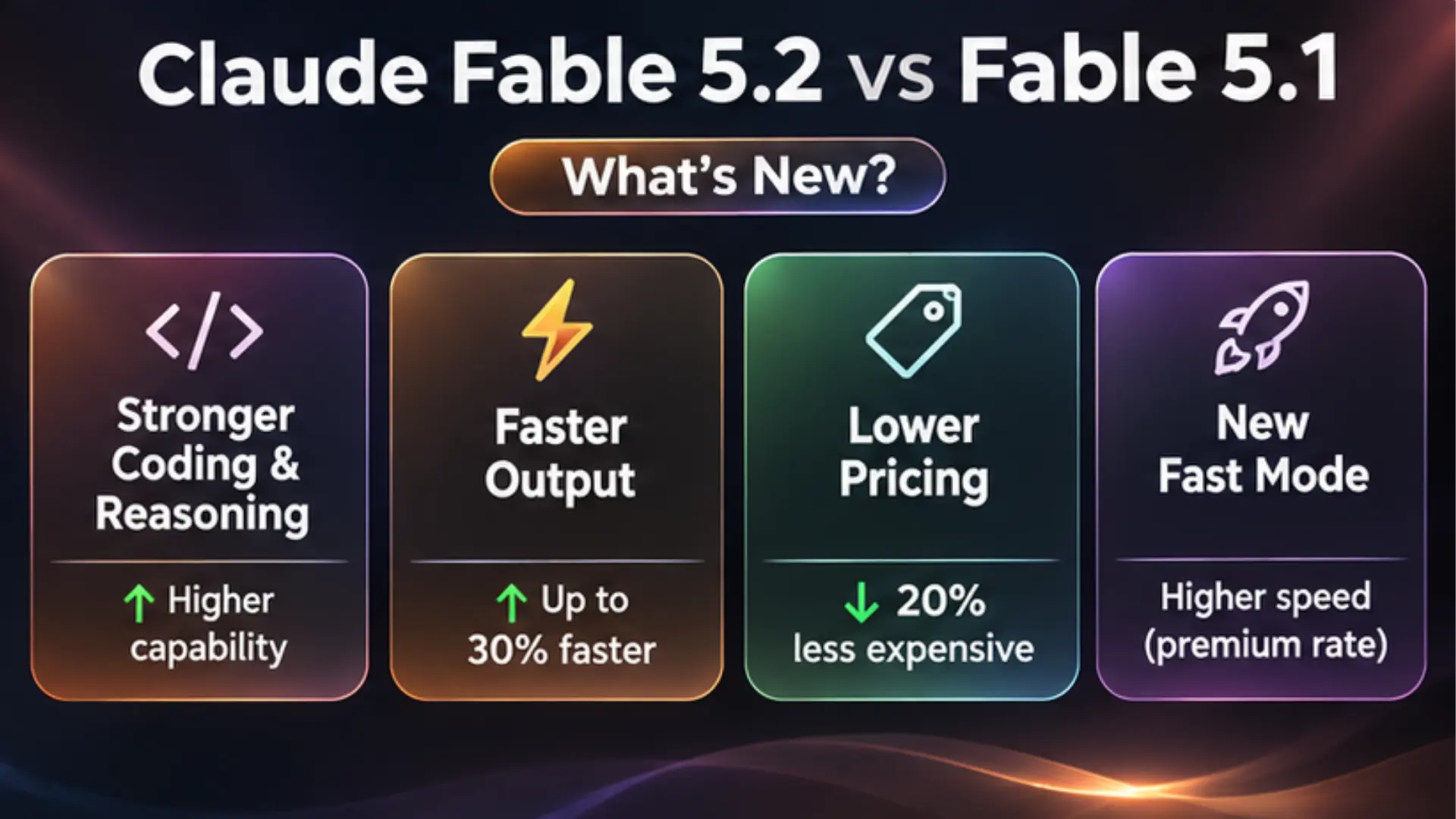
Fable 5.2 vs Fable 5.1
Fable 5.2 also introduces a new fast mode, which runs the same model at a higher speed for a premium price. Fable 5.1 did not offer this option. Teams that need quick answers on difficult problems now have an additional choice.
A Lower Price for Top-Tier AI
Price is often the biggest barrier to using the most powerful AI models, and Fable 5.2 lowers that barrier. It costs $8 per million input tokens and $40 per million output tokens. Fable 5.1 cost $10 and $50, so this is a 20 percent reduction.
Other costs dropped as well. Cached input now costs just $0.20 per million tokens, and batch jobs, which run in the background, cost half the standard rate. Fast mode costs double the standard rate, at $16 and $80.
Even with these reductions, Fable 5.2 remains a premium model. Claude Opus 5.5 costs half as much, at $4 and $20. This is why the decision between these two models matters so much for budgets.
How Effort Levels Work
Fable 5.2 always thinks before it answers, and this behavior cannot be turned off. Instead, developers control how deeply it thinks with a setting called effort. There are five levels: low, medium, high, extra high, and max.
The default level is high, and Anthropic says most of the performance gains appear by this level. Going above high adds cost and time, but the additional gains are uneven. They depend heavily on the specific task.
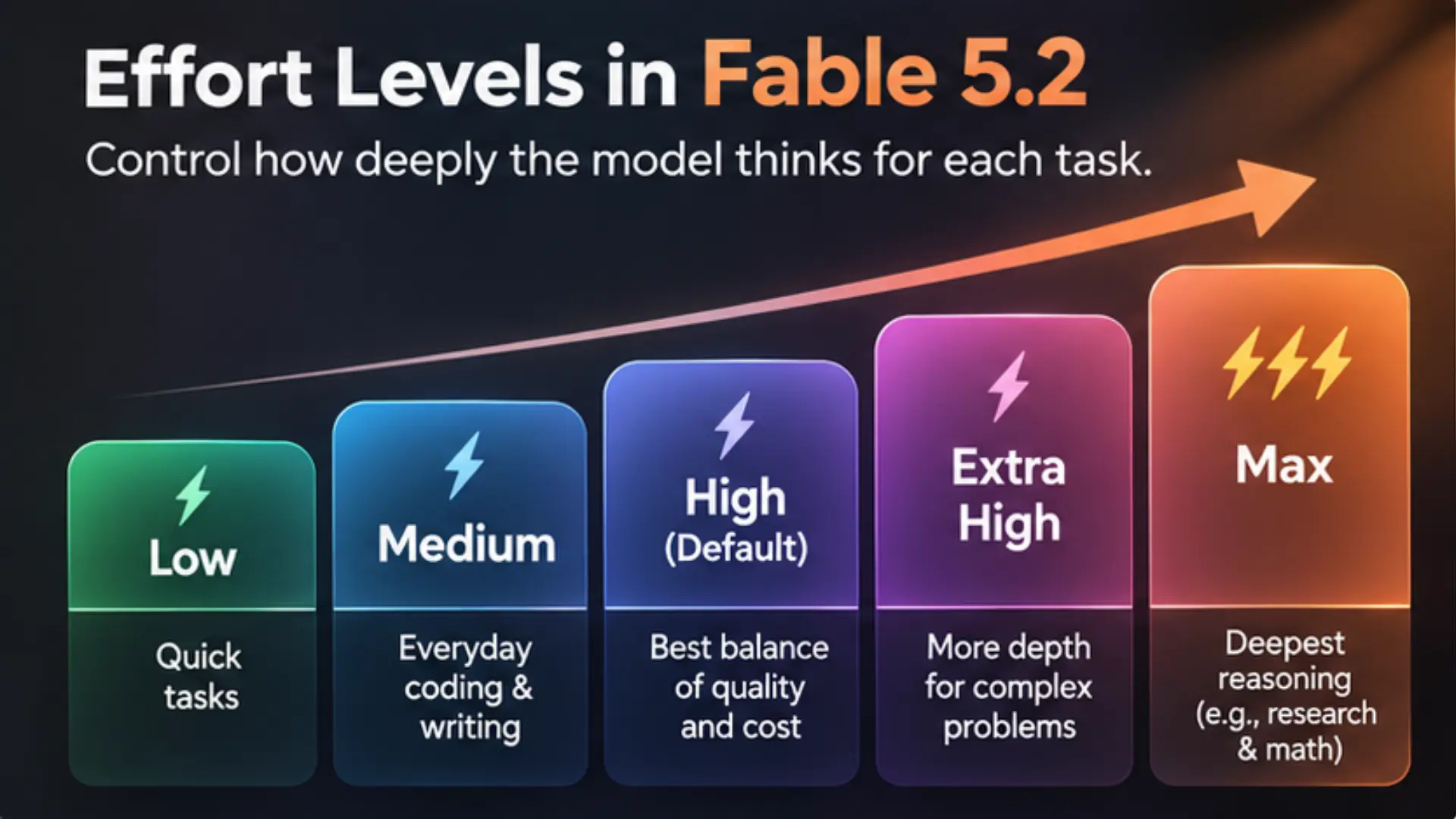
Effort levels in Fable 5.2
Lower levels are still surprisingly capable. In Anthropic’s testing, Fable 5.2 at low effort scored close to Fable 5.1 at higher levels. Low effort suits quick conversations and simple tasks, while medium suits everyday coding and writing. Max is best for open-ended problems like mathematics and scientific research.
The basic workflow is: Task → Effort Level → Thinking → Answer → Review.
This makes the model straightforward to tune. Teams can start at high, measure the results, and move down wherever the quality holds.
Built for Long Agent Tasks
Fable 5.2 performs best on work that requires many steps. An AI agent might read files, run tests, fix bugs, and verify results, all within one session. Fable 5.2 can stay focused on this kind of job for a long time, and a single difficult request can run for many minutes.
The model can also coordinate a team of other agents. It can plan the work, divide it into smaller parts, and assign those parts to helper agents. Early testers reported good results using it as a planner that directs other models. This approach can speed up work that runs well in parallel.
There are trade-offs to consider. Helper agents add to the total cost of a session. At lower effort levels, the model may also stop before a long task is complete. Anthropic recommends adding clear instructions that tell the model to finish the entire job.
Safety and Data Requirements
Anthropic built safety checks directly into Fable 5.2. The model may decline requests that could cause harm, such as creating malware or sharing dangerous laboratory methods. When this happens, the system returns a clear refusal signal instead of a normal answer, and developers can then send the request to a backup model.
Fable 5.2 also has a strict data requirement. Organizations must keep 30-day data retention enabled to use it. Teams that operate under zero data retention will receive errors unless Anthropic approves them, so they should review their settings before switching.
Some legitimate work in security or life sciences may trigger these safety checks. Anthropic offers verification programs for organizations whose genuine work gets blocked. This keeps the model available to most users while limiting misuse.
Fable 5.2 vs Claude Opus 5.5
Anthropic still calls Claude Opus 5.5 its “strongest daily driver.” For most coding and knowledge tasks, Opus 5.5 remains the better choice. It is fast, highly capable, and costs half as much.
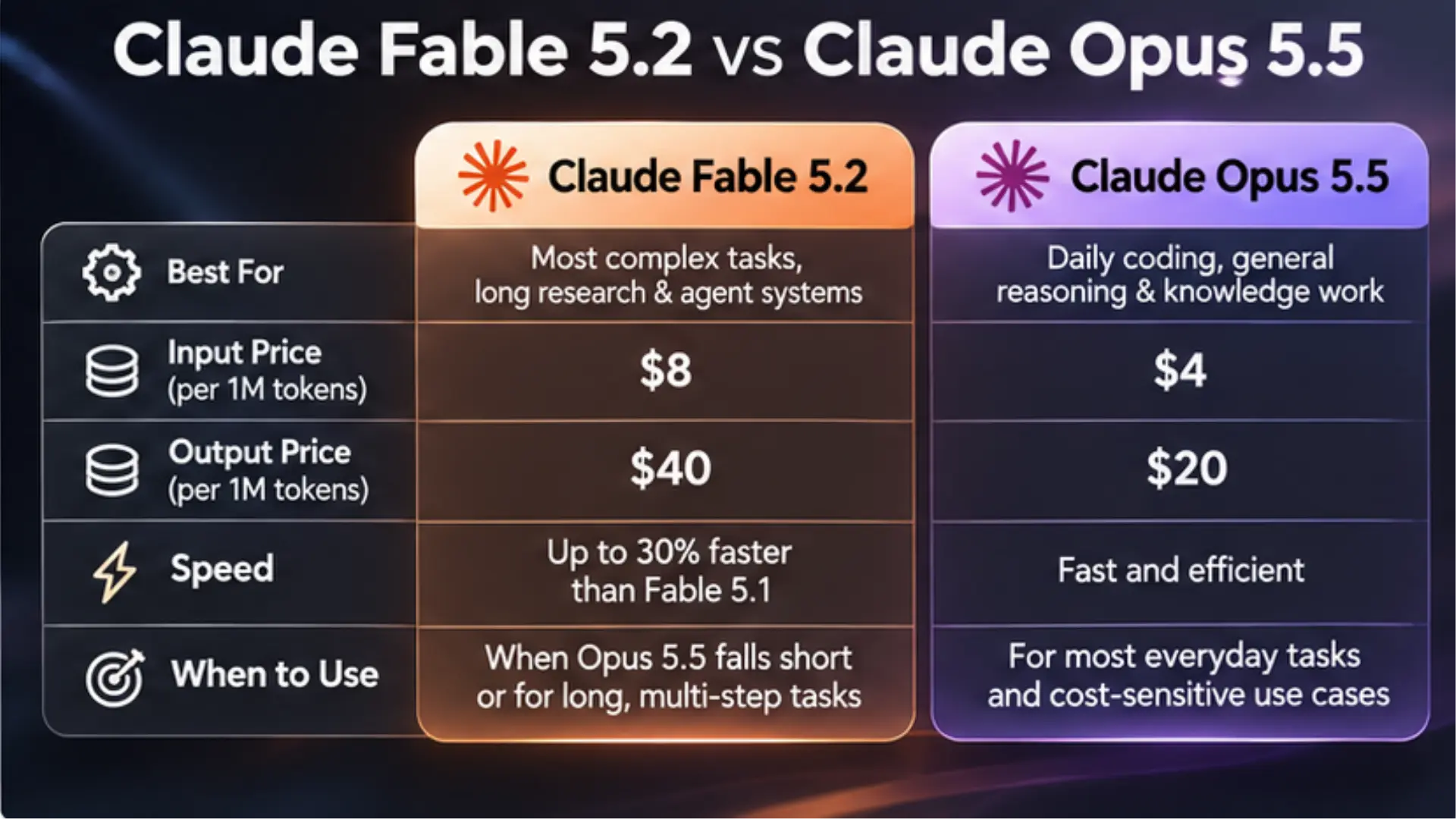
Fable 5.2 vs Opus 5.5
Fable 5.2 is meant for the situations where Opus 5.5 falls short. If your evaluations show that Opus 5.5 still struggles at high effort, it is time to try Fable 5.2. It is also the right choice for long research projects and complex agent systems.
A smart approach is to test both models. Run the same tasks on each one and compare the results carefully. Look at the cost per completed task, not just the cost per request. A cheaper model that needs more retries may end up costing more overall.
Switching to Fable 5.2
For many teams, moving to Fable 5.2 is mostly a matter of changing the model name in their code. The new model ID is claude-fable-5-2. Anthropic says it is available on its own platform, Amazon Web Services, Google Cloud, and Microsoft Azure.
There are a few changes to plan for. Fable 5.2 checks that a conversation’s history has not been edited between turns, so applications that rewrite earlier messages may see errors. Older models also cannot read Fable 5.2’s saved reasoning. Switching back in the middle of a conversation loses that context.
Prompts may need updates as well. Instructions written for older models can be too restrictive for Fable 5.2. Rules that tell the model to “think less” no longer work reliably, so it is better to lower the effort level instead.
Why Quality Data Still Matters
Even the most powerful model needs quality data around it. Teams that build on Fable 5.2 still need clean, labeled examples to evaluate their AI applications. Without them, it is hard to know whether a new model actually performs better on your own tasks.
This is where a labeling platform like Labellerr helps. Teams can label real samples from their own work and use them as evaluation sets. They can then run the same tests on Fable 5.2 and Opus 5.5 and compare the scores side by side.
Careful testing like this turns a model launch into a clear business decision. You no longer have to guess which model is best for your workflow, because the data shows you.
Real World Applications
Fable 5.2 can be useful across many industries. Its large context window and long focus make it a strong fit for demanding work.
One important application is Software Engineering. The model can plan large code changes, fix bugs across many files, and test its own work. This helps development teams ship features faster.

Real World Applications
The model also helps with Research and Analysis. It can read hundreds of pages of reports and extract the key findings. Researchers can use the max effort level for difficult mathematics and science problems.
Another major use is Document Review. Legal, finance, and compliance teams can load complete contracts or filings into one request. The model can then compare terms and flag potential risks.
Finally, it supports AI Data Workflows. Teams can use it to review labels, draft annotation guidelines, and spot errors in large datasets. This helps them build cleaner training data for their own AI models.
Key Features of Claude Fable 5.2
Large Context Window: The model can process up to 1 million tokens in one request, which is enough for large codebases and long document collections.
Faster Output: It generates results up to 30 percent faster than Fable 5.1, which saves time on long tasks.
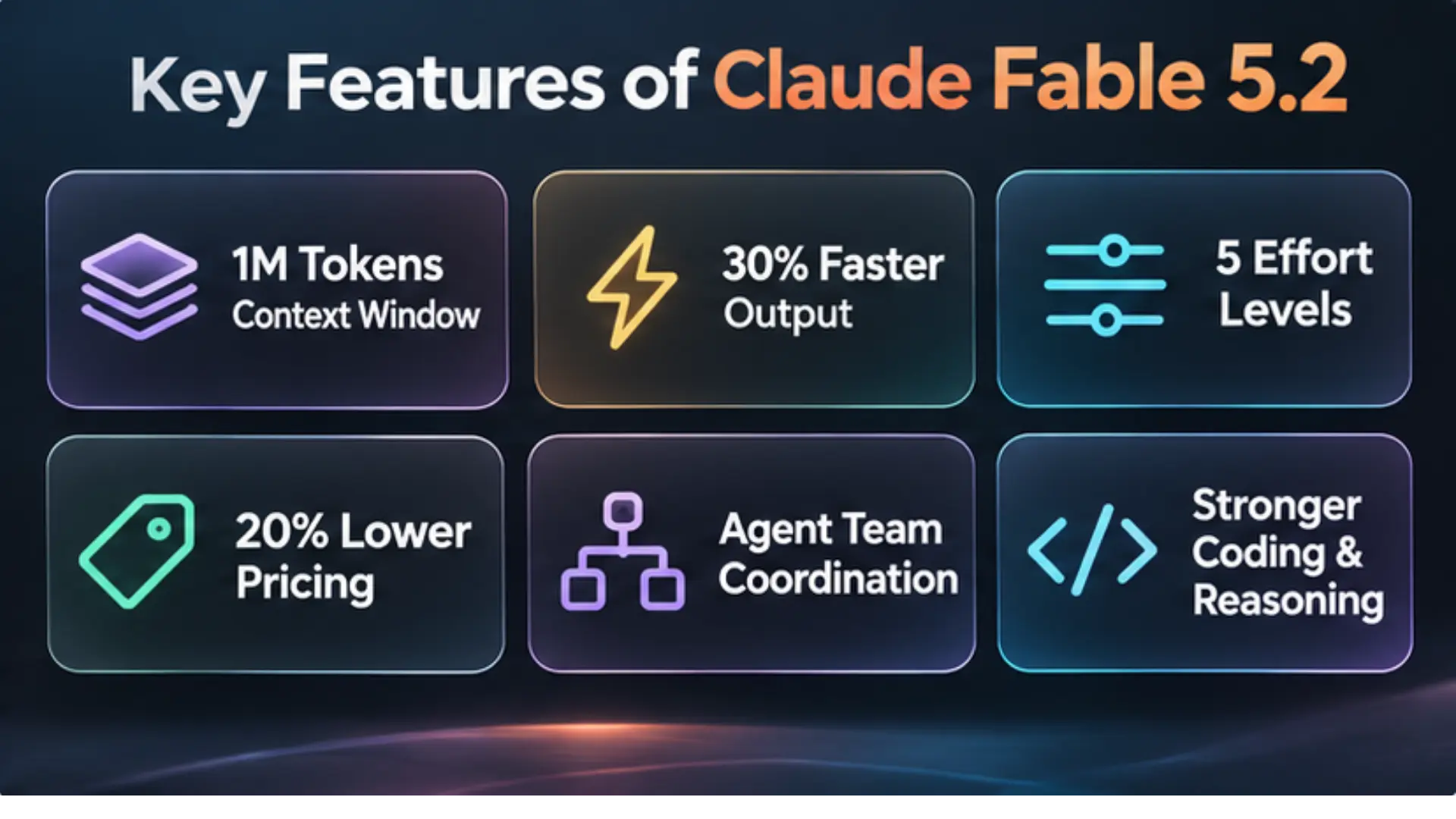
Key Features
Flexible Effort Control: Five effort levels let teams balance quality, speed, and cost for each individual task.
Lower Pricing: It costs 20 percent less than Fable 5.1, with cheaper cached input and half-price batch processing.
Agent Team Coordination: It can plan complex work and direct other agents to complete tasks in parallel.
Conclusion
Claude Fable 5.2 shows how quickly advanced AI is becoming more practical. It brings Anthropic’s strongest public reasoning to more teams, at a lower price and a faster speed. It is built for the hardest problems, where other models fall short.
The rest of the decision is simple. Use Opus 5.5 for daily work, and save Fable 5.2 for complex coding, detailed research, and long agent tasks. Test both models on your own workloads, and let the results guide you.
The current release proves that top-tier AI does not have to stay out of reach. With careful testing and clear prompts, teams can use Fable 5.2 to take on bigger and more ambitious projects than before. This creates a strong foundation for the next generation of AI agents.
FAQs
What is Claude Fable 5.2?
Claude Fable 5.2 is Anthropic’s most capable widely released AI model, launched on November 9, 2026. It is built for difficult reasoning, complex coding, and long, multi-step agent tasks. It can process up to 1 million tokens of context in one request.
How much does Claude Fable 5.2 cost?
Claude Fable 5.2 costs $8 per million input tokens and $40 per million output tokens. That is 20 percent less than Fable 5.1. Batch jobs cost half the standard rate, and the optional fast mode costs double.
Should I use Claude Fable 5.2 or Claude Opus 5.5?
For most coding and knowledge tasks, Claude Opus 5.5 is the better choice, and it costs half as much. Use Fable 5.2 when Opus 5.5 still falls short at high effort, or for long research projects and complex agent systems.

Simplify Your Data Annotation Workflow With Proven Strategies