10 Top Computer Vision Model Training Service Providers 2026
Discover the top computer vision model training platforms in 2026 that streamline annotation, automate QA, and enable fast deployment. Compare tools built for scalable, production-ready AI workflows.

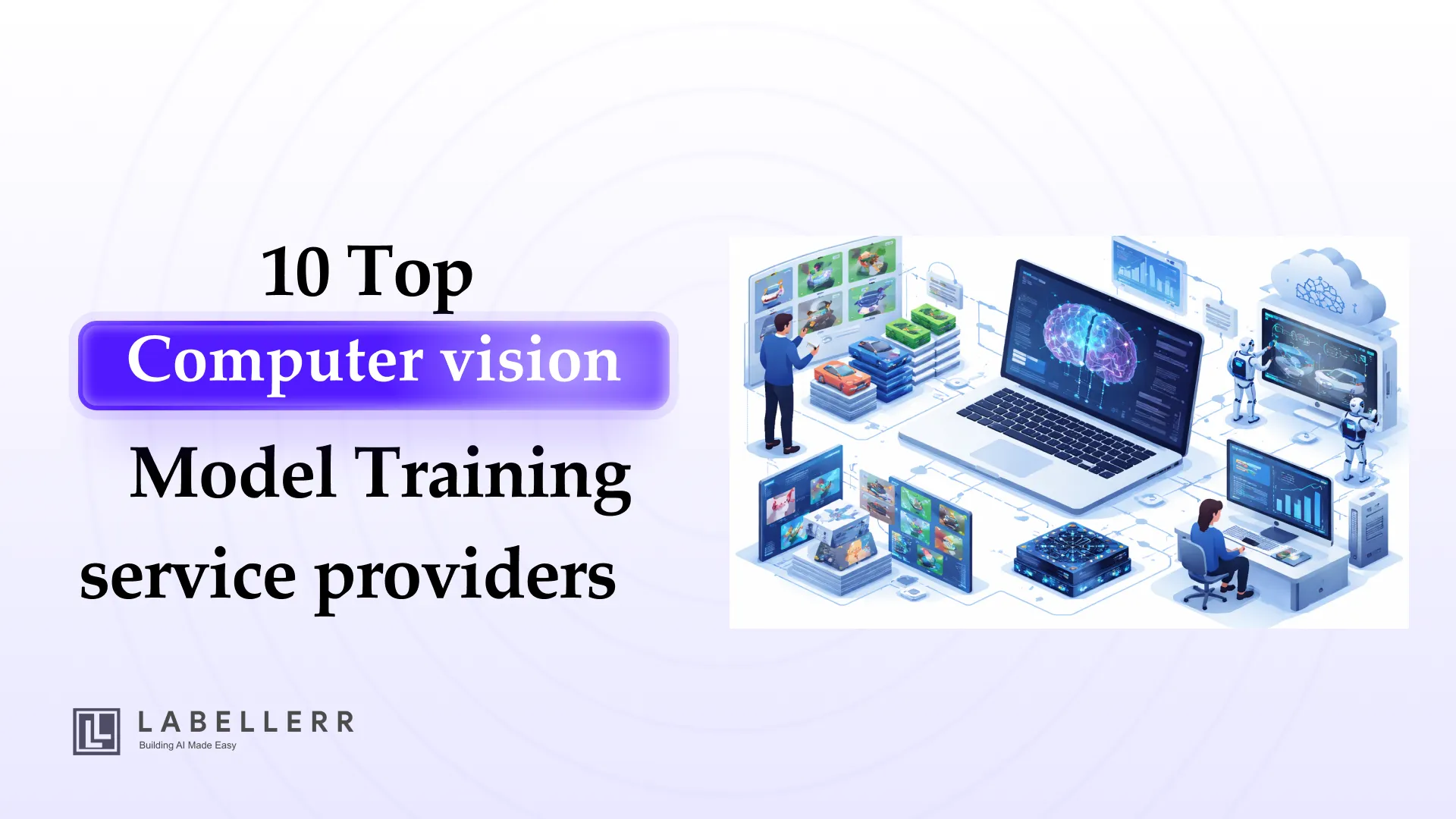
Training a computer vision model in 2026 is not just about picking the right architecture. It is about choosing the right platform one that handles annotation, active learning, quality control, and deployment without burying your team in GPU configs and broken pipelines.
The market has matured fast. Platforms that once offered basic labeling now run full active learning loops, automate QA, and push trained models to edge devices in one workflow.
1. Labellerr
Labellerr is a CV workflow automation platform built for ML teams that need clean training data at scale. Every label feeds back into an active learning loop that surfaces only the hardest sample wq54s for human review, cutting annotation cost without hurting quality.
It handles image, video, text, and audio, covering both computer vision and LLM fine-tuning in one place. G2 has rated it a High Performer and Easiest to Use in Data Labeling.
- SAM-powered video propagation: label one frame, the model tracks the rest
- SAM 3 integration for one-click instance segmentation across image and video datasets
- Automated QA using pre-trained models and ground-truth comparison
- One-click export to COCO, Pascal VOC, JSON, and CSV
2. Roboflow
Roboflow is a full production platform that takes you from raw images to a deployed model in one workflow. Over 750,000 datasets and 575 million labeled images have passed through the platform, reflecting real production adoption. More than half of the Fortune 100 builds with Roboflow.
It supports detection, segmentation, classification, and keypoint tasks. Its RF-DETR architecture, released in March 2025, combines a DINOv2 pretrained encoder with a multiscale DETR head and sets a strong benchmark on object detection tasks.
- Roboflow Universe: 750,000+ public datasets for fast project bootstrapping
- Roboflow Instant: trains a model in minutes once annotations are approved
- SAM-based label assist for fast polygon and mask annotation
- Dataset Health Check that surfaces class imbalances before training
3. Scale AI
Scale AI is the training data backbone behind some of the most advanced AI systems in the world. It has served Google, Microsoft, Meta, General Motors, OpenAI, and the U.S. Department of Defense.
For computer vision, Scale handles image, video, LiDAR, and 3D sensor annotation through AI-assisted tools and a managed human workforce. In March 2026, it launched Scale Labs, a research division focused on model evaluation, post-training methods, and AI risk oversight.
- Managed annotation for images, video, 3D point clouds, LiDAR, and audio
- Scale Rapid: workforce-based annotation with human-in-the-loop QA monitoring
- FedRAMP High authorization for secure government and defense deployments
- RLHF pipelines and model evaluation through Scale Labs
4. Clarifai
Clarifai has been a computer vision leader since 2013, when founder Matt Zeiler won the top five places at the ImageNet Challenge.
Today it is a full-lifecycle AI platform covering data labeling, model training, inference, and deployment across cloud, on-premise, bare metal, and hybrid environments.
It supports custom classification, object detection, video analysis, OCR, and content moderation. Users can chain models together using a drag-and-drop workflow graph editor and access hundreds of community models from Hugging Face, Google, Facebook, and Microsoft.
- Full AI lifecycle: annotation → training → evaluation → deployment in one platform
- Drag-and-drop workflow editor for chaining multimodal models
- Supports cloud, on-prem, bare metal, and hybrid deployment
- OpenAI-compatible API for fast migration and compute orchestration
5. Landing AI (LandingLens)
Landing AI was founded by Andrew Ng around a data-centric AI philosophy: improving your dataset is faster than tuning your model architecture.
LandingLens is a no-code, end-to-end platform covering data upload, labeling, one-button training, and deployment to cloud or edge via Docker and LandingEdge.
It runs entirely on AWS and integrates with Snowflake for in-platform inference. The platform supports classification, detection, segmentation, and anomaly detection tasks. Teams without AI backgrounds can go from raw images to a deployed model without writing code.
- Visual Prompting for fast defect labeling without manual polygon drawing
- Data-centric active learning with automatic mislabel detection
- Anomaly Detection project type for finding deviations with very few abnormal samples
- Continuous learning pipeline that retrains automatically from new deployment data
6. Ultralytics Hub
Ultralytics created the YOLO family - YOLOv5, YOLOv8, YOLO11, and in 2026, YOLO26. Ultralytics Hub is its managed cloud platform that runs training jobs on 22 GPU configurations, from RTX 2000 Ada to NVIDIA B200, without any local infrastructure setup.
YOLO26 supports detection, segmentation, pose estimation, oriented bounding box detection, and classification.
Trained models deploy to 43 global regions with autoscaling and export to 17+ formats including TFLite, CoreML, OpenVINO, TensorRT, and ONNX. Ultralytics is trusted by Siemens, Intel, and Shell in production environments.
- 22 GPU configurations for flexible training scale and cost control
- Live training metrics with experiment comparison dashboards
- Full YOLO family support: YOLO5 through YOLO26 across all five CV tasks
- Export to 17+ formats for cloud, edge, mobile, and embedded devices
7. Encord
Encord is built for teams training physical AI systems, autonomous vehicles, robotics, and surgical AI, where data quality is safety-critical. It annotates video natively without downsampling frames, preserving temporal continuity that most platforms lose by extracting frames as static images.
Production deployments using Encord's micro-model and interpolation modules have reached 99% annotation accuracy.
- Native video rendering with object tracking and frame-by-frame analysis, no downsampling
- Encord Active: automated quality metrics across data, labels, and model predictions
- Python SDK and API for programmatic access to all platform functions
- LiDAR, RGB, thermal, and multispectral data support for sensor fusion projects
8. Groundlight AI
Groundlight lets developers build CV applications using plain English. You describe your visual task "Is there a pallet blocking the fire exit?", and the platform builds an application-specific model. When the model's confidence falls below a set threshold, the query escalates to human reviewers in real time, and that feedback retrains the model continuously.
- Natural language visual queries with no dataset or ML expertise required
- Confidence-based escalation to 24/7 human reviewers when model certainty is low
- Groundlight Hub: a plug-and-play edge appliance for on-site camera integration
- Python SDK and ROS2 package for robotics system integration
9. Dataloop
Dataloop is an enterprise-grade data engine for building and running CV pipelines from ingestion to deployment. It covers annotation, automation pipelines, model management, and production serving, all from a single platform backed by a Python SDK and a function-as-a-service layer.
- Python SDK with automation recipes for pre-labeling and QA queue routing
- Function-as-a-service layer for custom data processing without infrastructure setup
- Git-based model version control with a continual learning pipeline
- Sub-second queries across millions of files by item attributes and metadata
10. Alegion
Alegion is a fully managed training data service. You bring your data and requirements; Alegion handles annotator recruitment, training, project management, and QA end to end.
Its ML-powered platform cuts task completion time by up to 70% through classless object tracking and single-click smart polygon generation.
Alegion has delivered up to one million annotations per month and served Fortune 500 companies across healthcare, retail, insurance, and automotive. One sports analytics client increased model accuracy by 70% after scaling to 200,000 annotated data points through Alegion's managed service.
- Fully managed end-to-end service: data collection, annotation, QA, and delivery
- 4K video annotation with AI-assisted interpolation cutting frame annotation volume by up to 90%
- Supports semantic segmentation, panoptic segmentation, cuboids, and skeletal key-points
- Available as SaaS (Alegion Control), Managed Platform, or full Managed Labeling Service
Get Your CV Model Production-Ready with Labellerr
Labellerr removes the three biggest blockers in CV model training: slow annotation, inconsistent quality, and fragmented pipelines. Its active learning engine sends only the most uncertain samples to human review. Its automated QA catches label errors before training runs.
Teams across agriculture, automotive, retail, and surveillance use Labellerr to ship production models, without annotation backlogs or infrastructure overhead.
Start free or book a demo - labellerr.com
Q1. What is the biggest challenge in training computer vision models in 2026?
The biggest challenge is managing high-quality annotated data and maintaining efficient workflows across annotation, QA, and deployment without increasing operational complexity.
Q2. How do modern platforms improve computer vision model training?
Modern platforms integrate annotation, active learning, automated QA, and deployment into a single pipeline, reducing manual effort and improving model accuracy faster.
Q3. Which platform is best for end-to-end computer vision workflows?
Platforms like Labellerr, Roboflow, and Dataloop provide full lifecycle solutions, covering everything from data labeling to deployment, making them ideal for production-ready workflows.

Simplify Your Data Annotation Workflow With Proven Strategies
.png)