
GPT-6 Sol and Luna: OpenAI’s New Frontier in Cost-Efficient AI
Discover the release of OpenAI's GPT-6 Sol and GPT-6 Luna. Learn how these new AI models bring the architectural breakthroughs of GPT-6 Astra to more accessible price points, offering massive gains in coding, computer use, and enterprise workflows at 50% of the cost.
Artificial intelligence changes how we write software and run our businesses. Today, frontier AI models manage complex workflows, analyze data, and operate digital tools. Following the release of the flagship GPT-6 Astra, OpenAI expanded its model family. On September 23, 2026, the company officially launched GPT-6 Sol and GPT-6 Luna.
These two models take the massive architectural improvements from GPT-6 Astra and bring them to a more accessible price point. They extend the same generation of intelligence downward. OpenAI optimized them to advance the frontier on cost efficiency rather than raw capability. They deliver Astra's advances in professional work, coding, and computer use to faster, more affordable tiers.
This release gives developers and businesses a targeted choice. You can now match the right level of intelligence to the right job without paying premium prices for simple tasks.
What Are GPT-6 Sol and Luna?
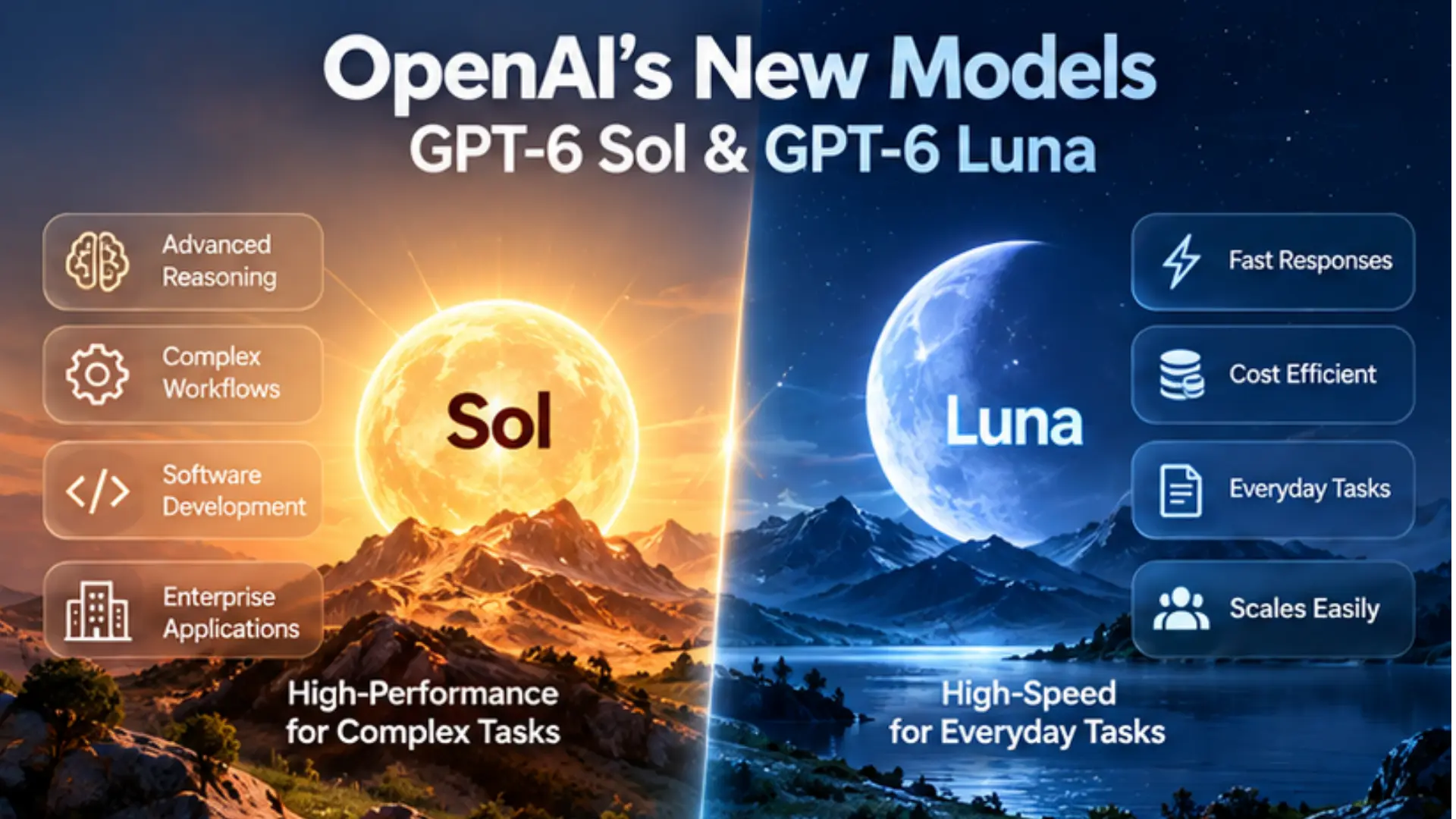
OpenAI designed these two models for different needs. They are both created with OpenAI's latest alignment techniques. These techniques include improved oversight mechanisms and safeguards around recursive self-improvement (RSI). They share advances like improved multilingual support, adaptive memory, and enhanced contextual understanding. However, they serve very different purposes in a digital workspace.
GPT-6 Sol & GPT-6 Luna
The Power of GPT-6 Sol
GPT-6 Sol is a high-performance model engineered for multi-step agentic tasks. It handles complex reasoning, deep technical research, and large-scale enterprise applications. It is built for demanding tasks that recur throughout software development and business operations.
Sol can implement software features, debug complex issues, refactor codebases, and complete multistep processes across different tools. It carries a task all the way from initial investigation through implementation and final validation. Importantly, it preserves the context behind its decisions as it works. OpenAI also states that Sol reduces factual errors by half compared to its predecessor, GPT-5.6 Sol, approaching Astra-level accuracy.
.webp)
How it works
The Speed of GPT-6 Luna
GPT-6 Luna is a lightweight, high-speed model. OpenAI built it for consumer applications, quick answers, daily conversational drafting, and document summarization. It offers faster performance on smaller devices and lower compute requirements.
Luna is designed for high-volume workloads where scaling matters. When a task runs thousands of times a day, the economics of each API call determine whether a workflow succeeds. You can use Luna to extract information from massive document collections, classify incoming user inputs, and answer focused questions across many applications. It makes focused, repeatable tasks practical at a massive scale.
Technical Specifications and API Pricing
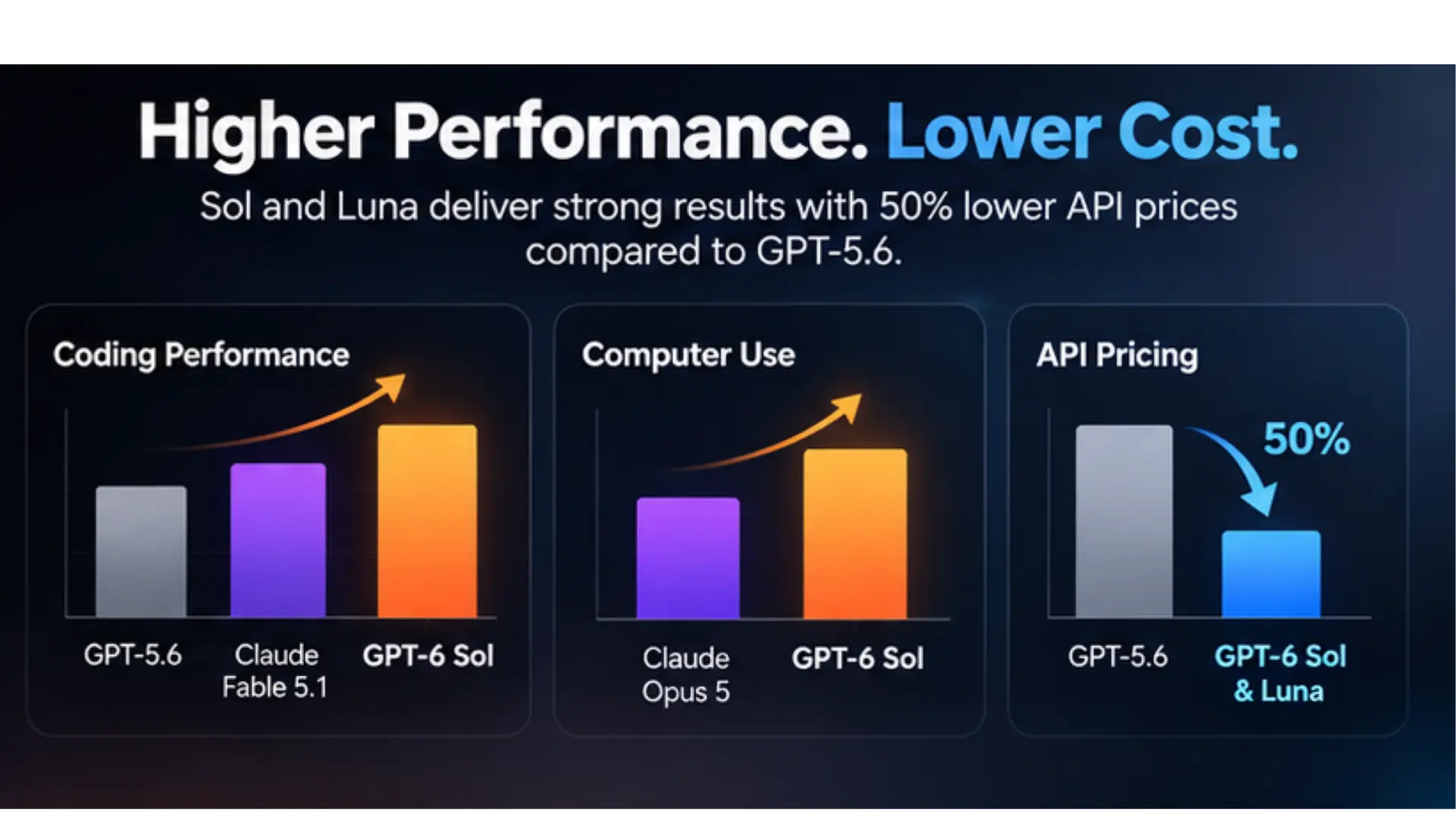
The biggest headline for developers is the massive change in economics. Thanks to major improvements in caching and inference, OpenAI reduced the API serving costs. They cut the API prices for both new models by 50% compared to their GPT-5.6 promotional pricing.
.webp)
Key Features
Both models support explicit prompt caching on platforms like Amazon Bedrock. You can mark prompt content for reuse, which allows subsequent requests to focus processing power only on new inputs.
Here are the core technical and pricing details for developers accessing the models via the OpenAI API as gpt-6-sol and gpt-6-luna.
| Feature | GPT-6 Sol | GPT-6 Luna |
| Primary Focus | Complex reasoning, agentic workflows | High-volume tasks, fast responses |
| Input Price (per 1M tokens) | $2.00 | $0.10 |
| Output Price (per 1M tokens) | $10.00 | $0.50 |
| Price Drop vs GPT-5.6 | 50% cheaper | 50% cheaper |
| Factuality Improvement | ~50% fewer errors | Improved reliability |
Benchmark Performance
OpenAI and independent groups shared impressive benchmark data for both models. They show massive gains in coding, computer use, and professional workflows.
Real-World Business Workflows
OpenAI tested Sol on AutomationBench, which evaluates real-world business workflows. At its highest effort setting, GPT-6 Sol outperforms Anthropic's Claude Opus 5 at maximum effort. Sol achieved this while costing just 9% as much per task.
On a test called Agents' Last Exam, which evaluates complex, long-horizon professional workflows, Sol scored 56.4% at max effort. This score sits ahead of Opus 5's best score in the same exact evaluation. Sol achieved this at a 60% lower cost per task.
Software Engineering and Coding
Coding performance saw a notable jump. On the FrontierCode benchmark, which grades AI code to see if it is ready to merge into real codebases, Sol improved substantially over its GPT-5.6 predecessor. It now matches Anthropic's Claude Fable 5.1 at a much lower price. On DeepSWE, a separate software engineering benchmark, Sol scored within roughly one percentage point of Fable 5's best result, while costing about 80% less per task.
High Performance with lower Cost
Computer Use and Navigation
GPT-6 Sol also excels at using a computer directly. On the OSWorld 2.0 offline test, Sol at its "xhigh" setting scored 60.5%. This beats Claude Opus 5 at medium effort, which scored 60.3%. Once again, Sol completed this at about 80% less cost per task.
Reductions in Hallucinations
Large language models often make up false facts, a problem known as hallucinating. Both new models show significant reductions in hallucinations. On the AA-Omniscience benchmark, GPT-6 Sol at max effort cut its hallucination rate from 92% to 60%. GPT-6 Luna at max effort cut its hallucination rate from 93% to 77%. Sol achieves this mainly by declining to answer more often; it attempts 83% of questions compared to 99% for its predecessor. This means the model knows when to stay quiet instead of guessing.
Here is a summary of how the models stack up on key tests.
| Benchmark | Focus Area | GPT-6 Sol Performance | Cost Efficiency Note |
| AutomationBench | Business Workflows | Outperforms Claude Opus 5 (max effort) | Costs 9% as much per task |
| Agents' Last Exam | Long-Horizon Work | Scored 56.4% (max effort) | 60% lower cost than Opus 5 |
| OSWorld 2.0 | Computer Use | Scored 60.5% (xhigh effort) | ~80% less cost per task |
| FrontierCode | Code Merging | Matches Claude Fable 5.1 (xhigh) | Much lower cost |
Real-World Applications for Developers
These models are built for real-world enterprise deployment. Developers can access them directly through the OpenAI API, and they are also generally available on Amazon Bedrock. Amazon Bedrock runs the models on an inference engine built for high performance, security, and reliability at scale.
The true value of these models comes from routing tasks intelligently. A single application might need different levels of intelligence as a request progresses. For example, a developer might use the extremely cheap GPT-6 Luna to classify incoming requests. If a request requires deep investigation, the system routes it to GPT-6 Sol. If the problem requires additional reasoning depth that can materially change a decision, the system passes it up to the flagship GPT-6 Astra.

Real-World Applications
This specific routing strategy concentrates intelligence where it creates the most value. It helps businesses manage latency and control costs across the entire system.
GPT-6 Sol also benefits from clearer communication about its work and results. When it handles a complex coding process, it reports what it changed, what it verified, and what it could not confirm. This clearer reporting helps human teams identify gaps sooner and understand exactly where human judgment is still needed.
How Consumers Can Access Sol and Luna
OpenAI is rolling out these models directly to users inside the ChatGPT interface. The availability depends heavily on your subscription tier.
- ChatGPT Free: Free tier subscribers get access to GPT-6 Luna exclusively via the ChatGPT Desktop App for macOS and Windows. It provides a significantly faster and more factual desktop assistant for everyday tasks at no cost. Standard web chat for free users continues on legacy models.
- ChatGPT Plus: Paid users gain targeted choice. They get GPT-6 Sol inside the ChatGPT Work mode and workspace. They get GPT-6 Luna as the fast chat engine and on desktop. They also retain full access to GPT-6 Astra.
- ChatGPT Team & Pro: Team and Pro users get full access to Sol inside ChatGPT Work and Codex workspaces. They also receive higher usage limits, and Pro users get uncapped priority reasoning for the Astra model.
Neither Sol nor Luna is currently available in the standard Chat interface for everyday web users. The rollout within ChatGPT happens gradually to keep the service stable.
The release of GPT-6 Sol and GPT-6 Luna pushes the absolute boundaries of cost efficiency in artificial intelligence. OpenAI has successfully brought the architectural breakthroughs of their flagship models down to a more accessible price point. GPT-6 Sol brings incredibly strong reasoning and coding capabilities to complex tasks performed throughout the week. It competes directly with top-tier competitor models at a fraction of the cost. Meanwhile, GPT-6 Luna makes repeatable, high-volume tasks practical at a massive scale. By cutting API costs in half and drastically reducing factual errors, OpenAI gives developers the exact tools they need to build the next generation of automated software.
FAQs
What is the main difference between GPT-6 Sol and GPT-6 Luna?
GPT-6 Sol is a high-performance model engineered for complex reasoning, multi-step workflows, and large-scale research. GPT-6 Luna is a lightweight, high-speed model built for high-volume tasks, fast responses, and consumer apps.
Question: How much do the GPT-6 Sol and Luna APIs cost?
Both models are 50% cheaper than their GPT-5.6 predecessors. GPT-6 Sol costs $2.00 per 1M input tokens and $10.00 per 1M output tokens. GPT-6 Luna costs $0.10 per 1M input tokens and $0.50 per 1M output tokens.
Can free users access GPT-6 Sol and Luna in ChatGPT?
Free users can access GPT-6 Luna exclusively via the ChatGPT Desktop App for macOS and Windows. Access to GPT-6 Sol requires a paid subscription, such as ChatGPT Plus, Team, or Pro.

Simplify Your Data Annotation Workflow With Proven Strategies
.png)