7 Best Data Annotation Software in 2026
Compare the best data annotation software of 2026, including Labellerr, CVAT, Label Studio, SuperAnnotate, V7 Darwin, Encord, and Labelbox. Discover features, pricing, supported data types, and how to choose the right platform for your AI projects.

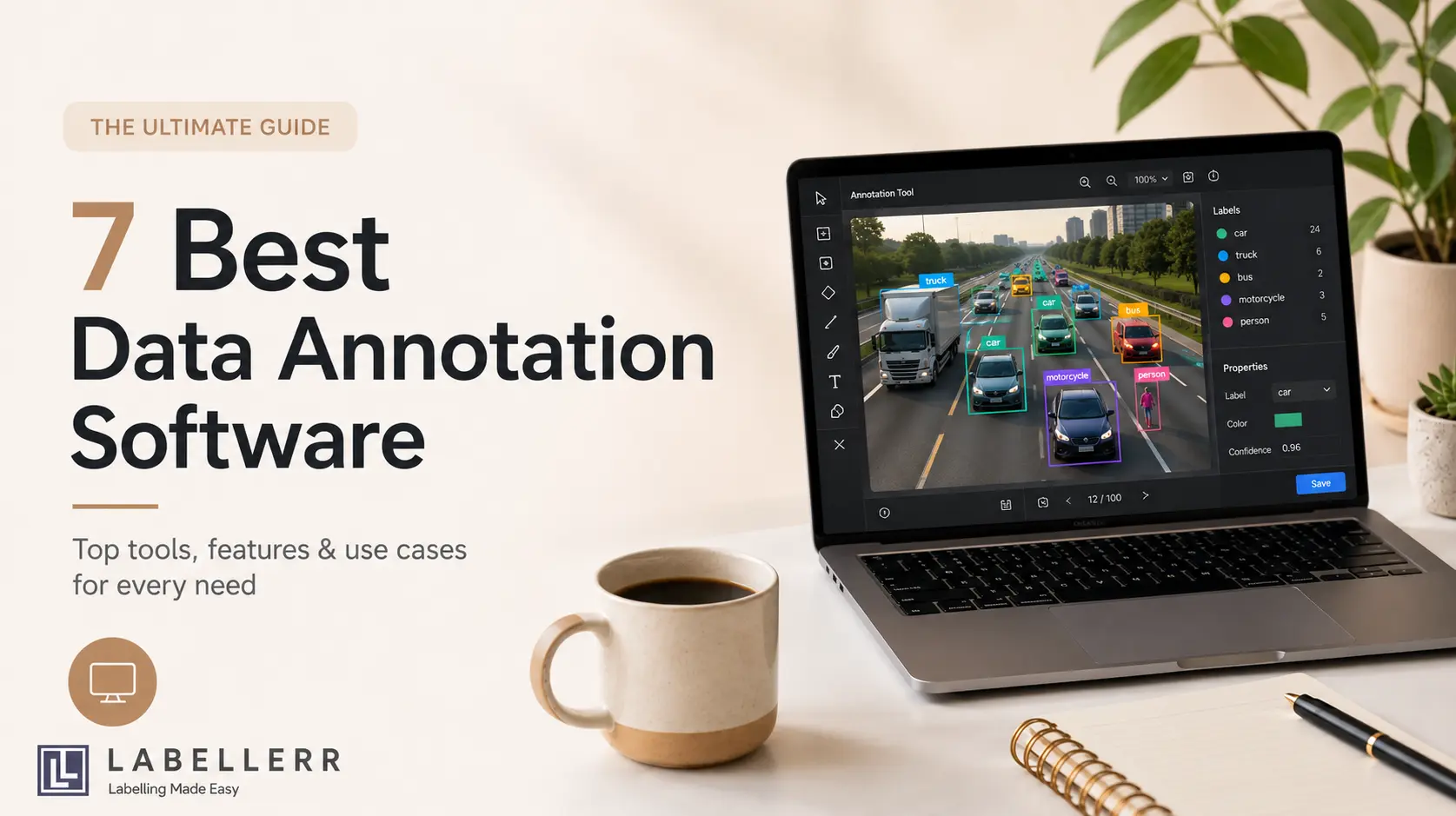
Your model is only as good as your training data. And your training data is only as good as the annotation tool behind it.
With hundreds of platforms flooding the market, picking the right data annotation software is no longer simple. The wrong choice costs you annotation speed, label quality, and ultimately, model accuracy.
Quick Comparison: 7 Best Data Annotation Software (2026)
| Tool | Best For | Data Types Supported |
|---|---|---|
| Labellerr | End-to-end AI teams, enterprise & egocentric CV | Images, video, text, audio, PDF, DICOM, LiDAR, NIfTI |
| CVAT | Open-source computer vision at scale | Images, video, 3D point clouds |
| Label Studio | Multi-modal, developer-first pipelines | Text, images, audio, video, time series |
| SuperAnnotate | CV, NLP, LLM evaluation with strong QA | Images, video, text, audio, multimodal |
| V7 Darwin | Medical, life sciences, specialized CV | Images, video, DICOM, NIfTI, 50+ formats |
| Encord | Regulated industries, multimodal enterprise | Images, video, audio, DICOM, LiDAR, 3D |
| Labelbox | Enterprise ML with NLP + CV pipelines | Images, video, text, audio, geospatial |
1. Labellerr
Labellerr is a full-stack data annotation platform built for teams that need speed, quality, and scale in one place. It covers images, video, text, audio, PDF, DICOM, LiDAR, and NIfTI, one of the broadest data type ranges of any platform on this list.
The platform pairs AI-assisted labeling (SAM, SAM 2, active learning, model-assisted pre-labeling) with a human expert layer. That expert layer includes domain specialists in healthcare, automotive, and manufacturing, not just generalist annotators.
Teams working on egocentric vision, keypoint-based body pose, or close-range object interaction get purpose-built tooling, not workarounds.
The May 2026 update added 21-keypoint hand tracking across images and video, specifically for gesture recognition and hand-object interaction use cases. Quality control runs through IOU metrics, inter-annotator agreement, model-assisted QA, and generative AI-powered review.
Integrations include Google Cloud Vertex AI, AWS SageMaker, Azure ML, HuggingFace, and OpenCV. Labellerr is SOC 2 Type II certified and GDPR compliant.
Pricing :
- Researcher Plan: Free 2,500 data credits, 1 seat, 1 workspace
- Pro Plan: $9,999/year 100,000 data credits, up to 200 seats, unlimited projects, full automation suite, human-in-the-loop access
- Enterprise Plan: Custom unlimited credits and seats, private cloud/on-premise add-on, SSO, dedicated ML engineers, custom SLAs
- Annotation services: Starting at $6/hr from a pool of 1,000+ expert annotators
G2 rating: 4.8/5 - G2 2024 Spring High Performer and Easiest to Use in Data Labeling Software
Building an AI model and need high-quality labeled data fast? Book a Labellerr demo and see how teams reduce annotation time by up to 10x without sacrificing accuracy.
2. CVAT
CVAT (Computer Vision Annotation Tool) started as an Intel project and is now one of the most widely adopted annotation platforms in CV research and production. Over 2.8 million self-hosted deployments and 15,000 GitHub stars make its adoption real.
The platform handles images, video, and 3D point clouds with tools for bounding boxes, polygons, keypoints, semantic segmentation, instance segmentation, and object tracking. In 2026, it ships with SAM 2 and SAM 3 support across all paid plans, enabling text-prompt based segmentation and automatic class detection across approximately 4 million unique concept labels.
CVAT Online offers three deployment layers: Community (open-source, self-hosted, free forever), Online (managed cloud), and Enterprise (self-hosted with SSO, RBAC, audit logs, and air-gapped deployment). It also offers managed labeling services with 300+ dedicated annotators across 12 time zones.
Pricing :
- Free Plan: 1 project, 3 tasks, 1 GB storage, 100 AI agent calls/month
- Solo: $23/user/month (annual) or $33/month, 10 projects, 250 tasks, SAM 2 + SAM 3, reports and analytics
- Team: $23/user/month (annual, 2-50 users), up to 2,500 tasks, SSO, RBAC, audit logs, batch auto-annotation
- Enterprise: From $12,000/year, self-hosted, full compliance stack
3. Label Studio

Label Studio is an open-source, multi-modal annotation platform maintained by HumanSignal. It is the go-to choice for teams that annotate text, audio, images, video, time series, and geospatial data and need one tool to handle all of it.
Its biggest strength is workflow customization. Teams build annotation interfaces via an XML-based config system, attach ML backends for pre-labeling, and trigger active learning loops through Python SDK and REST API. The 2025 SDK 2.0 release significantly improved developer experience and integration depth.
Enterprise features include role-based access control, consensus scoring, annotator performance dashboards, SSO/SAML, and managed infrastructure. LLM-specific features include chatbot evaluation templates, RLHF workflows, and side-by-side model comparison for GenAI teams.
Pricing :
- Community Edition: Free and open-source
- Starter Cloud: Paid plan for small teams, pricing starts at a monthly rate (contact HumanSignal)
- Enterprise: Custom pricing, RBAC, advanced QA, audit logs, SSO, analytics, managed infrastructure
4. SuperAnnotate
SuperAnnotate
SuperAnnotate holds a 4.9/5 rating from 278 reviews on G2 one of the highest scores in its category. It ranks at 98/100 on G2's data labeling leaderboard and 94/100 in image recognition. Clients include Motorola Solutions, Databricks, Qualcomm, and IBM.
The platform's patented AI algorithms achieve pixel-accurate object selection at 20x the speed of manual methods. In early 2026, it launched Agent Hub, native integration of AI data agents into annotation projects via MCP tools, with full trace visibility.
It also connects to models from Fireworks AI, AWS Bedrock, Google Vertex AI, and Databricks for automated labeling and model evaluation.
SuperAnnotate covers the full loop: annotation, data curation with similarity search, QA consensus scoring, and model evaluation, all inside one workspace. Its Expert Talent Network provides vetted human annotators, including specialists for LLM evaluation and multimodal tasks.
Pricing :
- Starter: Includes multimodal editor, image/video/text/audio tools, data curation, analytics, 1K compute hours, onboarding (contact for pricing)
- Pro: All Starter features + 2.5K compute hours, SSO, dedicated Slack channel, dedicated customer success manager (contact for pricing)
- Enterprise: All Pro features + 10K compute hours, dedicated solutions engineer, AI DataOps consulting (contact for pricing)
5. V7 Labs (Darwin)

V7 Labs
V7 Darwin is a purpose-built annotation platform for teams working with complex and specialized visual data. It supports 50+ data formats including DICOM, NIfTI, whole slide images (WSI), PDFs, architectural drawings, and standard image and video formats, making it the strongest choice for healthcare AI teams in this list.
In February 2026, V7 Darwin shipped SAM 3, bringing text-prompt-based automatic detection, higher-accuracy segmentation, and enhanced auto-tracking for video.
Teams can now type a class name and SAM 3 detects and segments all instances in the image, drawing on approximately 4 million concept labels. Video auto-tracking with SAM 3 cuts annotation time on dense scenes by a significant margin.
V7 Darwin is SOC 2 Type II certified and HIPAA compliant. Its multi-stage review workflows support conditional logic, consensus scoring, and task routing. Dataset versioning and model-in-the-loop support let teams integrate their own models for pre-labeling.
Note: V7 Labs now operates two separate products. V7 Darwin is the data annotation tool. V7 Go is an AI agent platform for document-intensive workflows in finance and insurance. They share a brand but serve entirely different use cases.
Pricing :
- Darwin: Custom pricing built from platform fee + user licenses + data processing volume. No public free tier. Book a demo for a quote.
- V7 Go: Custom pricing same structure, separate product
6. Encord
Encord is a full-stack data operations platform. Its product lineup covers Annotate (labeling), Active (data curation and model evaluation), and Apollo (AI agent workflows), designed to keep the entire data-to-model loop inside one platform.
It supports images, video, audio, text, documents, 3D point clouds, LiDAR, and DICOM/NIfTI medical imaging, all in a unified labeling editor. Annotation integrates SAM 2, GPT-4o, LLaMA 3.2, Gemini 1.5 Flash, and YOLO models for assisted labeling. Encord renders video natively with no downsampling, preserving temporal context across frames.
For medical imaging, Encord supports synchronized DICOM series navigation, multi-plane (sagittal, axial, coronal) views, Hounsfield unit windowing, and 3D annotation. It is HIPAA and SOC 2 compliant. Trusted by Kings College London, Memorial Sloan Kettering Cancer Center, and Stanford Medical Centre.
Pricing :
- Starter: Free trial available, entry-level access with core annotation tools
- Team: Custom pricing, advanced collaboration, QA workflows, analytics
- Enterprise: Custom pricing, HIPAA/SOC 2, dedicated customer success manager, white-glove onboarding, Data Agents, Accelerate managed labeling services
7. Labelbox
Labelbox has established itself as one of the leading enterprise annotation platforms, with an estimated ARR past $100M in 2025. It serves computer vision, NLP, audio, geospatial, and multimodal AI pipelines, and is one of the few platforms with a fully-featured data curation engine (Catalog) alongside its annotation tooling (Annotate).
Its Model Foundry layer connects your own models for pre-labeling, active learning, and evaluation, including integrations with Claude, Gemini, and OpenAI models as of 2026. In February 2026, Labelbox acquired Upcraft to expand its expert workforce. Workflow automation runs through a visual, node-based editor for multi-step labeling, review, and QA.
For governance, Labelbox aligns with SOC 2, ISO 27001, and GDPR standards. It is well-suited for healthcare, defense, and regulated enterprise teams that need audit trails and in-place cloud integrations with AWS and Google Cloud.
Pricing :
- Free: 500 LBU/month up to 30 users, 50 projects, 25 ontologies, community support
- Starter: $0.10 per LBU unlimited users, custom workflows, model-assisted labeling
- Enterprise: Custom pricing multiple workspaces, enhanced security, priority support, dedicated customer success
How to Choose the Right Data Annotation Software
No single platform wins across every use case. The right call depends on what your data looks like, how your team works, and what quality bar your model demands.
Start with your data types - If your pipeline touches medical formats like DICOM or LiDAR point clouds alongside standard images and video, you need a platform built for that breadth.
Think about who will do the labeling - Some teams have in-house annotators and just need tooling. Others need a managed workforce that can scale fast. Make sure the platform covers whichever mode you operate in.
Look at your automation requirements - Active learning, model-assisted pre-labeling, and SAM-based segmentation are now table-stakes features. Evaluate how deeply each tool integrates automation into the actual workflow.
Factor in quality control - Look for inter-annotator agreement scoring, IOU-based review, and reviewer workflows built into the core product.
Consider your compliance posture - If you work in healthcare, defense, or any regulated industry, SOC 2, HIPAA, and GDPR compliance are non-negotiable. Confirm certifications before committing.
Match the pricing model to your volume - Credit-based, seat-based, and usage-based models each behave differently at scale. Run your actual expected volume through the pricing structure before signing.
Conclusion
The best data annotation software in 2026 is the one that fits your data types, your team's workflow, and your model's quality requirements. A mismatch costs you more than time, it costs you model accuracy.
If you are building production-grade AI and need a platform that combines AI automation, human expertise, and enterprise security in one place, Labellerr is worth a close look.
Ready to build better training data? Schedule a Labellerr demo and see how leading AI teams cut annotation costs by 75% without sacrificing dataset quality.
FAQs
Q1. What is data annotation software used for?
Data annotation software helps label images, videos, text, audio, and other data types so AI and machine learning models can be trained accurately.
Q2. Which data annotation software is best for enterprise AI projects?
Enterprise teams often choose platforms like Labellerr, Labelbox, Encord, and SuperAnnotate due to their automation, compliance, quality assurance, and scalability features.
Q3. What features should I look for in a data annotation platform?
Look for AI-assisted labeling, quality control workflows, support for multiple data types, collaboration tools, compliance certifications, and integration with ML platforms.

Simplify Your Data Annotation Workflow With Proven Strategies
.png)