
Grok 4.5: SpaceXAI's Fastest, Most Efficient Coding Model
Discover everything about Grok 4.5, xAI's latest frontier AI model. Explore its architecture, coding benchmarks, token efficiency, pricing, real-world capabilities, and how it compares with other leading AI models in 2026.

Most AI model launches promise "smarter." Grok 4.5 promises something rarer: smarter, faster, and cheaper, all at once.
Released on July 8, 2026, Grok 4.5 is SpaceXAI's strongest model to date, built specifically for coding, agentic workflows, and knowledge work. It was trained alongside Cursor, one of the most widely used AI coding editors, which signals exactly where xAI wants this model to compete: the terminal, the IDE, and the agent loop.
What Is Grok 4.5, Really?
Grok 4.5 is a large language model optimized for real engineering tasks. That means software engineering benchmarks, terminal-based agent tasks, and long multi-step technical work, not just chat.
It was trained on datasets spanning coding, science, engineering, and math. The training goal was not raw scale alone. It was intelligent, efficient reasoning, meaning the model tries to solve problems using fewer steps and fewer tokens than its competitors.
That efficiency claim is not marketing fluff. It shows up directly in the benchmark data.
The Architecture Behind Grok 4.5
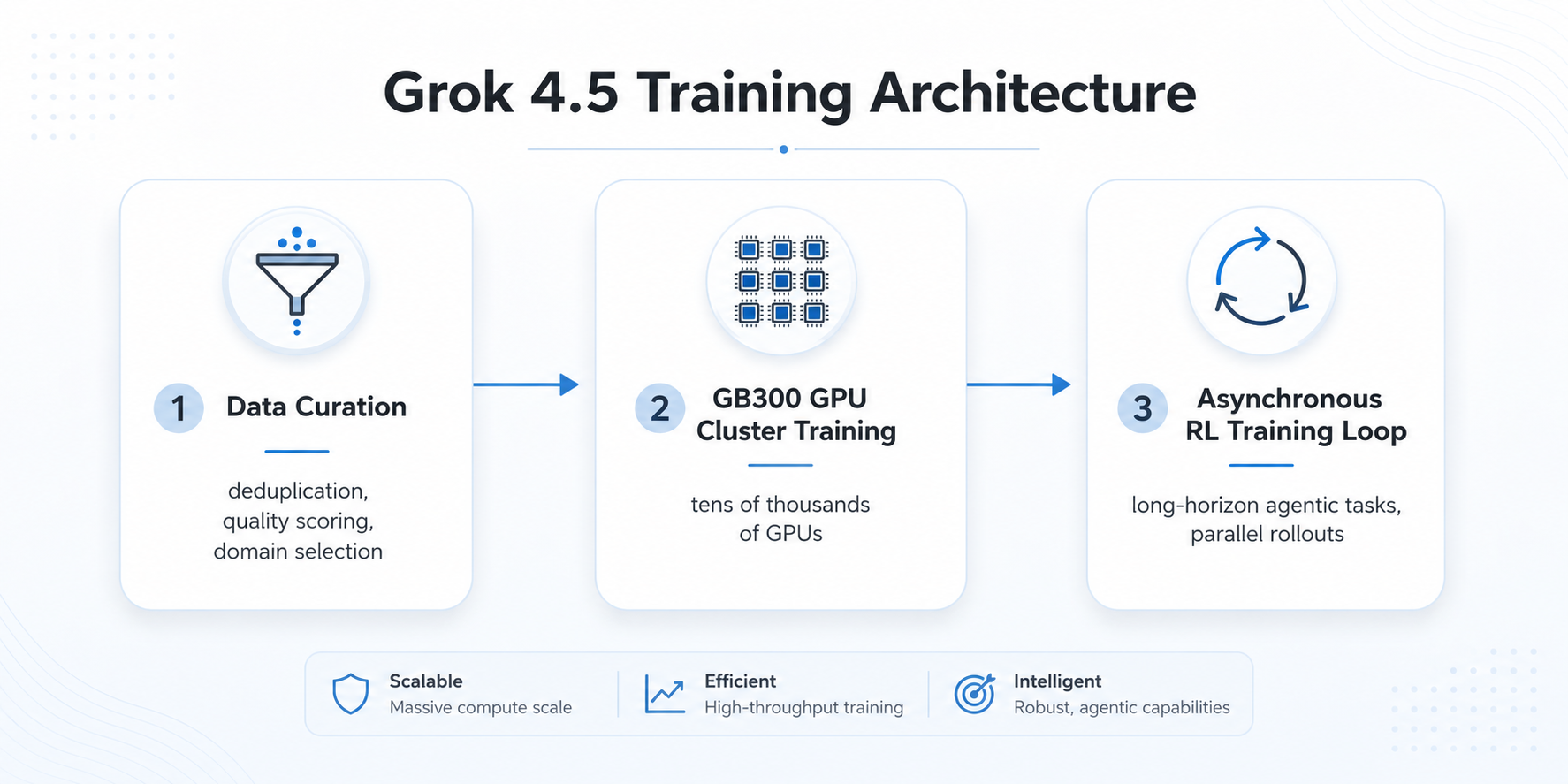
Grok 4.5 was trained across tens of thousands of NVIDIA GB300 GPUs. That is xAI's current generation compute backbone, built for large-scale, long-duration training runs.
architecture
Three architectural decisions stand out.
Aggressive data curation
Instead of just scaling token volume, the team invested heavily in deduplication, quality scoring, and domain-focused data selection. The goal was a training mixture that stays high-coverage and high-signal, not just large.
Reinforcement learning at scale
Grok 4.5's RL training spans hundreds of thousands of tasks, centered on multi-step software engineering work, graded through automated and model-based scoring systems.
Asynchronous agentic training
The training stack supports highly asynchronous rollouts, meaning agentic tasks can run for many hours while learning continues in parallel across tens of thousands of GPUs. This is what lets the model handle long-horizon coding tasks without losing coherence.
The result of this architecture is a model tuned for per-token intelligence, doing more reasoning per token generated, instead of just generating more tokens overall.
Benchmark Comparison: How Grok 4.5 Stacks Up
xAI published head-to-head benchmark results across five major evaluation suites. Here is how Grok 4.5 compares to other leading 2026 models.
| Benchmark | Grok 4.5 | Top Competitor | Notes |
|---|---|---|---|
| DeepSWE 1.0 (pass@1) | 62.0% | Fable max - 66.1% | GPT 5.5 (xhigh) close behind at 64.31% |
| DeepSWE 1.1 (mini-swe-agent harness) | 53% | Fable max - 70% | Grok trails here; GPT 5.5 at 67% |
| SWE Marathon (resolution rate) | 29.0% | Grok 4.5 leads | Ahead of Opus 4.8 max (26.0%) and Fable max (24.0%) |
| Terminal Bench 2.1 | 83.3% | Fable max - 84.3% | Extremely tight three-way race with GPT 5.5 |
| SWE Bench Pro (resolve rate) | 64.7% | Fable max - 80.4% | Fable leads by a wide margin here |

benchmark comparisons
The pattern is clear. Grok 4.5 is not the top scorer on every single benchmark. But it is consistently competitive, and it leads outright on SWE Marathon, a benchmark built for long-horizon task resolution.
The Real Differentiator: Token Efficiency
Benchmark scores only tell half the story. Cost and speed tell the rest.
On SWE Bench Pro, Grok 4.5 resolves tasks using an average of 15,954 output tokens. Opus 4.8 (max) uses 67,020 tokens for comparable tasks. That is a 4.2 times difference in token efficiency.

token efficiency
This matters because token usage directly drives API cost and response latency. A model that solves the same problem using a quarter of the tokens is not just cheaper. It is also faster, since fewer tokens means fewer generation steps.
Grok 4.5 is also served at fast-model speeds of 80 tokens per second, putting it in the same speed tier as models explicitly branded as "flash" or lightweight, while still competing with frontier-tier reasoning models on capability.
Pricing
Grok 4.5 pricing is straightforward and aggressive:
- Input tokens: $2 per million
- Output tokens: $6 per million
Combined with roughly 2x token efficiency over comparable models, and tasks often solved in under half the steps, the effective cost per solved task drops significantly compared to models with higher per-token pricing and lower efficiency.
For teams running high-volume agentic workflows, coding assistants, or automated pull request review pipelines, this pricing structure changes the cost math considerably.
How to Use Grok 4.5: Code Example
Getting started takes a few lines. Here is the official quickstart using the SpaceXAI API:
curl -s https://api.x.ai/v1/responses \
  -H "Authorization: Bearer $XAI_API_KEY" \
  -H "Content-Type: application/json" \
  -d '{
    "model": "grok-4.5",
    "input": "Find and fix the bug, then explain it: function median(a){a.sort();return a[a.length/2]}"
  }'
You will need an API key from the SpaceXAI console before running this. Grok 4.5 is also available directly inside Grok Build (xAI's CLI tool), inside Cursor on all plans, and through the console at console.x.ai.
One important note for teams in the EU: Grok 4.5 is not yet available in the EU across any SpaceXAI products or the API console. EU availability is expected in mid-July 2026.
Built With One Prompt
One of Grok 4.5's headline capabilities is building complete, functional applications from a single, minimally detailed prompt. xAI's own demo used this prompt to generate a full Three.js solar system simulation, complete with adjustable time speed, realistic orbital motion, and a styled HUD, in one shot.
"Make a beautiful simulation of a coral reef ecosystem. should be sped up with adjustable time, realistic fish motion, currents, coral growth. use threejs. Make the HUD well styled and conform to modern design principles."Beyond web apps, Grok 4.5 now serves as the default model in Grok Build for office-style work too. It can construct multi-sheet Excel models that pull in live web research, build complex diagrams using native PowerPoint shapes, and write structured prose directly in Word documents.
Where Grok 4.5 Fits in the 2026 Model Landscape
The benchmark data paints an honest picture. Grok 4.5 is not universally the top performer. On raw resolve rates like SWE Bench Pro, other models pull ahead. But its combination of competitive accuracy, class-leading token efficiency, and aggressive pricing makes it a strong default choice for teams that care about cost-per-task, not just leaderboard rank.
For long-horizon agentic work specifically, its lead on SWE Marathon suggests real strength in sustained, multi-step problem solving, which is exactly the kind of workload growing fastest across engineering teams in 2026.
Conclusion
Grok 4.5 is not trying to win every benchmark by the widest possible margin. It is trying to win the calculation that actually matters to engineering teams: how much real capability you get per dollar and per second spent.
That focus on efficiency, backed by a genuinely large training infrastructure and a data curation strategy built specifically for high-signal engineering tasks, is what makes this release worth paying attention to. Whether it becomes your default coding model will likely come down to your specific workload: raw ceiling performance versus efficient, sustained throughput.
If your team is building or evaluating AI-powered products, whether that means agentic coding tools, generative applications, or ML pipelines that rely on high-quality labeled data to train and validate models, the foundation still comes down to data quality. That is where Labellerr helps. Labellerr supports teams building and fine-tuning AI systems with precise, scalable data annotation, so whatever model you choose to build on, your data is ready for it.
FAQs
1. What makes Grok 4.5 different from previous Grok models?
Grok 4.5 focuses on software engineering, coding, and long-horizon agentic workflows. It combines competitive reasoning performance with improved token efficiency, faster inference speeds, and lower API costs compared to many frontier AI models.
2. Is Grok 4.5 suitable for enterprise AI applications?
Yes. Grok 4.5 is designed for enterprise use cases such as AI coding assistants, automated code reviews, research agents, workflow automation, and large-scale software engineering tasks where speed, efficiency, and cost are important.
3. How does Grok 4.5 compare to other frontier AI models?
Grok 4.5 performs competitively across major coding benchmarks and leads on SWE Marathon, highlighting its strength in long-running engineering tasks. While some competitors achieve higher scores on specific benchmarks, Grok 4.5 stands out for its combination of strong performance, lower token usage, and aggressive pricing.

Simplify Your Data Annotation Workflow With Proven Strategies
.png)