
AI Yoga Pose Classifier & Posture Tracking
Learn how to build a real-time AI yoga pose classifier using a custom YOLO11-Pose model trained on Labellerr data. Explore how trigonometric joint calculations, custom safeguards, and frame-accurate HUD overlays transform a standard video stream into an automated computer vision coach.
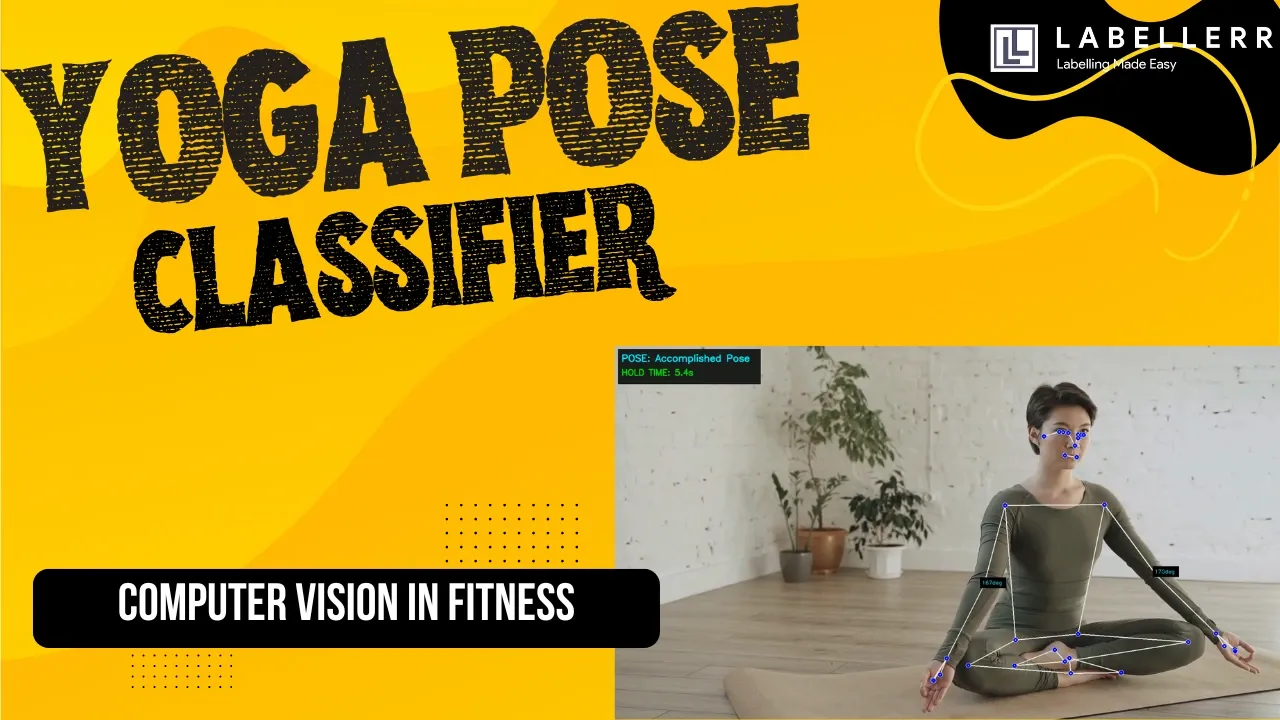
Modern wellness and flexibility training rely heavily on manual tracking or basic wearable sensors. Every day, people log their stretching routines in phone applications or wear smartwatches that guess their physical activity based on simple wrist movements. However, physical sensors present major limitations when evaluating complex full-body postures. A wristband cannot tell if your spine is properly aligned during a deep seated pose. It cannot check if your hips are square or if your body is leaning off-balance. Without accurate form feedback, yoga practitioners risk pulling muscles and experience slower structural progress over time.
That is why we built the AI-Powered Yoga Pose Classifier and Precision Form Analytics HUD. This project uses advanced computer vision to turn a standard webcam into an interactive, real-time posture coach. It allows users to track their entire flexibility routine accurately using a clean, live video stream. This system is superior to basic motion tracking because it understands the exact structural geometry of the human body during static holds. By combining custom deep learning with smart software engineering, we have created an interface that identifies postures and evaluates joint quality at the same time. In this blog, we will explore how this system works, how it evaluates body angles, and why custom training data changes everything.
The Problem with Generic Tracking Frameworks
Most fitness vision projects rely on off-the-shelf public models to detect body positions. These pre-packaged libraries are excellent for basic programming prototypes. However, they frequently fail when deployed in rigorous, real-world fitness and yoga scenarios. Generic tracking frameworks are optimized for standing people facing the camera directly. If a user drops down into a deep forward bend or executes a complex asymmetric stretch, the public tracking logic quickly breaks down because limbs cross over each other and the body profile changes completely.
When a standard tracking model struggles with overlapping limbs, the output coordinates begin to vibrate violently or lose track of joints entirely. For a user, this results in a broken feedback system that jumps between different pose labels or shows incorrect tracking data. Trying to get an useful summary of your flexibility routine with a jittery model becomes an exhausting task. Furthermore, standard public models do not adapt well to camera tilt or perspective distortion. To achieve commercial-grade reliability, developers must move away from generic public assets and build a tailored data pipeline.
How the Custom Pose Monitor Fixes This
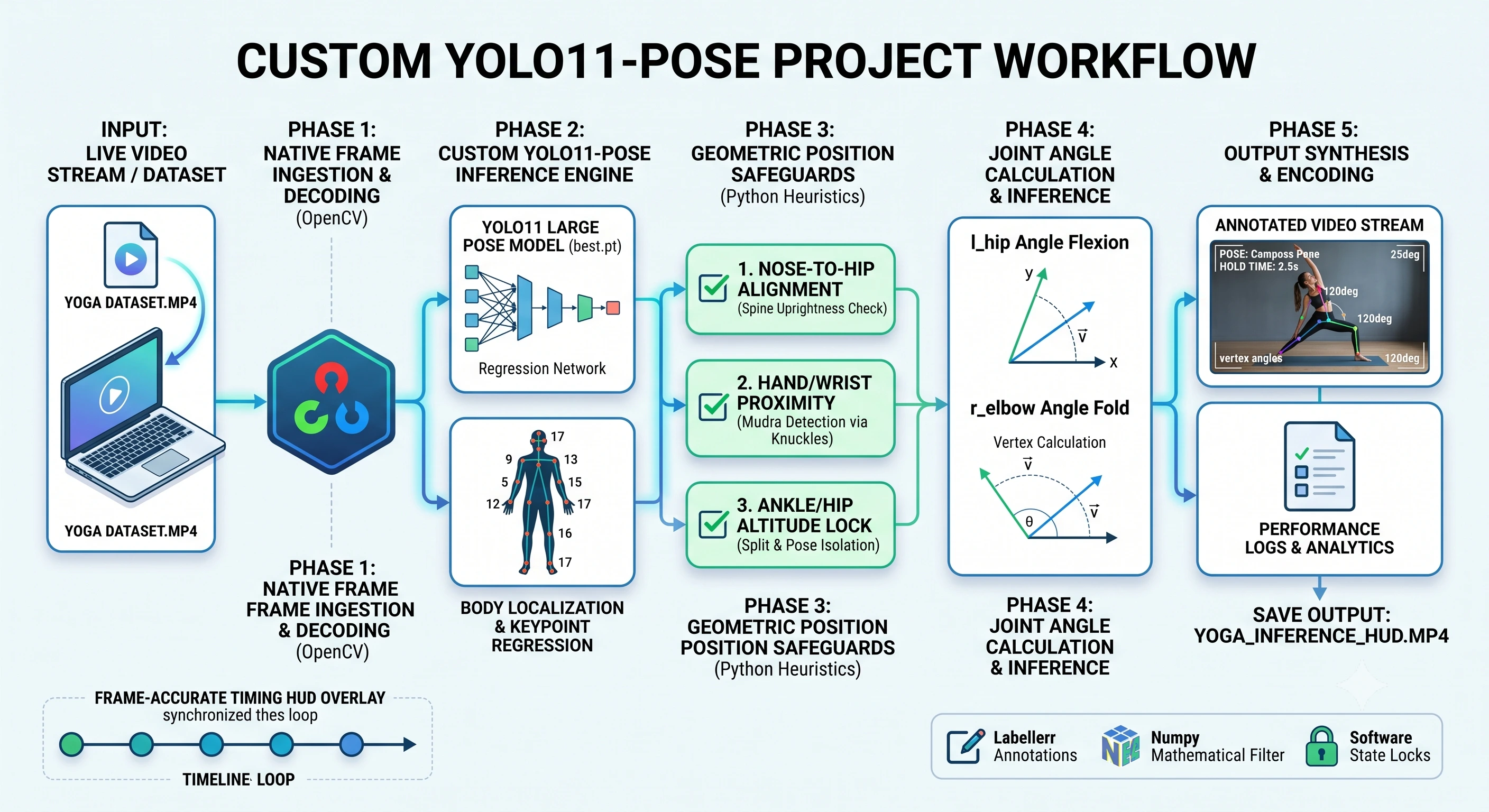
To solve these tracking limitations, I designed an independent system that operates across three core architectural phases: custom data mapping, algorithmic angle calculation, and position-safeguarded pose inference. By taking total control of the training data and downstream logic, the system transitions from a simple camera feed into a highly dependable posture automation engine.
1. Precision Skeleton Topology via Labellerr
Instead of guessing joint locations in complex folded poses, our system relies on a perfectly mapped skeletal framework. We collected high-resolution video streams of diverse body shapes performing advanced yoga asanas under varied lighting angles and clothing styles. These frames were uploaded directly into the Labellerr Keypoint Annotation Platform. Using Labellerr's professional tracking suite, we precisely tagged the absolute ground-truth coordinates for every single keypoint—from the nose and shoulders to the hips and ankles. This custom-labeled dataset allowed us to train a specialized YOLO11 Large Pose neural network optimized for localized body topology in deep flexibility positions.
2. Trigonometric Joint Angle Evaluation
Webcam sensors naturally suffer from sub-pixel noise, making raw coordinate data difficult to use for direct triggers. To eliminate this ambiguity, the system extracts the predicted coordinates from the custom YOLO model and processes them through a mathematical angle filter using NumPy. By treating specific joints like the hips or elbows as a vertex between connecting bone segments, the system tracks real-time articulation. The underlying math applies vector dot products and inverse trigonometric functions to convert raw pixel coordinates into clean, stable degree values on a 2D plane in real time.
3. Position-Safeguarded Inference Logic
Real-time webcams process dozens of video frames every second, which makes deep learning loops highly vulnerable to perspective warping and joint-swapping errors. We fixed this by engineering strict structural safeguards into our classification script. For instance, instead of relying on generic tracking lines that can glitch during a deep cross-legged meditation pose, our code uses advanced landmark relationship checks. It measures the horizontal drift of the nose relative to the center of the hips to confirm an upright spine. It also uses finger-knuckle clusters to verify hand positions and utilizes vertical altitude locks to check if a foot is lifted high off the ground.

Yoga pose tracking using computer vision
Real-World Applications
This technology is far more than a simple desktop novelty. Because our core model is trained on independent data configurations, it can be customized for highly specialized commercial sectors where automated movement evaluation is valuable.
Smart Gyms & Interactive Mirrors
In modern fitness centers, members want interactive feedback without paying for an expensive personal instructor every single session. By integrating this software into smart gym mirrors or kiosk cameras, facilities can offer automated wellness coaching. The AI automatically detects the specific posture, measures structural alignment angles, and visually guides members to improve their extension safely, making high-quality form coaching accessible to everyone.
Automated Physical Therapy & Rehab
Maintaining proper movement form is critical inside a physical therapy clinic or a remote rehabilitation setup. Patients recovering from injuries must perform stretches within exact geometric ranges to rebuild mobility safely without over-extending. This touchless monitor provides an ultra-reliable solution. Physical therapists can remotely track a patient's exact joint angles, monitor maximum hold thresholds, and review historical performance data during home exercises, keeping patients safe and ensuring a faster recovery.
Standardized Athletic & Wellness Coaching
Wellness institutions and athletic clubs require objective, unbiased judging to evaluate progress accurately during flexibility testing. Human graders can make mistakes, experience fatigue, or miss slight posture shifts when grading a practitioner during a long timed hold. This project bridges that gap completely. Because the tracking logic is fully automated and relies on strict mathematical thresholds, it guarantees that every single second of an active hold meets the exact institutional guidelines for alignment and depth.
Key Features of the System
To summarize the engineering pillars that make this custom yoga pose monitor so effective, let’s look at the four primary design components:
Project Workflow
- Precision Dataset: Built using the Labellerr platform to ensure perfect skeletal alignment across thousands of unique custom image frames.
- Advanced Position Safeguards: Incorporates smart relationship checks like nose-to-hip vertical tracking and knuckle proximity mapping to eliminate joint-swapping errors.
- Frame-Accurate Timer: Features a localized stopwatch system calculated via the video's native metadata frame index to prevent timer acceleration bugs.
- Intelligent Overlay HUD: Renders a clean, high-visibility on-screen display showing active pose classifications alongside real-time degree measurements attached directly to the vertex joints.
Project Workflow
Conclusion
The AI-Powered Yoga Pose Classifier and Precision Form Analytics HUD represents a significant leap forward in the field of automated movement coaching. By moving away from rigid, generic public frameworks and embracing a custom data workflow through Labellerr and YOLO11-Pose, we have created a tool that delivers professional reliability on standard computer hardware. This project proves that when you combine clean machine learning data with robust software logic, you can turn a basic webcam into an intelligent personal trainer.
Whether deployed in a commercial smart gym, a remote physical therapy application, or a standardized testing facility, this technology provides a smooth and safe way to evaluate exercise performance. It eliminates the limitations of traditional tracking apps and creates a helpful digital guide for every movement. As we head toward a future of responsive fitness environments, custom-trained tools like this will become the new standard. Through the power of precision keypoint regression, we are making workout tracking more accurate and safer for everyone.
FAQ
Why does YOLO11-Pose outperform generic tracking frameworks like MediaPipe for yoga analysis?
Generic models struggle with self-occlusion and horizontal posture profiles. By fine-tuning a custom YOLO11-Pose model on domain-specific data labeled via Labellerr, the neural network learns to accurately regress absolute coordinate maps even during deep folds or complex body rolls.
How does the system prevent joint-swapping or flickering errors during overlapping limb poses?
The software utilizes custom position safeguards and localized landmark heuristics. Instead of relying purely on unstable joint lines, it checks knuckle proximity groups for mudras, horizontal head drift over the hip center for spinal posture, and altitude locks for vertical splits.
How is the hold timer calculated to prevent fast-forwarding or execution speed lag?
Rather than using system clock intervals which vary based on hardware performance, the pipeline tracks elapsed time directly against the video stream's native frame index metadata, dividing consecutive valid frames by the video's true FPS.

Simplify Your Data Annotation Workflow With Proven Strategies
.png)