
Meta Muse Wonder: Key Features and Details
Explore the key features, benchmarks, and pricing of Meta's Muse Wonder AI. Discover how Active Memory and Active Focus turn this frontier model into an autonomous digital worker for complex coding and knowledge workflows.

A massive codebase migration finished in less than a single day. A company needed to update one million lines of legacy code. A human engineering team would require three full months to finish this. They would spend weeks just planning the architecture.
One engineer assigned this exact job to Muse Wonder. The model began its work at sunset. It read every single file. It mapped the core software dependencies. It rewrote the legacy logic into modern frameworks. It built new automated tests. It ran those tests itself. When a test failed, the model read the error log. It fixed its own mistake immediately. The engineer woke up the next morning. The job was completely done. The new code compiled perfectly on the first try.
This story is not science fiction. This is a verified test case. Meta released Muse Wonder on October 12, 2026. It is their newest frontier model. It acts as a relentless software agent. It delivers massive capability.
If you waited for an AI model that works like a true autonomous engineer, your wait is over.
What Muse Wonder Actually Is
Muse Wonder is a frontier reasoning model. Meta Superintelligence Labs built this system. They released it to the public in October 2026. The model handles complex personal tasks. It also targets heavy professional agentic workflows. External evaluators tested it thoroughly before launch.
.webp)
Key Features
The model features a massive context window. It holds one million tokens at once. This means you can drop an entire software codebase into the prompt. You can upload fifty heavy financial reports. The model remembers every detail. It does not lose the plot during long tasks.
Meta built this system to compete at the very top tier. They moved past simple chatbots. They built an autonomous worker. Muse Wonder takes a goal, makes a clear plan, and executes that plan. It operates software tools. It solves real business problems.
Architecture and Design Choices
Meta gave Muse Wonder two unique abilities. They call these features Active Memory and Active Focus. These specific tools separate the model from older legacy systems.
.webp)
Architecture
Active Memory changes how the model stores facts. Standard models forget everything when you start a new chat window. Muse Wonder keeps track of important details over time. It remembers your project rules. It knows your specific coding style. It recalls a software bug you fixed three weeks ago. You do not need to repeat yourself every day. The model builds a deep understanding of your daily needs.
If the model gets completely stuck, it pauses the workflow. It asks the user for direct help. It explains exactly what went wrong. It offers three distinct solutions. It waits for your choice before moving forward. This makes the model extremely safe for long automated tasks.
The Benchmark Numbers
Meta tested Muse Wonder on rigorous performance benchmarks. They used the Design Arena suite. This suite tests real software engineering skills. It measures how well a model builds actual working software.
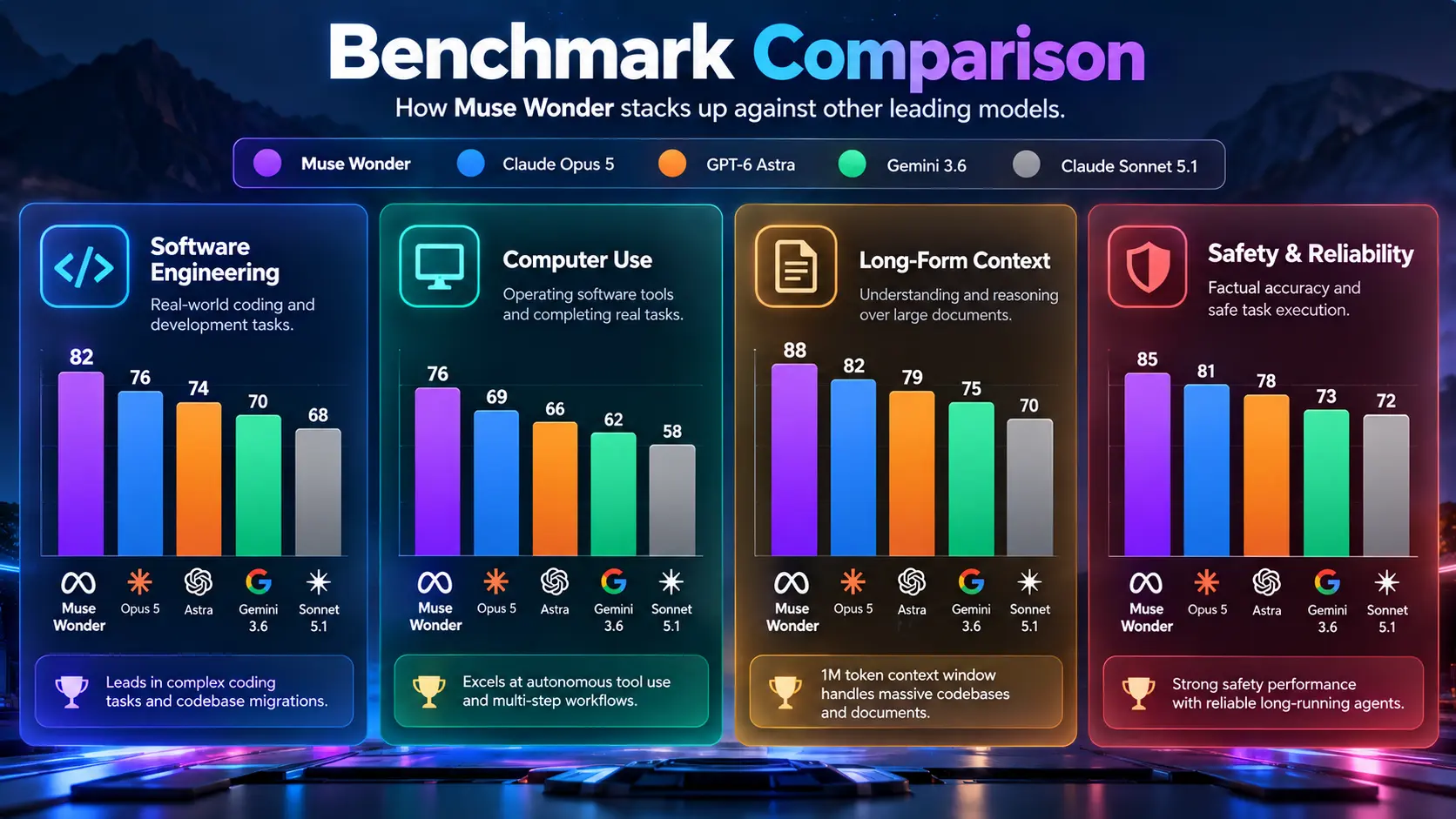
Benchmark Comparison
The tests use the standard Elo rating system. A higher score means a stronger and smarter model. All published scores use the model's maximum reasoning effort setting. Here are the exact numbers published by Meta:
| Benchmark Area | Muse Wonder Elo Score |
| UI Component | 1405 |
| Game Development | 1397 |
| Code Categories | 1373 |
| Data Visualization | 1330 |
Let us look closely at these specific numbers. The UI Component score sits at 1405. This is a massive technical achievement. Building user interfaces requires strong visual logic. The model must understand page layout, spacing, and state management. Muse Wonder handles these visual tasks perfectly.
Pricing: The Real Cost Story
High costs ruin many great AI projects. Meta knows this fact perfectly well. They priced Muse Wonder to encourage heavy, continuous agent usage.
Here is the exact pricing breakdown for API developers:
| Cost Type | Price per 1M tokens |
| Input tokens | $4.00 |
| Output tokens | $20.00 |
| Cache reads | $0.20 |
The input token price is four dollars. The output token price is twenty dollars. These numbers seem fairly standard. However, the cache read price changes the entire financial equation.
Cache reads cost only twenty cents per million tokens. This is a massive price drop. It makes complex agents very cheap to run. Agent workflows send the exact same system prompt many times. They send the same massive codebase hundreds of times. With prompt caching, you only pay the full four dollars once. Every subsequent API call uses the cached data. You pay twenty cents instead of four dollars.
This extreme discount allows developers to run agents all night long. You can let the model iterate fifty times on a single broken script. The total cost remains tiny. Meta also offers a built-in web search tool. The API charges two dollars and fifty cents for every thousand search queries.
Coding: The Numbers Teams Actually Care About
Developers already use Muse Wonder for heavy software lifting. It powers some of the most popular coding tools on OpenRouter today. The Plato Computer Use Agent relies on it entirely. Claude Code and Kilo Code also support it as a primary engine.
The model tackles multi-file codebase refactors with total ease. A developer can ask it to change a core database schema. Muse Wonder finds the exact schema file. It updates the database tables. It then finds every single file that uses that specific database. It updates the backend queries. It updates the frontend display components. It updates the testing files. It finishes the job cleanly.
The one million token context window makes this magic possible. The model holds the entire software project in its mind. It sees how a tiny change in file A breaks a large function in file Z. Older models could not do this. They lacked the memory capacity. Muse Wonder sees the entire board.
Knowledge Work: Where Muse Wonder Pulls Ahead
Coding is not the only valid use case. Muse Wonder masters professional knowledge work effortlessly. It handles dense law, finance, and healthcare tasks.
Financial analysts use the model to process messy market data. They upload fifty quarterly earnings reports at once. The model compares the revenue numbers across five years. It finds hidden market trends. It spots strange accounting tricks. It writes a complete summary of the company's true financial health.
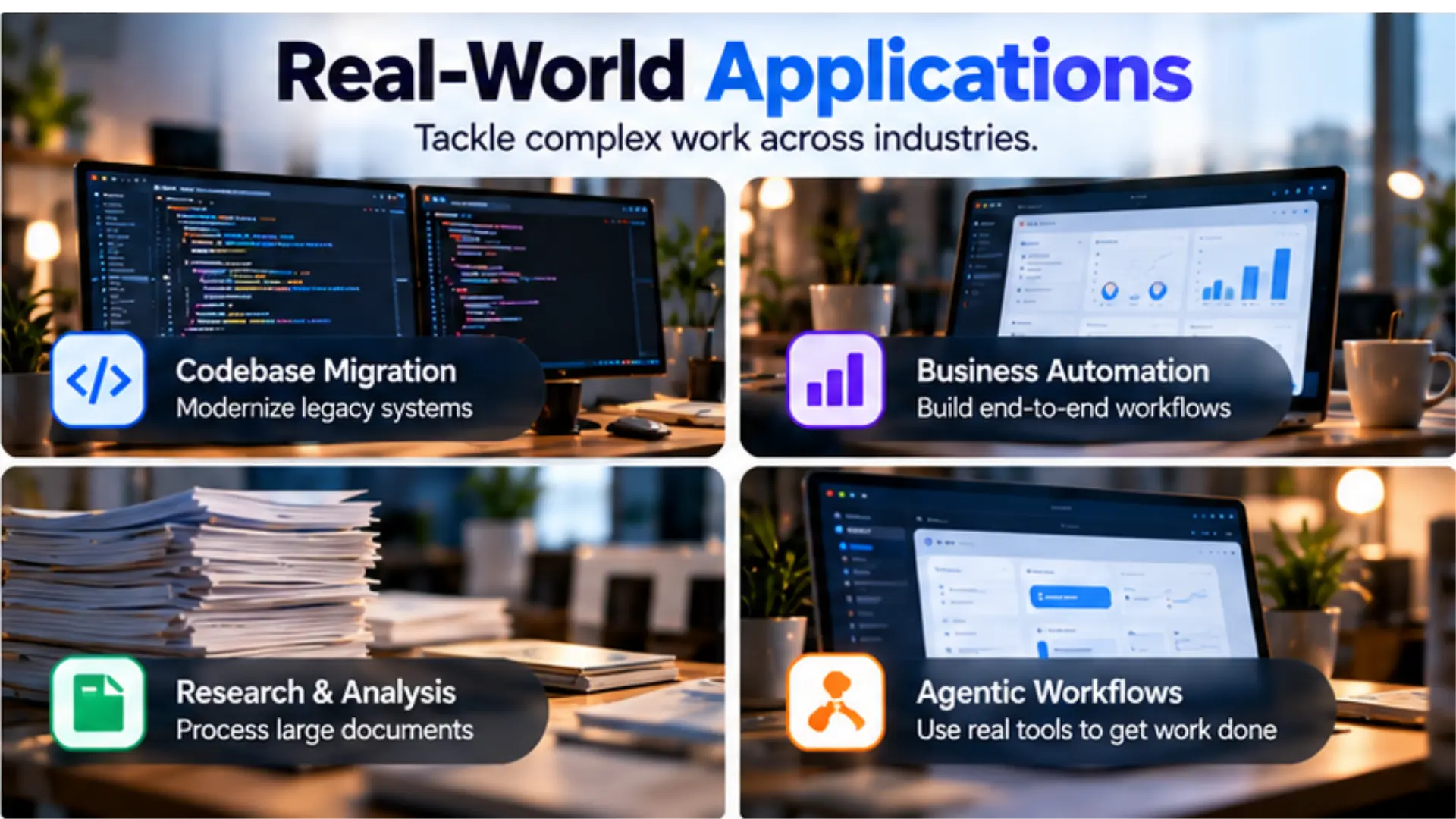
Real World Applications
The model accepts raw PDF files directly. It reads data tables inside the PDF. It reads visual charts. It understands the complex layout of the page. You do not need to extract the text first. You just upload the raw file and ask your question.
Active Memory makes knowledge work much better. An analyst can ask a question on Monday. They can ask a follow-up question on Thursday. The model remembers the exact Monday conversation. It connects the dots. It provides a deeper, smarter answer.
Communication: The Underrated Upgrade
Older AI models suffered from a major character flaw. They were far too confident. They guessed wildly when they did not know the actual answer. They hallucinated fake facts. They broke stable codebases by guessing.
Muse Wonder fixes this serious communication problem. It knows exactly what it does not know. If a task is literally impossible, it stops working. It tells you exactly why it cannot finish the job.
When the model explains a complex technical topic, it uses simple words. It puts the most important facts at the very top of the page. It avoids useless corporate jargon. It respects the reader's time. You get clear, concise answers every single time.
Safety: A Shift to Proprietary Deployment
Meta made a huge strategic change with Muse Wonder. They changed their entire AI release strategy. This model is not open source. You cannot download the raw model weights to your computer.
In the past, Meta gave away their models for free. Anyone could run them on local private servers. This was great for academic researchers. It was great for small tech startups. However, frontier agent models carry massive new risks.
This proprietary shift upset some open source developers. However, it ensures total enterprise safety. Large companies need strict safety guardrails. They need legal guarantees. Meta provides these solid guarantees through their secure API endpoints. The model remains highly aligned and safe for corporate use.
How to Use Muse Wonder
You can start using Muse Wonder right now. The official model string is meta/muse-wonder. The system integration is very simple. You can use standard HTTP web requests. You can also use popular Python SDKs.
Here is exactly how you call the model using the standard OpenAI Python client. This code works perfectly with the OpenRouter API endpoint.
Python
from openai import OpenAI

client = OpenAI(
    api_key="YOUR_OPENROUTER_API_KEY",
    base_url="https://openrouter.ai/api/v1"
)

response = client.chat.completions.create(
    model="meta/muse-wonder",
    messages=[
        {
            "role": "user",
            "content": "Audit this codebase for security flaws. Please provide a clear, prioritized fix plan."
        }
    ]
)

print(response.choices[0].message.content)
The model supports advanced software tool use natively. You can pass strict JSON schemas to the API. The model will return exact data structures every time. This makes it perfect for automated data extraction pipelines. You can also give the model access to your own custom database functions. It will decide when to call them intelligently.
Muse Wonder: The Practical Decision
The software choice is very clear. If you build autonomous software agents, you absolutely need this model.
The technical gains are massive. You get a one million token context window. You get Active Memory. You get Active Focus. The model reads images, audio, and video flawlessly. It handles massive coding jobs without failing halfway through.
The pricing structure seals the deal. The cheap cache reads make long agent sessions highly affordable. You get premium frontier performance at a steep financial discount. You can run automated coding workflows all night without breaking the bank.
Conclusion
Meta released Muse Wonder as a frontier model for autonomous coding and multi-step agent tasks. It pairs a one-million token context window with native multimodal support for text, documents, images, video, and audio. Benchmark results highlight strong performance in UI generation, game logic, and technical reasoning. Instead of behaving like a basic chatbot, it plans steps, runs tools, and executes long jobs unattended.
Its standout features are Active Memory and Active Focus. Active Memory carries project context, rules, and user preferences across separate chats. Active Focus helps the agent persist through failures by testing alternative solutions and fixing broken code before requesting help. At four dollars per million input tokens and just twenty cents for cache reads, running repetitive, multi-turn loops remains affordable.
Does Muse Wonder deserve the immense hype, or is it just another nominal update? In raw reasoning power, the leap feels incremental rather than miraculous, and abandoning open weights frustrates open-source teams. Yet the hype holds merit for agent stability. Packaging persistent memory, automated recovery, and cheap caching turns brittle scripts into dependable tools. For engineers running unattended tasks, that endurance delivers real value.
FAQs
What makes Muse Wonder different from previous AI models?
Muse Wonder is a frontier agentic model featuring Active Memory and Active Focus, allowing it to remember project details across sessions and autonomously push through complex, multi-step tasks without quitting.
How much does it cost to run the Muse Wonder AI model?
Muse Wonder costs $4.00 per million input tokens and $20.00 per million output tokens, but features highly affordable prompt caching at just $0.20 per million cache reads.
Is the Muse Wonder model open-source?
No, Meta shifted to a proprietary deployment strategy for Muse Wonder. It is securely accessible only through hosted cloud services and APIs like OpenRouter to ensure enterprise safety.

Simplify Your Data Annotation Workflow With Proven Strategies
.png)