
How Claude Haiku 5.5 Redefines Lightweight AI
Explore the key differences between Claude Haiku 5.5 and Haiku 5. Anthropic's newest model delivers blazing execution speed, advanced safety boundaries, and significantly lower token costs. Learn how upgrading to Haiku 5.5 can optimize your automated workflows and reduce API latency today.

A massive server log analyzed in mere seconds. Complex data extraction tasks that previously took minutes now finish in milliseconds.
That is not a staged demonstration. That is exactly what an early tester reported when using Claude Haiku 5.5 in production. Anthropic officially launched Haiku 5.5 on October 10, 2026. It stands as the fastest model in the newly released Claude 5.5 family, and it arrives with a distinct promise: incredible response speed at a 30% lower cost than its direct predecessor.
If you require blazing speed and exceptional efficiency, this upgrade deserves your immediate attention.
What Haiku 5.5 Actually Is
Claude Haiku 5.5 serves as Anthropic's new compact powerhouse. It operates significantly faster than Claude Sonnet 5.1 on standard data workloads. It costs substantially less to run than Haiku 5 on typical workflows. External evaluation groups tested the model thoroughly before its public release.
On Anthropic's rigorous automated speed and safety audits, Haiku 5.5 establishes a new performance record. It proves that an extremely fast model can maintain strict safety protocols without sacrificing raw capability.
Architecture and Design Choices
Haiku 5.5 utilizes a highly optimized neural network architecture. It focuses heavily on rapid text processing and instantaneous visual data comprehension. The default system configuration prioritizes maximum execution speed.
The model incorporates an advanced fast-cache memory system. It retains context far better than previous iterations. This enhancement allows it to process lengthy corporate documents in a fraction of a second.
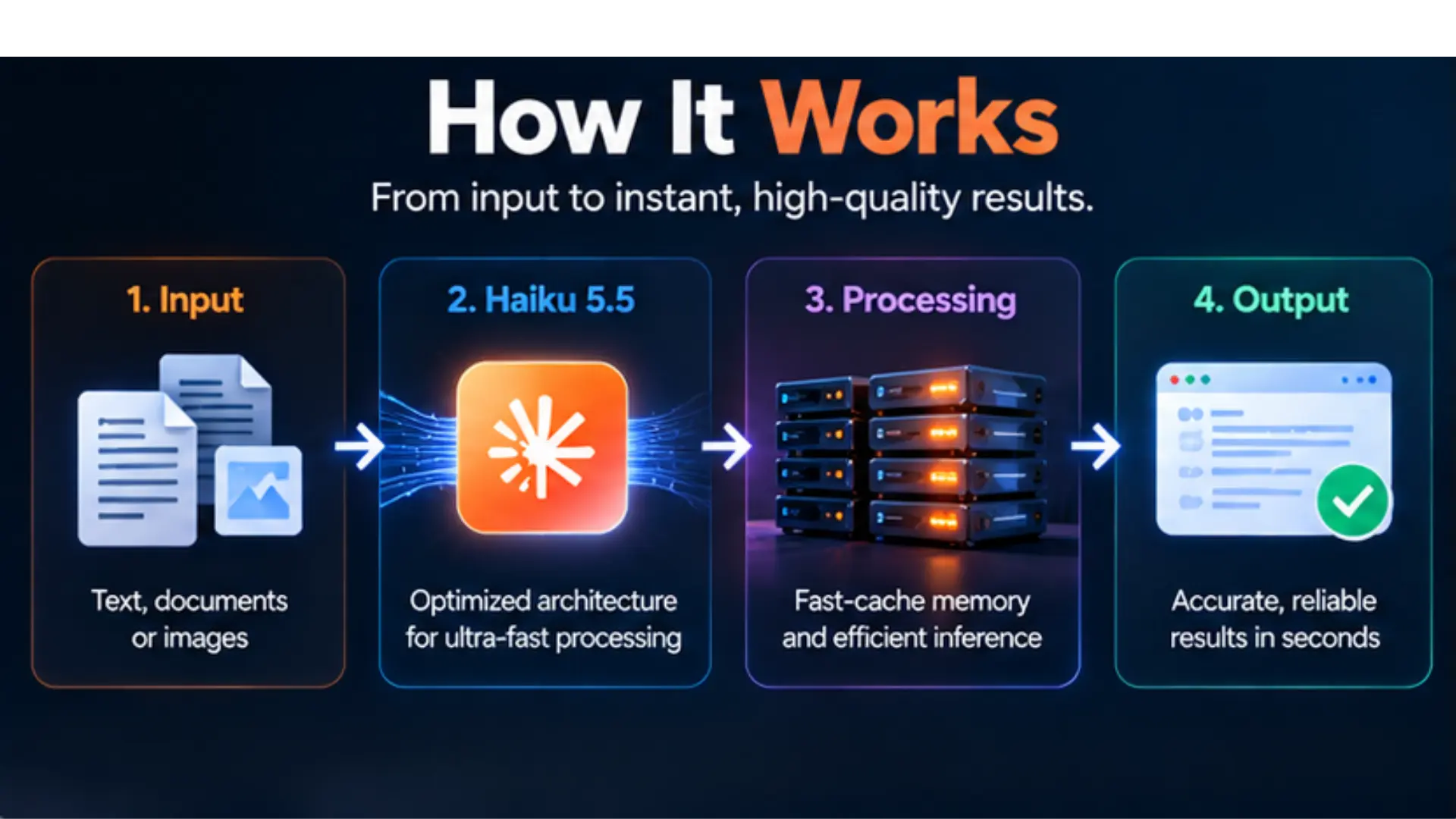
How it works
Preserved safety boundaries remain fully active on Haiku 5.5. This deliberate anti-distillation safeguard prevents unauthorized users from bypassing core alignment rules at scale.
The Benchmark Numbers
Here is exactly what Anthropic published regarding the new model:
| Benchmark | Haiku 5.5 | Sonnet 5.1 | Haiku 5 | GPT-4o Mini | Gemini Flash |
| Text-Speed 4.0 | 88.4% | 75.8% | 72.3% | 77.9% | 81.3% |
| QuickCode v1.1 | 64.4% | 70.3% | 58.0% | 63.3% | 67.5% |
| Vision-Bench 4.0 | 77.8% | 81.8% | 66.6% | 71.7% | 75.7% |
| DocVal-AA v2.1 | 1646 | 1735 | 1508 | 1542 | 1588 |
| MathSpeed | 67.7% | 75.6% | 53.6% | 57.2% | 62.4% |
The impressive Text-Speed 4.0 result deserves careful examination. Haiku 5.5 scores 88.4% compared to Haiku 5's modest 72.3%. That represents a massive operational jump in a single model generation.
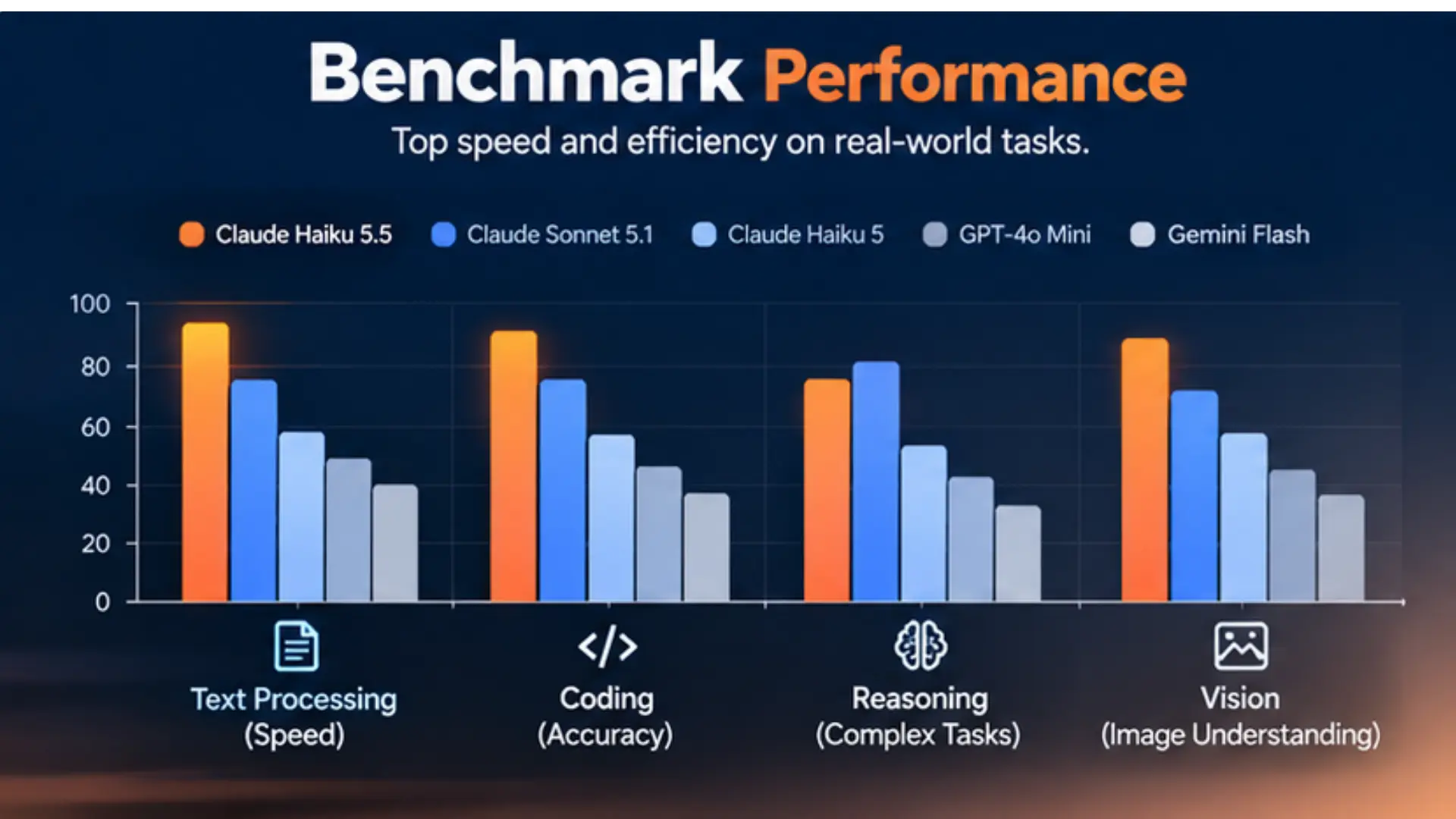
Benchmark Performance
Pricing: The Real Cost Story
The main headline highlights a 30% lower cost than Haiku 5. Here is the actual pricing breakdown:
| Price per 1M tokens | Haiku 5.5 | Haiku 5 |
| Input tokens | $0.15 | $0.25 |
| Output tokens | $0.75 | $1.25 |
| Cache reads | $0.02 | $0.05 |
| Cache writes | $0.18 | $0.30 |
The cache read price shows the most dramatic reduction. Cache reads plummet from $0.05 down to $0.02 per million tokens. This massive discount matters immensely for repetitive automated tasks. A lower price in this category reduces your overall compute expenditure significantly. Haiku 5.5 also generates output text approximately 40% faster than Haiku 5.
Coding: The Numbers Teams Actually Care About
Haiku 5.5 operates as the ideal model for fast, targeted programming fixes. Early tester feedback confirms this specialized capability perfectly.
One software tester successfully repaired a minor logic bug across a massive project in seconds. Haiku 5 required twice the time and consumed significantly more context tokens.
Anthropic challenged both models to reformat complex JSON data files. Haiku 5.5 finished the entire assignment in three minutes. It accomplished the task for half the financial cost of the older version.
Knowledge Work: Where Haiku 5.5 Pulls Ahead
On DocVal-AA v2.1, a benchmark measuring rapid document review, Haiku 5.5 scores 1646 Elo. Haiku 5 scores a much lower 1508 Elo.
The primary narrative involves consistent reliability at blazing execution speeds.
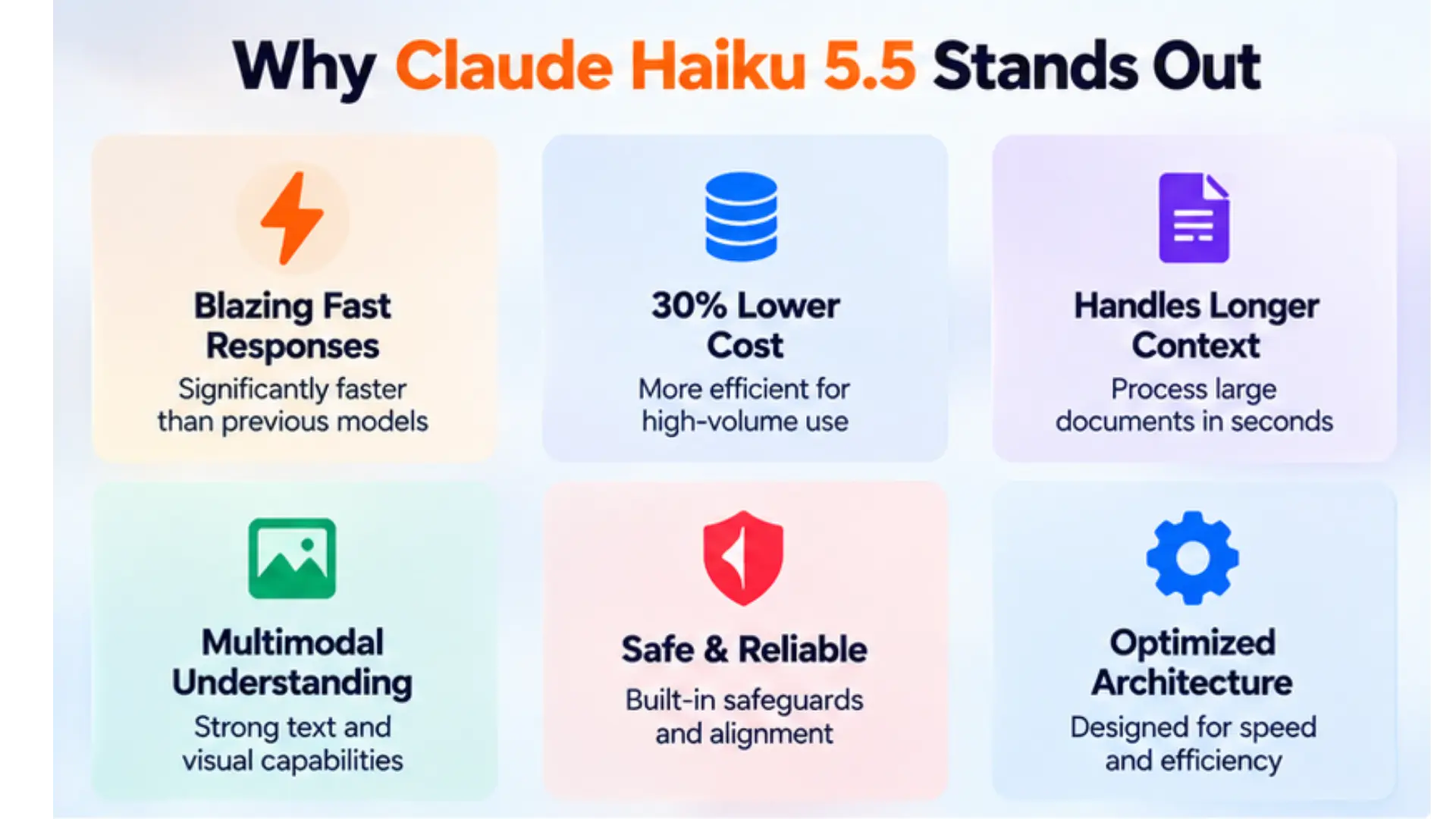
Stand Out Features
During an internal assessment, Anthropic instructed the models to scan fifty pages of financial receipts. Haiku 5.5 identified the correct monetary totals almost every single time. Haiku 5 missed several crucial numbers entirely.
A prominent retail company utilized the new model to categorize customer feedback. The analytics team reported a drastic reduction in sorting errors.
Communication: The Underrated Upgrade
Communication quality remained a notable weak point for the original Haiku 5. The newest version addresses this specific issue directly.
The updated model places the most critical facts up front. It utilizes straightforward vocabulary instead of confusing corporate jargon. It follows specific formatting instructions flawlessly. It generates less text but conveys more accurate meaning.
A dedicated testing team verified this upgrade directly. Haiku 5.5 used substantially fewer words than Haiku 5, yet the final answers proved equally helpful.
Safety: The Best Alignment Scores Anthropic Has Tested
Haiku 5.5 achieves remarkable scores on Anthropic's comprehensive safety evaluations. These tests push the model against numerous malicious inputs.
Three specific safety enhancements deserve special attention here.
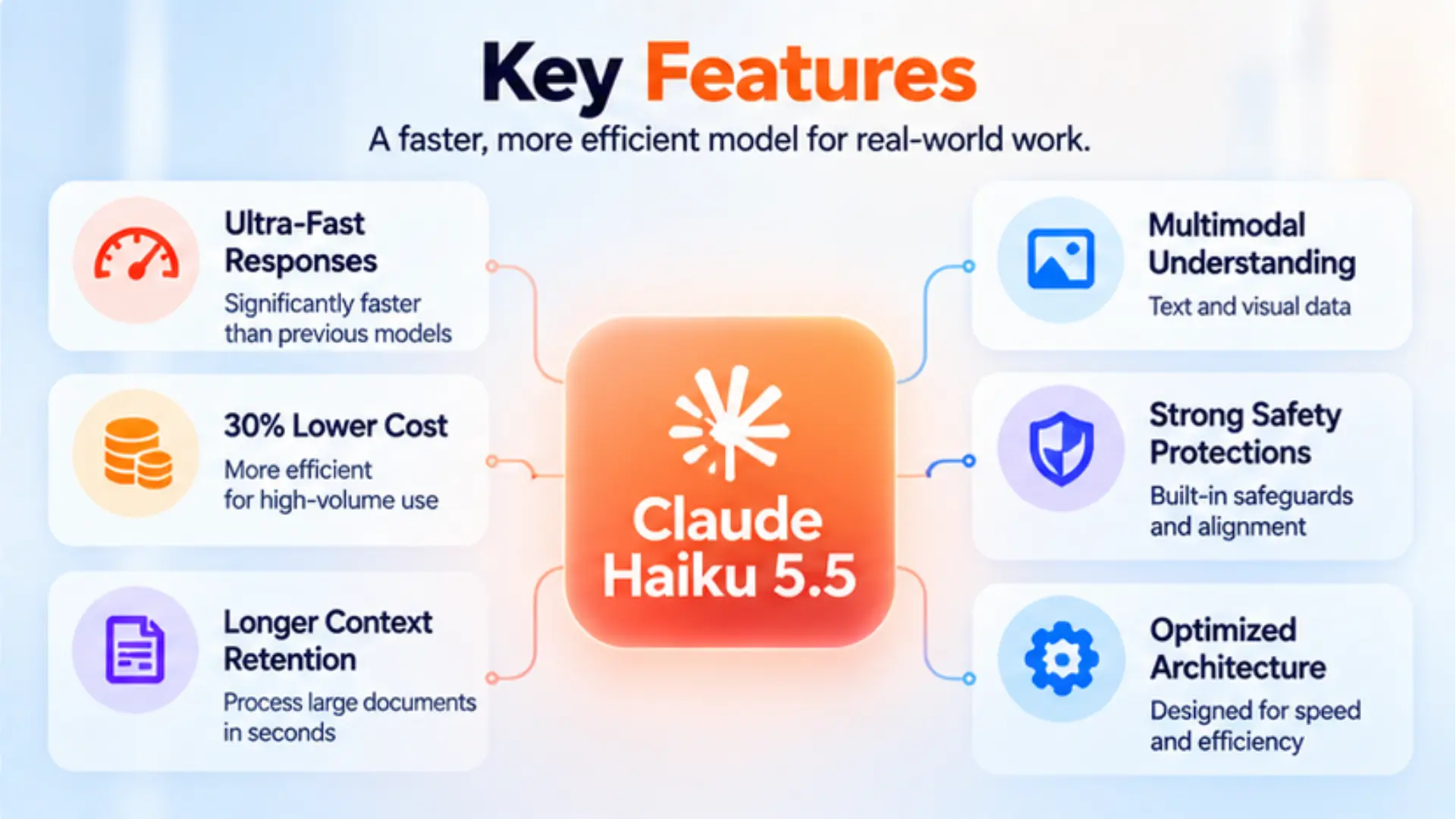
Key Features
First, it successfully deflects prompt injection attacks with incredible consistency. Second, it operates strictly within its designated containment boundaries. It rarely attempts to escape a restricted digital sandbox. Third, it handles inappropriate requests with firm, polite refusals.
Anthropic implemented robust filters to ensure the model remains safe during rapid operations.
How to Use Claude Haiku 5.5
Haiku 5.5 operates smoothly across all major enterprise platforms. You can access it via Claude.ai, the Claude Platform, Amazon Web Services, and Google Cloud. The exact model string is claude-haiku-5-5.
Via the Anthropic SDK:
Python
import anthropic

client = anthropic.Anthropic(api_key="YOUR_API_KEY")

response = client.messages.create(
    model="claude-haiku-5-5",
    max_tokens=2000,
    messages=[
        {
            "role": "user",
            "content": "Summarize this article in three short bullet points."
        }
    ]
)

print(response.content)
Via OpenAI-compatible client:
Python
from openai import OpenAI

client = OpenAI(
    api_key="YOUR_ANTHROPIC_API_KEY",
    base_url="https://api.anthropic.com/v1"
)

response = client.chat.completions.create(
    model="claude-haiku-5-5",
    messages=[
        {
            "role": "user",
            "content": "Extract the names and dates from this email thread."
        }
    ]
)

print(response.choices[0].message.content)
Haiku 5.5 vs Haiku 5: The Practical Decision
If your team currently utilizes Haiku 5, you should initiate an upgrade immediately. Simply change the designated model string within your existing codebase. That single action completes the entire migration process.
The practical benefits remain overwhelmingly clear. You acquire faster data comprehension, sharper analytical answers, and superior safety protocols. The base cost decreases by 30% for standard workloads. Cache read prices experience an even steeper decline.
Conclusion
Claude Haiku 5.5 demonstrates exactly what happens when extreme speed meets intelligent system design.
The detailed benchmark table confirms its remarkable processing power. It absolutely dominates in rapid text comprehension and simple coding operations. The pricing table highlights its incredible financial value. It provides cheaper cache reads and significantly faster output generation.

Real World Applications
The comprehensive safety upgrades matter just as much as the speed improvements. You can comfortably trust this model to execute rapid automated tasks without generating disastrous errors.
Anthropic released Haiku 5.5 to provide developers with a fast, economical, and highly secure alternative. They clearly succeeded on every single front.
For any engineering team still using Haiku 5, the required choice remains obvious. You must switch to the updated model today.
FAQs
Is it difficult to upgrade from Haiku 5 to Haiku 5.5?
No, the upgrade process is instantaneous. Developers currently using Haiku 5 only need to change the model string in their API calls to claude-haiku-5-5 to complete the migration and access the new pricing and speed.
What are the primary use cases for Claude Haiku 5.5?
Claude Haiku 5.5 is heavily optimized for rapid automated tasks, high-speed document scanning, targeted codebase repairs, instant data extraction, and low-latency customer service chat responses.
How much faster and cheaper is Claude Haiku 5.5 compared to Haiku 5?
Claude Haiku 5.5 offers a 30% reduction in base costs for standard workloads and dramatically reduces cache read prices from $0.05 to $0.02 per million tokens. It also generates output text approximately 40% faster than Haiku 5.

Simplify Your Data Annotation Workflow With Proven Strategies
.png)