5 Best YOLO Model Training Service Providers in 2026
Discover how to train high-performance YOLO models using optimized datasets and workflows tailored for real-world use cases in India, including traffic, agriculture, and surveillance applications.

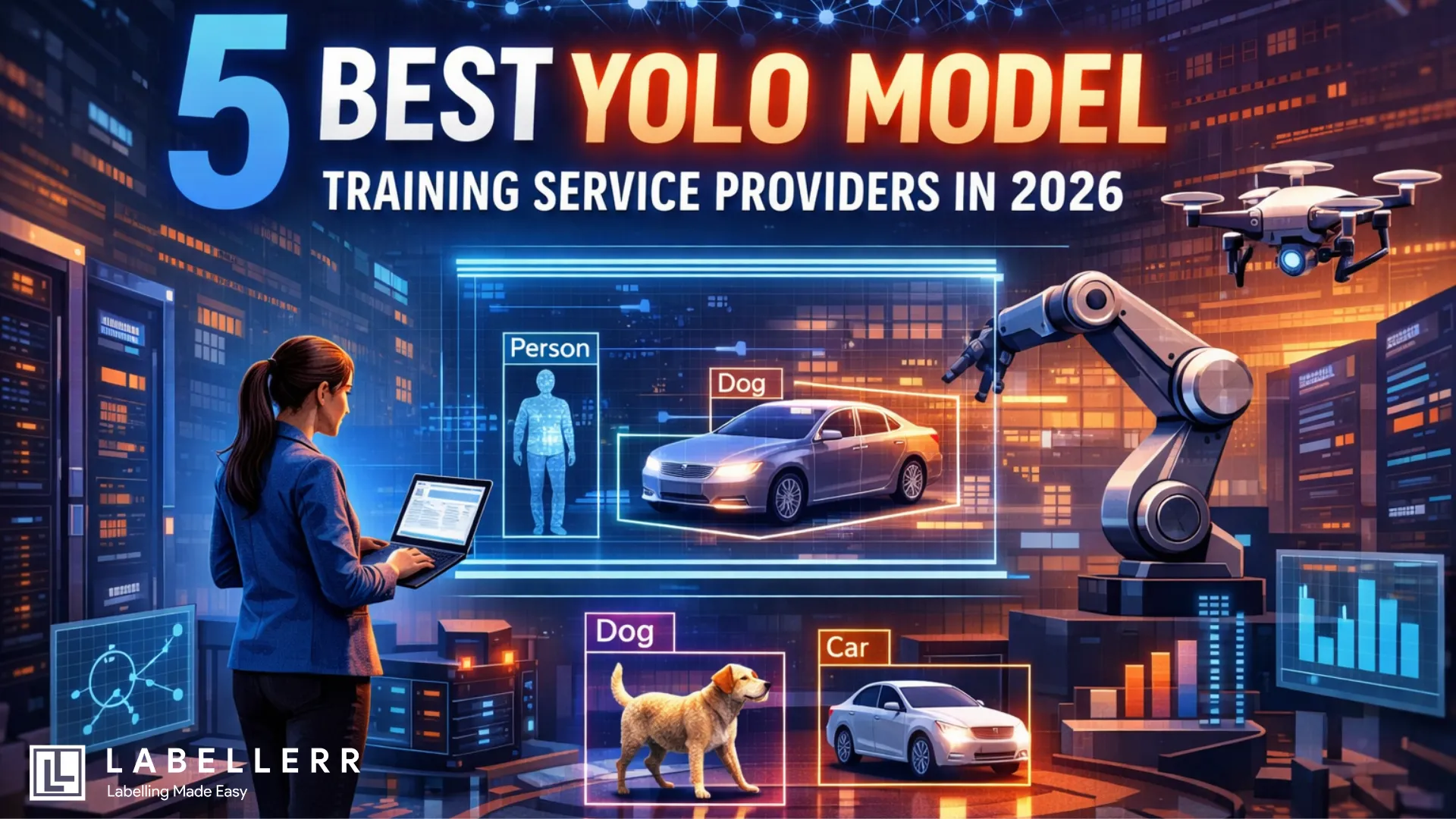
Training a YOLO model is not just about picking the right architecture. It is about the full pipeline, annotation quality, data cleanliness, and how directly your dataset flows into training. A broken step anywhere means a weaker model.
In 2026, five platforms lead the space. Here is an honest breakdown of what each one delivers for YOLO model training.
Quick Comparison Table
| Labellerr | Ultralytics | Roboflow | Encord | Scale AI | |
|---|---|---|---|---|---|
| AI Annotation | SAM, SAM 3, pre-labeling, active learning | SAM 2.1, SAM 3 | SAM 3, Label Assist, Instant | SAM 2, SAM 3, GPT-4o, Gemini Pro | Human-in-the-loop + AI |
| Active Learning | Built-in | No | No | Encord Active | No |
| Export Formats | YOLO, COCO, Pascal VOC | 17+ formats | 40+ formats | YOLO, COCO, custom | Scale JSON to YOLO |
| Dataset Versioning | Yes | Yes | Yes | Yes | No |
| Free Plan | Yes | Yes | Yes | No | No |
| Best For | Full annotation-to-training pipeline | Native YOLO cloud training | Fast CV prototyping | Enterprise video annotation | Managed enterprise labeling |
1. Labellerr : Best End-to-End YOLO Training Pipeline
Labellerr is a training data platform built for computer vision teams. It covers the full YOLO training lifecycle, annotation, active learning, quality control, and cloud export in one connected workflow.
The platform's active learning engine ranks samples by model uncertainty and routes only the hardest edge cases to human reviewers. This means cleaner data going into YOLO training without inflating annotation cost. Teams have reported 99.5% label accuracy on production projects.
- SAM-powered video propagation: label one frame, the tracker annotates the full video automatically
- Built-in active learning: surfaces low-confidence samples to maximize YOLO training data quality
- Automated QA: model-based and ground truth-based checks catch label errors before training
- Python SDK: full MLOps pipeline automation for engineering teams
Best for: CV teams that need annotation, active learning, QA, and cloud training exports in one pipeline.
2. Ultralytics: Best for Native YOLO Cloud Training
Ultralytics built YOLO. They created YOLOv5, YOLOv8, YOLO11, and YOLO26 - the latest release with NMS-free architecture and up to 43% faster CPU inference. Their platform unifies annotation, cloud training, and deployment for teams working natively within the YOLO family.
The cloud training layer is the standout. One-click training across 22 GPU configurations, live metrics streaming, and automatic checkpoint saving. Engineers get a YAML editor with 40+ training parameters. Teams that want speed get a no-code interface that works out of the box.
- 22 cloud GPU configurations: RTX 2000 Ada to NVIDIA B200 with live metrics and checkpoint saving
- Full YOLO family support: YOLOv5, v8, YOLO11, YOLO26 across detection, segmentation, classification, pose, and OBB
- 40+ configurable training parameters: YAML editor for fine-grained control plus a no-code interface
- 17+ export formats: ONNX, TensorRT, CoreML, TFLite for edge deployment on Jetson, Raspberry Pi, and mobile
- 43-region global deployment: autoscaling endpoints with real-time inference monitoring post-training
Best for: ML engineers who want native YOLO cloud training with full model family control, from the team that builds YOLO.
3. Roboflow: Best for Fast YOLO Prototyping
Roboflow is built for speed. It takes you from raw images to a trained YOLO model annotation, training, and inference inside one platform with no infrastructure setup. Over one million developers build on it for exactly that reason.
The data preparation tools are what make it strong for YOLO training. Roboflow Instant auto-labels datasets using SAM and CLIP with zero manual input. Dataset versioning with built-in augmentation means every training run starts from a clean, reproducible snapshot.
- Roboflow Instant: zero-shot auto-labeling using SAM and CLIP, no manual annotation needed before YOLO training
- Dataset health check: catches class imbalance and annotation errors that would degrade YOLO model performance
- 40+ format support: import and export any annotation format including all YOLO variants and COCO
- Roboflow Universe: 50,000+ public models usable as label assistants or YOLO training checkpoints
- Roboflow Inference: deploy trained YOLO models on CPU or GPU via Python SDK, REST API, or Workflows
Best for: Researchers, developers, and startups who want a fast, complete YOLO training workflow without deep MLOps overhead.
4. Encord: Best for YOLO Training on Video Data
Encord is built for enterprise teams training YOLO models on video-heavy datasets. Autonomous vehicles, physical AI, robotics, and healthcare imaging all require frame-level accuracy and temporal consistency and Encord's native video stack is the deepest on this list.
The platform integrates SAM2, GPT-4o, and Gemini Pro directly into annotation workflows for automated pre-labeling at scale. Encord Active then identifies mislabeled data and surfaces edge cases to improve YOLO training outcomes without simply adding more data.
- Native video annotation: keyframe interpolation, object tracking, and frame analysis without downsampling, preserving temporal context for YOLO training
- SAM2, GPT-4o, and Gemini Pro pre-labeling: SOTA models automate annotation workflows at enterprise scale
- Encord Active: identifies mislabeled data and prioritizes high-value samples to improve YOLO model performance
- 500,000+ images and 200,000+ frame video support: built for large-scale physical AI and autonomous vehicle YOLO datasets
- SOC2 Type II, HIPAA, and GDPR compliant: audit trails and consensus QA workflows for regulated industries
Best for: Enterprise teams training YOLO models on large-scale video datasets in autonomous vehicles, robotics, or healthcare.
5. Scale AI: Best for High-Volume Managed YOLO Labeling
Scale AI is one of the largest data labeling companies in the world. Founded in 2016, its clients include Google, Microsoft, Meta, OpenAI, and General Motors. In June 2025, Meta acquired a 49% non-voting stake for $14.8 billion. For teams that need a managed labeling workforce rather than a self-serve tool, Scale AI is the most established option.
Scale AI does not train YOLO models. Its role is to produce high-quality labeled datasets you feed into your own training pipeline. Scale Rapid handles this with its annotator workforce. Scale Studio lets your own team annotate inside their environment with monitoring and QA tools on top.
- Scale Rapid: upload data and instructions, Scale's workforce handles annotation with human-in-the-loop QA
- Scale Studio: bring-your-own-annotator platform with task management and quality monitoring
- Broad modality support: images, video, text, maps, 3D point clouds, and audio exportable for YOLO training
- Scale Evaluation: launched April 2025, benchmarks trained YOLO model performance and flags data gaps
- Government and defense grade: active DoD contracts and partnerships with major governments for regulated AI programs
Best for: Large enterprises needing high-volume managed labeling with a vetted workforce and existing YOLO training infrastructure.
Conclusion
Ultralytics wins for native YOLO cloud training. Roboflow wins for speed to prototype. Encord handles enterprise video annotation. Scale AI manages labeled data volume at scale.
Labellerr is the strongest end-to-end YOLO training pipeline. It is the only platform that combines SAM-powered auto-labeling, built-in active learning, automated QA, and direct cloud training exports in one connected workflow. If clean data and a pipeline that actually connects to training matter, Labellerr is the clearest choice.
Build Better YOLO Models with Labellerr
Stop managing annotation tools, QA scripts, and export pipelines separately. Labellerr connects every step of your YOLO training workflow in one place.
Start free or book a demo - labellerr.com
FAQs
Q1. What is the most important step in YOLO model training?
Data annotation quality is the most critical step, as inaccurate labels directly reduce model performance and reliability.
Q2. How can I reduce overfitting in YOLO models?
Use data augmentation, increase dataset diversity, and apply regularization techniques during training to improve generalization.
Q3. What type of data works best for YOLO object detection?
High-resolution, well-balanced datasets with clear object boundaries and consistent annotations work best for accurate detection.

Simplify Your Data Annotation Workflow With Proven Strategies
.png)