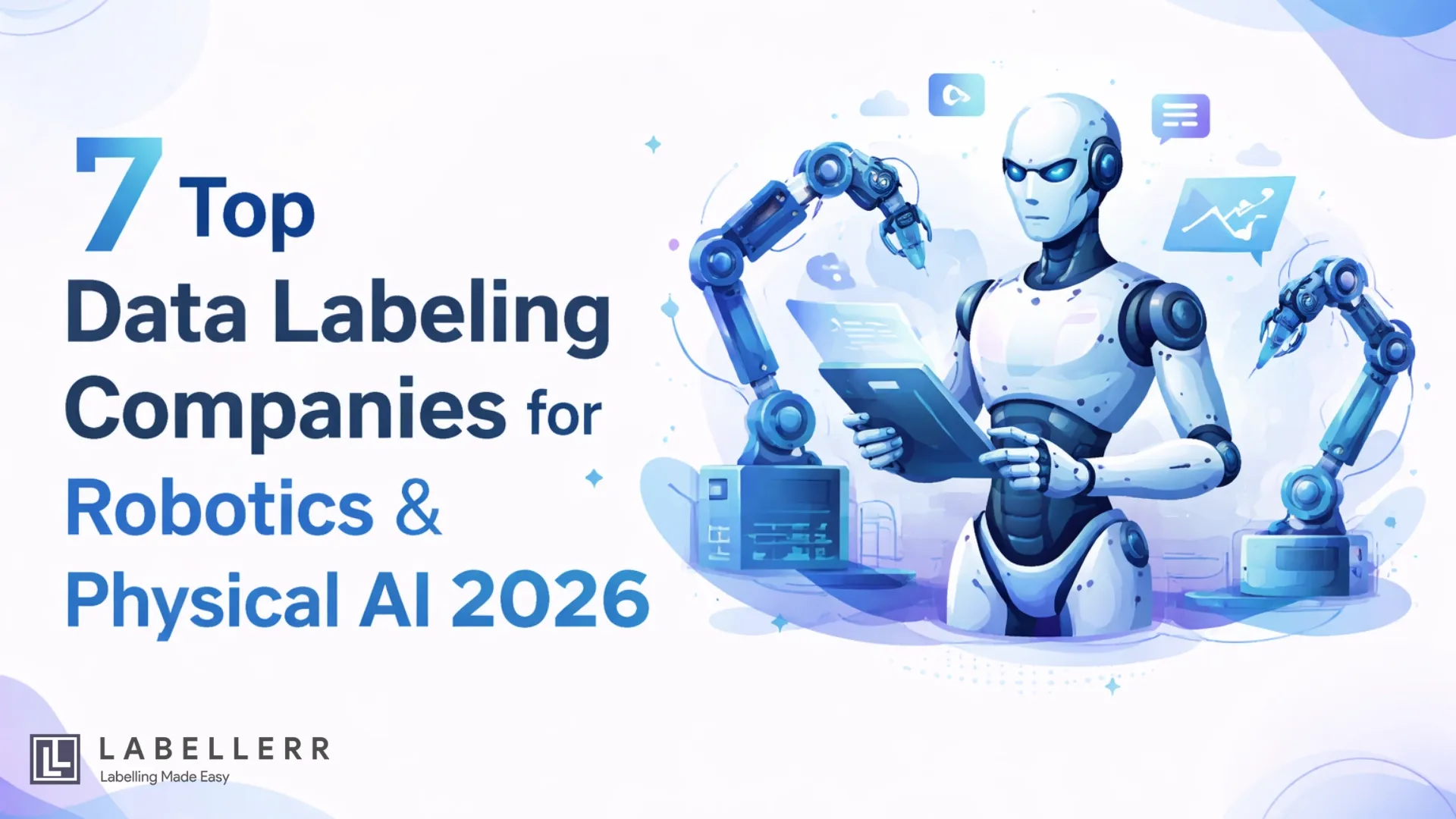
7 Top Data Labeling Companies in Robotics & Physical AI 2026
Discover the top data annotation companies for robotics and physical AI in 2026. Compare platforms for egocentric video, LiDAR, and multimodal datasets that help robots learn faster with high-quality training data.

Robots are no longer just a concept - they're here. Humanoids are moving into warehouses. Autonomous systems are running on factory floors every day. But behind every robot that works in the real world, there is one thing most people overlook-clean, accurate training data.
Every robot learns from labeled data. When that data is bad, the model breaks. When it is clean and accurate, you get a system that performs. That is why picking the right annotation partner is one of the most critical choices in your program.
The demand for robotics training data is growing fast. The wrong partner costs you time, accuracy, and your edge. This guide covers the top data annotation companies for robotics and physical AI in 2026.
Comparison Table
| Platform | Best For | Key Strength |
|---|---|---|
| Labellerr | Humanoid & embodied AI | Full-stack + Smart Feedback Loop |
| Scale AI | Large enterprise programs | Physical AI data engine |
| Encord | Unified data lifecycle | Active learning flywheel |
| Appen | High-volume & compliance | 1M+ contributor network |
| Build AI | Industrial egocentric data | Egocentric-100K dataset |
| Luel | Fast, compliant egocentric data | Consent-first + Ego4D base |
| Alegion | 3D spatial & AV programs | Expert LiDAR annotation |
1. Labellerr

Labellerr is a full-stack annotation platform built for robotics and physical AI teams. It is not a generic labeling tool it was designed for egocentric video, humanoid training, and the workflows that physical AI programs actually need.
The platform combines AI-powered auto-labeling with a Smart Feedback Loop that keeps label quality high as your project grows. It works with AWS, GCP, and Azure and offers on-premise options for teams with strict security requirements.
Key Features:
1. Egocentric Video Annotation: Labellerr labels first-person, head-mounted, and wearable POV video, the core data format for humanoid and embodied AI training. Multi-sensor streams are synced for richer, context-aware datasets.
2. Smart Feedback Loop: Catches errors early and keeps labels consistent throughout your project. This stops bad data from reaching your model and compounding downstream.
3. Auto-Labeling Automation: AI tools automatically label up to 80% of your data. Your team stays focused on edge cases and high-impact samples instead of routine frames.
4. Enterprise MLOps Integration: Delivers ML-ready data through 1,000+ domain experts across robotics, warehouse management, and autonomous systems. Cloud and on-premise options are both available.
2. Scale AI

Scale AI is one of the most recognized names in AI training data. It has built pipelines for autonomous trucks, agricultural robots, and industrial pick-and-place systems.
It launched a dedicated data engine for humanoid robots and autonomous systems. It is built for large enterprise programs, so smaller teams may find it expensive and slow to onboard.
Key Features:
1. Physical AI Data Engine: Built on over 100,000 production hours at its San Francisco lab. It uses real robot interaction data not synthetic simulations.
2. Multimodal Annotation at Scale: Covers video, LiDAR, sensor data, and 3D point clouds in one pipeline. Processes over 1.2 billion annotations every year across automotive, defense, and industrial sectors.
3. Human + AI Hybrid Workflow: Combines a global annotation workforce with AI automation. Supports both managed and self-serve programs depending on your team's needs.
3. Encord

Encord covers the full data lifecycle - curation, annotation, and evaluation inside one platform. It is built for teams that are tired of juggling multiple tools just to get data from raw capture to model-ready output.
The platform handles LiDAR, 3D point clouds, multi-camera setups, and synced video streams. Active learning and quality tools are built directly into the workflow. Pickle Robot improved grasping precision by 15% after using Encord for its manipulation training data.
Key Features:
1. AI-Native Multimodal Annotation: Handles LiDAR, radar, 3D point clouds, and synced video natively. Supports over 5 million labels and 200,000+ video frames per project.
2. Active Learning Data Flywheel: Finds the most impactful samples for human review and improves label quality over time. Quality goes up without costs rising at the same rate.
3. Unified Data Layer: Combines curation, annotation, and evaluation in one workflow. No tool switching and no manual handoffs slowing your pipeline down.
4. Appen

Appen has been in the training data business for nearly three decades. It has supported robotics programs for Tesla and ABB and contributed to key datasets like Ego4D for egocentric robotics perception.
It runs one of the largest contributor networks in the world. For enterprise teams with large budgets and complex compliance needs, Appen is a proven partner. Smaller teams may find the onboarding heavy and the pricing built for bigger programs.
Key Features:
1. Global Contributor Network: Over 1 million contributors across 170+ countries. Provides geographic and demographic diversity that makes robotics datasets more robust and generalizable.
2. Multimodal Annotation Support: Covers text, image, audio, and video in one workflow. Includes gesture recognition and video captioning for robotics and autonomy use cases.
3. End-to-End Data Solutions: Manages the full pipeline from collection through annotation, validation, and model evaluation. Reduces the number of vendors your team needs to manage.
4. Enterprise Compliance & Security: Built for strict data privacy standards including PII and PHI handling. A strong fit for regulated industries and defense-adjacent robotics programs.
5. Build AI

Build AI focuses on one specific problem the need for massive video datasets for industrial robots and embodied AI. It is newer than most platforms here but fills a gap that general-purpose tools rarely address.
Its flagship product is Egocentric-100K. It delivers over 100,000 hours of first-person video for manipulation and physical task learning. Every dataset comes with full provenance tracking so teams always know where their data came from.
Key Features:
1. Egocentric-100K Dataset: Over 100,000 hours of first-person video built for manipulation and embodied AI training. One of the largest egocentric collections built specifically for robotics programs.
2. Provenance-Tracked Data: Every dataset includes full chain-of-custody records. This is critical for teams facing regulatory scrutiny as their programs scale into production.
3. Sim-to-Real Transfer Focus: Datasets are built to help models trained in simulation work in physical environments. This reduces the performance gap that breaks many robotics programs at deployment.
4. Industrial Task Specialization: Data reflects real factory environments and manipulation tasks not generic web footage repurposed for robot training.
6. Luel

Luel is a purpose-built data provider for egocentric video and multimodal datasets. It focuses on two things above all else speed and compliance. Both are non-negotiable for robotics teams operating under US and EU data regulations.
Its datasets draw from the Ego4D framework and cover thousands of hours of first-person video. Custom capture projects move fast and every dataset is collected with explicit contributor consent from the start.
Key Features:
1. Ego4D-Based First-Person Datasets: Covers 3,670+ hours of first-person video built on one of the most trusted egocentric frameworks in robotics research.
2. Consent-First Data Collection: Every dataset is collected with explicit contributor consent. Keeps teams fully compliant with data privacy laws in the US and EU.
3. Fast Custom Capture Turnaround: Custom collection projects move faster than standard enterprise pipelines. Built for teams that cannot wait months for their training data.
4. LMM Robot Alignment: Data structures match how large multimodal model robots are actually trained not repurposed from general computer vision datasets.
7. Alegion

Alegion specializes in 3D spatial data annotation for robotics and AV programs. Its annotators are trained for technical labeling work not drawn from a general crowdsource pool where consistency is harder to control.
It is a specialist platform and that focus shows in the output quality for LiDAR and dense sensor data. For teams with high-density spatial datasets and tight accuracy requirements, Alegion is a reliable choice.
Key Features:
1. LiDAR & 3D Point Cloud Annotation: Handles dense spatial data with the precision that drone and robotic arm perception systems depend on.
2. Multi-Frame Object Tracking: Tracks objects across dynamic scenes. Built for robots working in environments where people and objects move constantly.
3. Expert Technical Workforce: Annotators are trained for complex technical labeling tasks not sourced from a general crowdsource pool where quality is harder to enforce.
4. Spatial Data QA Pipeline: Quality checks are built specifically for 3D and sensor data not adapted from standard image or video workflows.
How to Pick the Right Annotation Partner
Not every platform fits every team. Here is what to think through before you decide.
Start with your data type: If you work with egocentric video, pick a platform native to it. If your primary data is LiDAR or 3D point clouds, go with a specialist.
Be honest about your scale: Some platforms are built for research pilots. Others handle production pipelines with millions of samples. Know where you are and where you are going.
Speed compounds: Slow annotation slows your whole development loop. Platforms with AI-assisted labeling will always outpace manual-first approaches as your dataset grows.
Integration is non-negotiable: Your annotation platform needs to fit your existing ML stack not force you to rebuild around it.
Start Building Better Robot Training Data
Labellerr is built for where physical AI is heading. From egocentric video to humanoid training pipelines, it brings AI-powered automation, domain expert annotators, and enterprise MLOps integration into one platform.
You do not need five separate tools to go from raw data to model-ready output. Labellerr handles the full pipeline end to end with the accuracy and speed that competitive robotics programs need.
Ready to see it in action? Book a free demo with Labellerr and see how fast your pipeline can move.
Q1. Why is data annotation important for robotics and physical AI?
Data annotation provides the labeled datasets robots use to learn perception, navigation, and interaction tasks. High-quality labels help models understand objects, environments, and human actions, which improves real-world robot performance.
Q2. What types of data are commonly annotated for robotics training?
Robotics systems typically require annotation for egocentric video, LiDAR point clouds, sensor data, multi-camera video streams, and 3D spatial data used for navigation, object detection, and manipulation tasks.
Q3. How do companies choose the right robotics data annotation platform?
Teams should evaluate platforms based on supported data types, automation capabilities, integration with ML pipelines, annotation quality controls, scalability, and compliance with security or privacy requirements.

Simplify Your Data Annotation Workflow With Proven Strategies
.png)