
6 Top Human-in-the-Loop Data Services for Robotics 2026
Human-in-the-loop data services help robotics teams train smarter AI by combining automation with human expertise. Discover the top HITL platforms used to label LiDAR, video, and sensor data for warehouse robots, autonomous systems, and humanoid robotics.

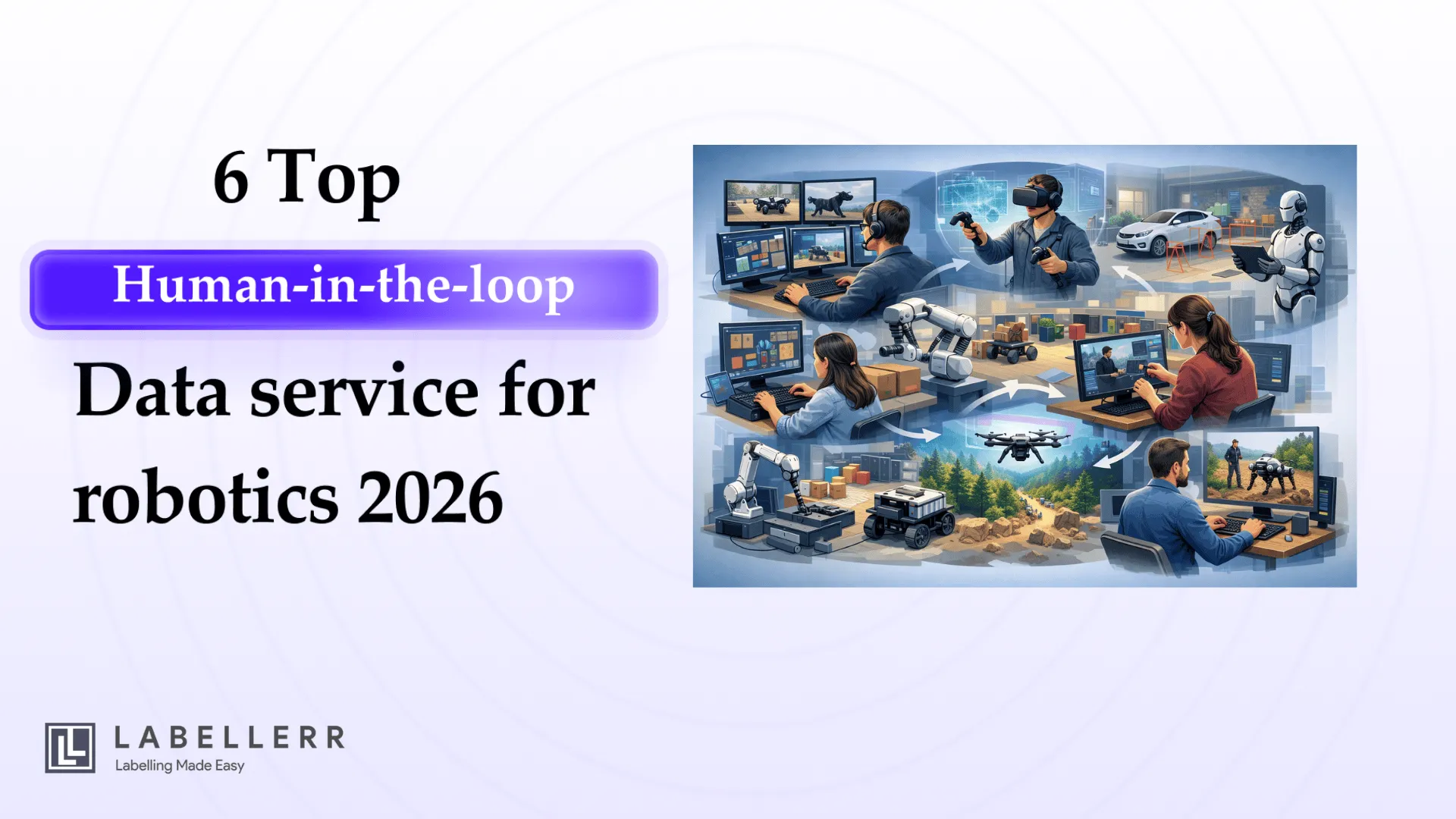
Robots are moving out of labs. They work in warehouses. They work in factories. They work in hospitals. But every robot that works well has one thing behind it clean, accurate training data. And behind that data is a human.
That is what human-in-the-loop (HITL) data services do. They keep humans in the training loop. The AI labels what it knows. A human fixes what it does not. The robot learns faster and makes fewer mistakes.
What Is Human-in-the-Loop Data Labeling for Robotics?
HITL means a human stays in the training process. The model does not learn alone. It flags hard cases. A human steps in and labels them. The model improves.
For robotics, this matters more than in most fields. Robots work in the real world. A wrong label can make a robot arm crash. It can make a drone veer off course. It can cause an autonomous system to fail at the worst moment.
The data types are complex: LiDAR point clouds, Synchronized video, Depth sensors, Force and torque inputs. Each one needs expert annotation to be useful. AI can pre-label. But a human must check the work.
Quick Comparison
| Company | Best For | Key Strength | HITL Approach |
|---|---|---|---|
| Labellerr | Startups & Enterprises | Speed + Automation | Active learning + Smart QA |
| Scale AI | Large Enterprise | Annotation at Scale | AI-assisted + global workforce |
| Encord | Physical AI Teams | Full-Stack Data Ops | Hybrid AI + human review |
| Sanctuary AI | Humanoid Robotics | Embodied AI Training | Robot-human teleoperation |
| Surge AI | RLHF and LLM Workloads | Expert Annotator Quality | Domain expert workforce |
| Labelbox | Enterprise ML Teams | End-to-End Data Engine | Model-assisted labeling |
The Top 6 HITL Data Services for Robotics Learning
1. Labellerr - Fast, Automated, and Built for Physical AI

Labellerr is a full-stack annotation platform built for robotics and physical AI teams. It combines AI-powered auto-labeling with a Smart Feedback Loop. Label quality stays remains as your project scales.
For robotics teams, Labellerr handles LiDAR, camera, and sensor data. It supports autonomous driving, warehouse robots, and humanoid training workflows. It is recognized as a G2 High Performer in data labeling software.
Key Features:
- 90% reduction in time to data preparation with AI-powered auto-labeling
- Smart QA system catches label errors before they reach model training
- 1,000+ domain experts across robotics, warehouse, and autonomous systems
- Direct integration with AWS, GCP, and Azure ML pipelines
- Supports COCO, Pascal VOC, JSON, and CSV export formats
2. Scale AI - Enterprise Annotation Infrastructure

Scale AI has been in data labeling since 2016. It built annotation infrastructure for autonomous vehicles, robotics, and generative AI.
Scale AI runs a dedicated Physical AI Data Engine. It uses real robot interaction data from its San Francisco lab not simulations. Scale AI also runs Remote tasks and Outlier to source annotators for vision and LLM tasks.
Key Features:
- LiDAR annotation, cuboid annotation, and 3D map labeling for robotics datasets
- Physical AI Data Engine built on real robot interaction data
- Scale Rapid for self-serve teams and Scale Studio for enterprise workflows
- Active learning tools that surface rare and hard training scenarios
- AI-assisted pre-labeling to reduce repetitive human annotation work
3. Encord - Full-Stack Platform for Physical AI

Encord is built for the full complexity of physical AI. It handles 2D, 3D, LiDAR, video, and medical imaging in one platform. It offers automation, compliance tooling, and workflow control for large robotics teams.
Encord is API-first. Your data stays in your own cloud. There is no migration required. Teams connect their pipeline and start labeling without changing their infrastructure.
Key Features:
- Native support for LiDAR, radar, 3D point clouds, RGB, depth, and force inputs
- Hybrid HITL workflows : AI pre-labels, humans review uncertain cases
- Data Agents automate annotation and QA through SDK integration
- Active learning pipelines prioritize uncertain samples for human review
- Supports visual-language alignment for multimodal foundation models
- Zero data migration and your data stays in your cloud
4. Sanctuary AI - HITL Built Inside the Robot

Sanctuary AI does something different. It does not label data after collection. It builds HITL directly into how its Phoenix robots learn. The Carbon AI control system captures human behavioral data during live task demonstrations. Every human motion becomes a training signal.
In 2026, Phoenix Gen 8 is optimized for high-fidelity data capture. It has improved cameras, telemetry, and haptic feedback for fine-grained motion data.
Key Features:
- Carbon AI system captures human behavioral data during teleoperated tasks in real time
- 21-degree-of-freedom hydraulic hands for detailed physical task annotation
- Sim-to-real transfer using reinforcement learning for dexterous manipulation
- Human-in-the-loop resolves edge cases during live robot operation not after
- Deployed in automotive manufacturing through a partnership with Magna International
- Phoenix Gen 8 built specifically for training data capture at scale
5. Surge AI - Expert-Grade RLHF and Language Data

Surge AI is built on quality. It uses expert annotators not crowdsourced labor. Surge AI is the strongest choice for RLHF workflows, preference labeling, and robotics tasks that need language and code understanding.
It matches tasks to annotators by domain like engineers, PhDs, native speakers, and subject experts.
Key Features:
- Largest RLHF platform - supports preference labeling, red teaming, and SFT data
- Expert annotator matching by domain expertise, not random assignment
- Real-time dashboards with accuracy scores and inter-annotator agreement metrics
- Supports labeling in over 30 languages for global robotics projects
- Python SDK and API for direct pipeline integration
6. Labelbox - Enterprise Data Engine with Deep ML Integration

Labelbox is built for enterprise ML teams. It gives teams full control over their data pipeline. It combines labeling tools, workflow management, and a managed annotation workforce in one place.
For robotics, Labelbox handles 3D point clouds, video, geospatial data, and sensor fusion. Labelbox Boost connects teams with domain expert labelers when internal capacity is not enough.
Key Features:
- Model-assisted labeling with HITL refinement and continuous feedback loops
- Native support for 3D point clouds, video, geospatial, and sensor fusion data
- Benchmark and Consensus tools for maintaining label accuracy at scale
- Deep integration with AWS SageMaker, GCP Vertex AI, and Azure ML
- Labelbox Boost for access to expert labelers on complex robotics datasets
- Dataset catalog for curation across classification, detection, and multi-modal tasks
- Labels refined based on model errors and downstream performance metrics
How to Choose the Right HITL Service
The right platform depends on three things - your data type, your team size, and your training stage.
Start with your data : If you work with LiDAR, 3D point clouds, or sensor fusion, look for a platform built for multimodal annotation. Not every tool handles these formats well.
Think about your robot type : If you are training a humanoid, you need a service that captures human motion data during real task demonstrations. Static labeling tools are not enough.
Consider your annotation needs : If your work involves language grounding, RLHF, or preference labeling, you need expert annotators not a crowdsourced workforce.
Look at your pipeline size : Large enterprise teams need platforms that scale to millions of labels without breaking. Smaller teams need flexibility and fast turnaround.
Think about cost and speed : Some platforms are built for big budgets and long timelines. Others are built to move fast without sacrificing quality. Know which one your team actually needs.
The best platform is the one that fits where you are right now and grows with you as your data needs change.
Conclusion
Most robotics teams cannot wait weeks for labeled data. They need fast iteration, accurate labels, and a pipeline that connects directly to model training.
Labellerr gives you all three. Auto-labeling cuts manual work by up to 90%. Smart QA catches errors before they reach training. And direct cloud integrations mean your data flows straight into AWS, GCP, or Azure no extra steps.
Whether you are building a warehouse robot, a surgical assistant, or a humanoid for manufacturing - Labellerr gives your team the data foundation to move faster.
Try Labellerr free or book a demo
FAQs
Q1. Why is human-in-the-loop important for robotics training data?
Human-in-the-loop ensures AI models learn from accurate annotations and corrections. Humans review difficult cases, fix labeling errors, and improve the quality of datasets used to train robots.
Q2. What types of data need HITL annotation in robotics?
Robotics datasets often include LiDAR point clouds, video streams, depth sensors, and force or torque data. These complex multimodal datasets require human validation to ensure accuracy.
Q3. How does HITL improve robot learning performance?
HITL improves model accuracy by correcting edge cases, validating AI-generated labels, and prioritizing difficult samples through active learning, helping robots learn faster with fewer mistakes.

Simplify Your Data Annotation Workflow With Proven Strategies
.png)