7 Top Synthetic Data Platforms for Robotics in 2026
Synthetic data is transforming robotics by enabling scalable, safe, and fully labeled training environments. Discover top platforms powering simulation-driven robot learning in 2026.

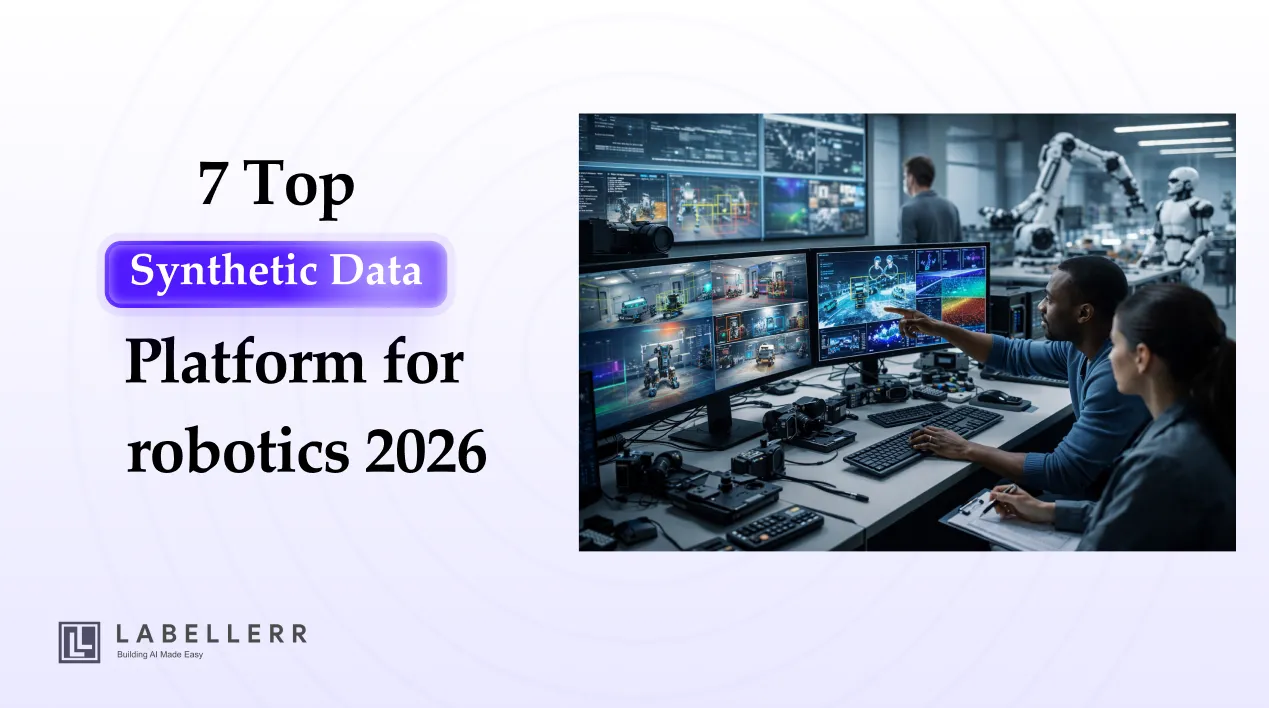
Training a robot takes data, but real-world data collection is slow. It is expensive. Some scenarios are too dangerous to capture at all. You cannot recreate every factory edge case. You cannot send a robot into a hazardous zone just to gather footage.
Real-world data collection cannot scale fast enough to meet the demand. Synthetic datasets have become a key part of robot training. They allow engineers to generate large amounts of data in simulation. This data is controlled, repeatable, and easy to label.
What Is Synthetic Data?
Synthetic data is artificially generated data created in simulation, not collected in the real world.
In robotics, it means generating images, LiDAR scans, depth maps, and sensor streams inside a virtual environment. Every variable is controlled by software. Labels are generated automatically - no cameras, no field crews, no manual annotation.
It fills the gaps real data cannot. Edge cases. Dangerous environments. Rare failures. Scenarios that take months to capture naturally. That is why robotics teams use it not as a shortcut, but as the only practical way to cover every condition a deployed robot will face.
Quick Comparison
| Provider | Best For | Key Strength | Sensors Supported |
|---|---|---|---|
| Labellerr | Synthetic + real data pipelines | Full pipeline control + AI automation | Video, LiDAR, RGB, multi-sensor |
| SyntheticAIdata | Computer vision at scale | Fast, privacy-safe dataset generation | RGB, multi-modal |
| SKY ENGINE AI | Industrial and warehouse robotics | Pixel-perfect annotations, Gartner recognized | RGB, IR, LiDAR, depth, hyperspectral |
| Anyverse | Automotive and perception AI | Proprietary physics render engine | RGB, NIR, LiDAR, radar, thermal |
| NVIDIA Isaac Sim | Full robotics simulation stacks | OpenUSD + Cosmos world foundation models | All major sensor types |
| DataMesh Robotics | Industrial embodied AI training | Executable Digital Twin with process logic | RGB, depth, segmentation, 3D bounding boxes |
| Rendered.ai | Specialized sensor modalities | Physics-first PaaS, NVIDIA Omniverse integration | Radar, SAR, thermal, hyperspectral, RGB |
1. Labellerr

Labellerr is a data platform built for robotics teams. It handles synthetic data generation, real-world data annotation, and quality control inside one pipeline. Teams use it to label LiDAR point clouds, RGB video, depth sensor streams, and multi-sensor data without jumping between tools.
The platform uses AI-powered auto-labeling to speed up annotation. A Smart Feedback Loop flags inconsistent labels before they reach training. Human reviewers stay in the loop for quality control. Everything exports in COCO, JSON, or custom schemas.
It runs on AWS, GCP, Azure, and supports on-premises deployment for teams with strict data policies.
Key Features:
- Blends synthetic and real-world data in one labeled pipeline
- AI-powered auto-labeling for image, video, LiDAR, and 3D point clouds
- Multi-sensor sync across RGB, depth, and LiDAR
- Smart Feedback Loop to catch label errors early
- Runs on AWS, GCP, Azure, or on-premises
- Exports in COCO, JSON, and custom ML schemas
2. SyntheticAIdata

Not every team needs a complex simulation stack. Some teams just need clean, diverse, labeled image data delivered quickly.
SyntheticAIdata is built for that. The platform generates large computer vision datasets with automatic labeling. No real-world collection. No privacy issues. It covers edge cases that field data miss and fits directly into existing ML pipelines.
Key Features:
- Large-scale synthetic dataset generation for computer vision
- Auto-annotation across bounding boxes, segmentation, and keypoints
- Privacy-safe, no real-world data is collected
- Covers rare events that real data cannot capture
- Integrates with standard ML pipelines
3. SKY ENGINE AI

SKY ENGINE AI's Synthetic Data Cloud gives robotics teams full control over their training environments. The platform renders complex scenes with multispectral ray tracing and outputs pixel-perfect annotations automatically with no manual labeling needed.
Its Omnihuman framework handles the edge cases that matter most. Low light. Partial occlusion. Rare object positions. Sensor interference. These are the scenarios that break deployed models. SKY ENGINE AI lets teams generate them at will.
For robotics specifically, teams deploy virtual robots and drones inside synthetic environments. They train and test on navigation, item localization, and inventory management all before a single physical robot is involved. This cuts hardware testing time and catches model failures early.
Key Features:
- Physics-based rendering with multispectral ray tracing
- Pixel-perfect 2D and 3D bounding boxes, depth maps, and semantic segmentation
- Supports RGB, infrared, LiDAR, hyperspectral, and X-ray sensors
- Native PyTorch and TensorFlow integration
- Scene presets for robotics, manufacturing, automotive, and defense
4. Anyverse

Anyverse brings over 25 years of physics-based simulation experience. It won a 2008 Academy Technical Achievement Award. When it claims physical accuracy, it has the track record to prove it.
Most platforms build synthetic environments on Unity or Unreal Engine. Anyverse does not. Its own render engine simulates how light actually behaves, how it bounces, scatters, and absorbs. The sensor data it produces behaves like real sensor data. That matters when you are training a perception model for real-world deployment.
Key Features:
- Proprietary physics rendering engine, not Unity or Unreal
- Supports RGB-IR, near-infrared, LiDAR, radar, and thermal sensors
- Domain randomization for balanced dataset distributions
- Automated ground truth aligned to custom labeling specs
- Cloud-native for production-scale scene generation
5. NVIDIA Isaac Sim

NVIDIA Isaac Sim is an open-source framework built on NVIDIA Omniverse. It lets teams simulate and test AI-driven robots in physically accurate virtual environments.
It is more than a data tool. It is the infrastructure layer the robotics industry is converging on. The pipeline is straightforward: reconstruct a digital twin with NuRec, populate it with SimReady OpenUSD assets, generate data with MobilityGen, then add photorealistic variation through Cosmos Transfer models.
Key Features:
- OpenUSD scene composition with SimReady 3D assets
- GR00T-Mimic and GR00T-Dreams for manipulation and trajectory data
- New OmniSensor USD schema for accurate sensor simulation
- NVIDIA OSMO for scaling data generation pipelines
- Supports Boston Dynamics, Agility, Fanuc, Unitree, and more
- Fully open-source on GitHub
6. DataMesh Robotics

Most digital twin tools are static. They show you what a factory looks like. DataMesh goes further. Its Executable Industrial Digital Twin runs like a live environment: objects move, processes evolve, events trigger, logic executes.
Robots train inside conditions that mirror real industrial workflows, not a frozen 3D replica. This makes it purpose-built for sequential industrial tasks where order and context matter as much as object recognition.
Key Features:
- Executable Digital Twin: a live environment, not a static model
- Outputs RGB, depth, segmentation, 2D and 3D bounding boxes, object poses, and trajectories
- Configurable reward signals for reinforcement learning
- Integrates with NVIDIA Isaac Sim and Omniverse
- On-premises, private cloud, and hybrid deployment options
- Gartner-recognized in Intelligent Simulation
7. Rendered.ai

Rendered.ai fills a gap that most synthetic data vendors ignore.
The platform is a PaaS built on one rule: physics first. Every image follows the laws of physics; lighting, materials, sensor physics, and geometry are all simulated from first principles. That is not a tagline. It is why the platform exists.
Where it stands apart is sensor coverage. Radar, SAR, infrared, thermal, hyperspectral; modalities that RGB-focused platforms simply cannot simulate well. It holds a commercial NVIDIA Omniverse Replicator license and integrates NVIDIA OptiX for SAR simulation.
Key Features:
- Physics-first simulation with automatic labeling at generation time
- No-code, graph-based workflow for fast iteration
- Integrates with NVIDIA Omniverse Replicator and TAO Toolkit
- Covers radar, SAR, thermal, multispectral, hyperspectral, and X-ray
- On-platform model training, validation, and performance analysis
How to Pick the Right One
Every team's bottleneck is different.
Need specialized sensors like thermal, radar, or hyperspectral? Look for a platform with a proprietary physics rendering engine not one built on a game engine.
Building industrial robots that follow process logic and sequential workflows? Choose a platform with a live, executable environment, not a static 3D replica.
Want an open-source simulation stack with wide hardware support and a large community? Look for frameworks built on industry-standard scene description formats.
Need synthetic and real-world data in one pipeline labeled, quality-checked, and export-ready? Choose a platform that handles both data types end-to-end without manual handoffs.
Conclusion
Data quality has become the biggest bottleneck in robotics. Robots do not rely on handwritten rules to operate in real environments. They learn behavior through data-driven models, where every perception, decision, and motion is shaped by prior examples.
Labellerr handles synthetic data generation, real-world annotation, and AI-powered labeling all in one pipeline. No extra tools. No manual handoffs. Just clean, labeled, training-ready data.
Book a free demo with Labellerr and see how fast your robotics pipeline can move.
FAQs
Q1. Why is synthetic data important for robotics training?
Synthetic data allows robotics teams to generate large, labeled datasets quickly, covering rare, dangerous, and edge-case scenarios that are difficult or impossible to capture in real-world environments.
Q2. Can synthetic data replace real-world data completely?
No. Synthetic data complements real-world data. The best results come from combining both to improve model robustness and accuracy.
Q3. What types of sensors can synthetic data simulate?
Synthetic data platforms can simulate RGB cameras, LiDAR, depth sensors, radar, thermal, infrared, and hyperspectral sensors depending on the platform.

Simplify Your Data Annotation Workflow With Proven Strategies
.png)