End-to-End AI-Based Bottle Cap Quality Inspection System
Learn how to build an AI-powered bottle cap inspection system using computer vision. Detect missing caps in real time, reduce defects, and improve quality control on high-speed production lines.

Modern factories produce thousands of bottles every hour. Each bottle must have a properly placed cap before shipping. A single missing cap can cause leaks, contamination, and product loss. Manual inspection cannot keep up with this speed. It is slow and often inaccurate.
AI-based quality inspection solves this problem. It uses cameras and computer vision models to check every bottle in real time. The system works without breaks and gives consistent results. This makes it ideal for fast production lines.
In this blog, we explain how to build an AI-powered bottle cap inspection system. The system detects bottles and caps, checks cap presence, and marks products as pass or defect.
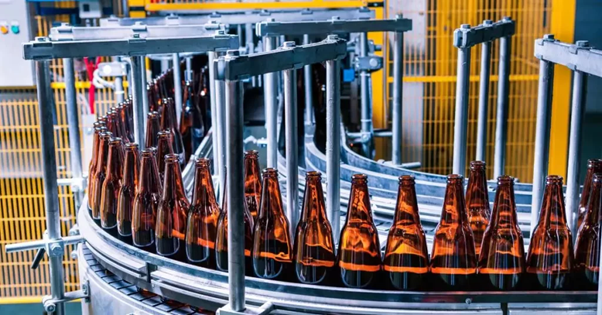
bottle manufacturing unit
What Is AI-Based Quality Inspection?
Quality inspection means checking products against defined standards. In bottling plants, this includes checking bottle shape, fill level, labels, and caps. A missing cap makes the product unsafe.
AI-based inspection uses cameras and trained models to automate this task. The system looks at images instead of relying on human judgment. It detects problems faster and more accurately.
These systems work continuously. They do not get tired. They apply the same rules to every product. This ensures stable quality across production.
Why Traditional Inspection Is Not Enough
Many factories still use manual inspection. Workers stand near conveyor belts and check bottles visually. This method depends on focus and experience. Over time, mistakes happen.
Human inspection slows down at high speeds. Poor lighting and repetitive work increase errors. Results also vary from one person to another.
Simple sensor-based systems also have limits. They fail when bottle designs change or lighting varies. They cannot adapt easily.
AI-based inspection overcomes these issues. It learns from data and adjusts to real-world conditions.
How the Bottle Cap Inspection System Works
The system uses a camera placed above a conveyor belt. The camera records a video of moving bottles. This video is sent to a computer vision model.
The model detects bottles and caps in each frame. Based on these detections, the system decides if a bottle has a cap.
A defined inspection line is used. When a bottle crosses this line, the cap status is checked. The bottle is marked as pass or defect.
This process runs automatically and continuously without manual intervention, allowing the system to inspect bottles in real time during production.
Vision based Quality Inspection in Action
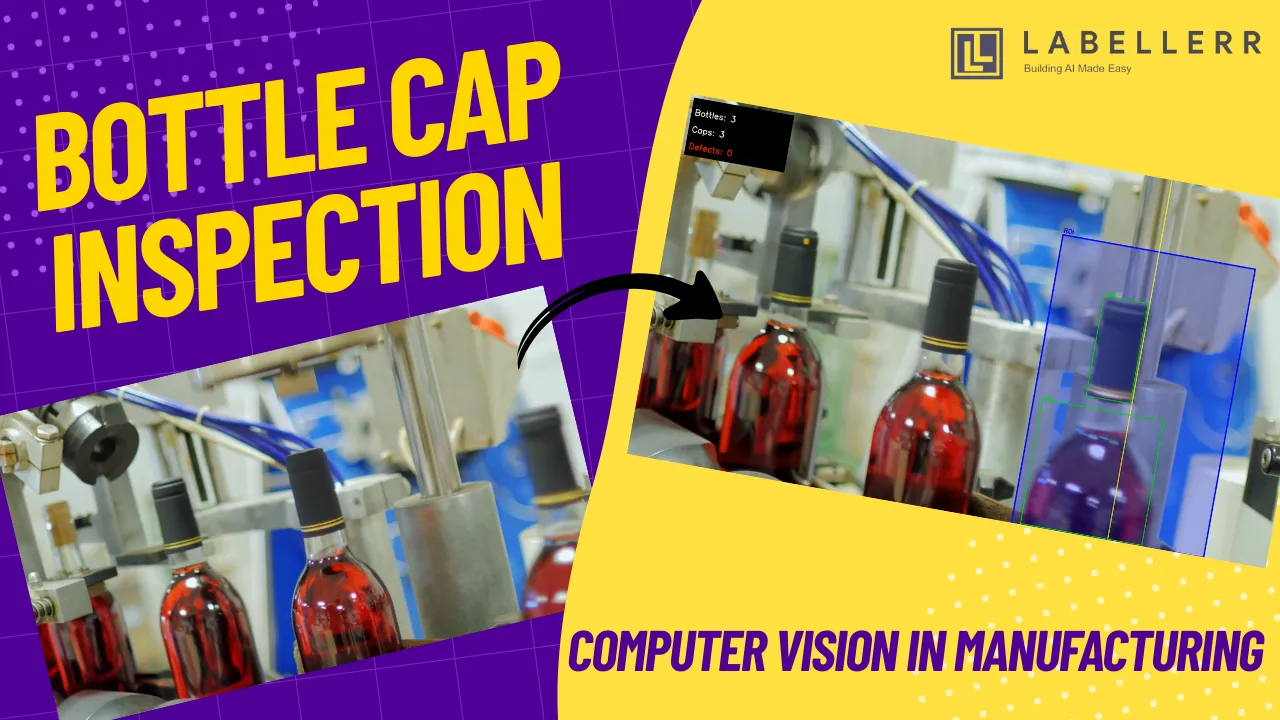
Lets see the how a raw footage of a assembly line, can be turned into AI powered Inspection line
Here after AI-powered Inspection is enabled.
Main Stages of the Inspection Pipeline
The system is built using three main stages:
- Data preparation and annotation
- Model training and validation
- Inspection logic and deployment
Each stage is important. A mistake in one stage affects the entire system.
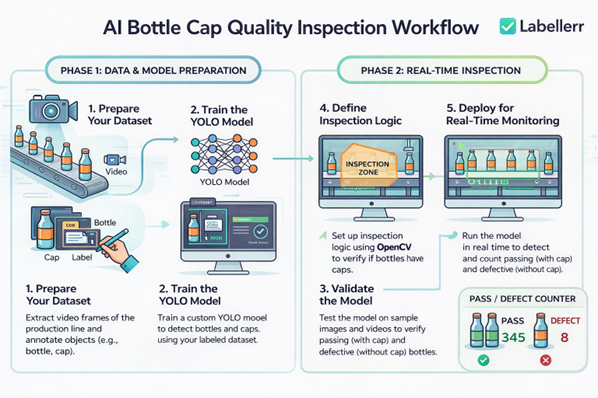
Inspection workflow
Stage 1: Data Preparation and Annotation
AI models need good and reliable data to perform well in real-world applications. In this project, the data comes from videos captured on a conveyor belt in a production environment.
The first step is frame extraction. Frames are taken from the video at regular intervals. These frames show bottles in different positions.
Next, the images are labeled. Bounding boxes are drawn around bottles and caps. Each object gets a class label.
Label quality matters a lot for model performance. Incorrect or inconsistent labels can confuse the model during training. Accurate and consistent labeling helps improve detection accuracy and reliability.
Once labeling is complete, the dataset is reviewed and finalized. The labeled dataset is then saved in the required format and prepared carefully for the model training process.
Stage 2: Model Training and Validation
After labeling, the dataset is used to train an object detection model. YOLO is a strong choice for this task because it is fast and performs well in real-time inspection systems.
The dataset is split into training, validation, and test sets. This split helps measure model performance and ensures fair evaluation.
During training, the model learns how bottles and caps appear in different conditions. It updates its internal weights over many training epochs.
After training, the model is tested on unseen images. Metrics such as precision and recall are checked to evaluate detection quality. These metrics show how well the model performs.
Once the results reach an acceptable level, the trained model is saved. It is then ready to be used for real-time inspection tasks.
Stage 3: Inspection Logic and Deployment
Detection alone is not enough for quality inspection. The system must also decide whether a bottle should be marked as pass or defect.
A region of interest is defined on the conveyor belt to limit inspection to the required area. Only bottles that enter this region are checked by the system.
An inspection line is placed within this region to trigger evaluation. When a bottle crosses this line, the system checks whether a cap is present.
If a cap is detected inside the bottle’s bounding area, the bottle is marked as a pass. If no cap is detected, the bottle is marked as a defect.
Counters track the total number of bottles, passed bottles, and defective bottles. This information helps monitor production quality and system performance.
Handling Real-World Conditions
Factories are not perfect environments for vision systems. Lighting conditions can change over time. Bottles may overlap as they move. Cameras can also shake due to vibrations.
Confidence thresholds help reduce false detections during inspection. Predictions with low confidence scores are ignored by the system.
Tracking methods are used to follow bottles across multiple video frames. This helps avoid double counting the same bottle.
With proper tuning and testing, the inspection system remains stable and reliable in real production conditions.
Conclusion
AI-based bottle cap inspection provides a fast and reliable solution for modern quality control. It replaces slow and error-prone manual checks with automated computer vision systems.
By combining high-quality data, a well-trained detection model, and clear inspection logic, manufacturers can inspect every product accurately in real time.
This system improves production efficiency, reduces defective output, and ensures consistent product quality. It represents a practical and effective step toward smarter manufacturing systems.
How does AI detect missing bottle caps in real time?
AI models analyze live camera footage to detect bottles and caps. When a bottle crosses an inspection line, the system checks cap presence and flags defects instantly.
What type of camera is required for bottle cap inspection?
A standard industrial RGB camera with stable mounting and good lighting is sufficient. High frame rates improve accuracy on fast conveyor belts.
Can this inspection system adapt to different bottle designs?
Yes. AI models can be retrained with new data, allowing the system to adapt to changes in bottle shape, size, or cap type.

Simplify Your Data Annotation Workflow With Proven Strategies
.png)