
Converting Sports Videos into 2D Tactical Maps with AI
Learn how to transform standard sports footage into a professional 2D tactical map. Using YOLO11 and Planar Homography, this project solves perspective distortion to provide real-time player tracking and spatial analytics for coaches and fans.
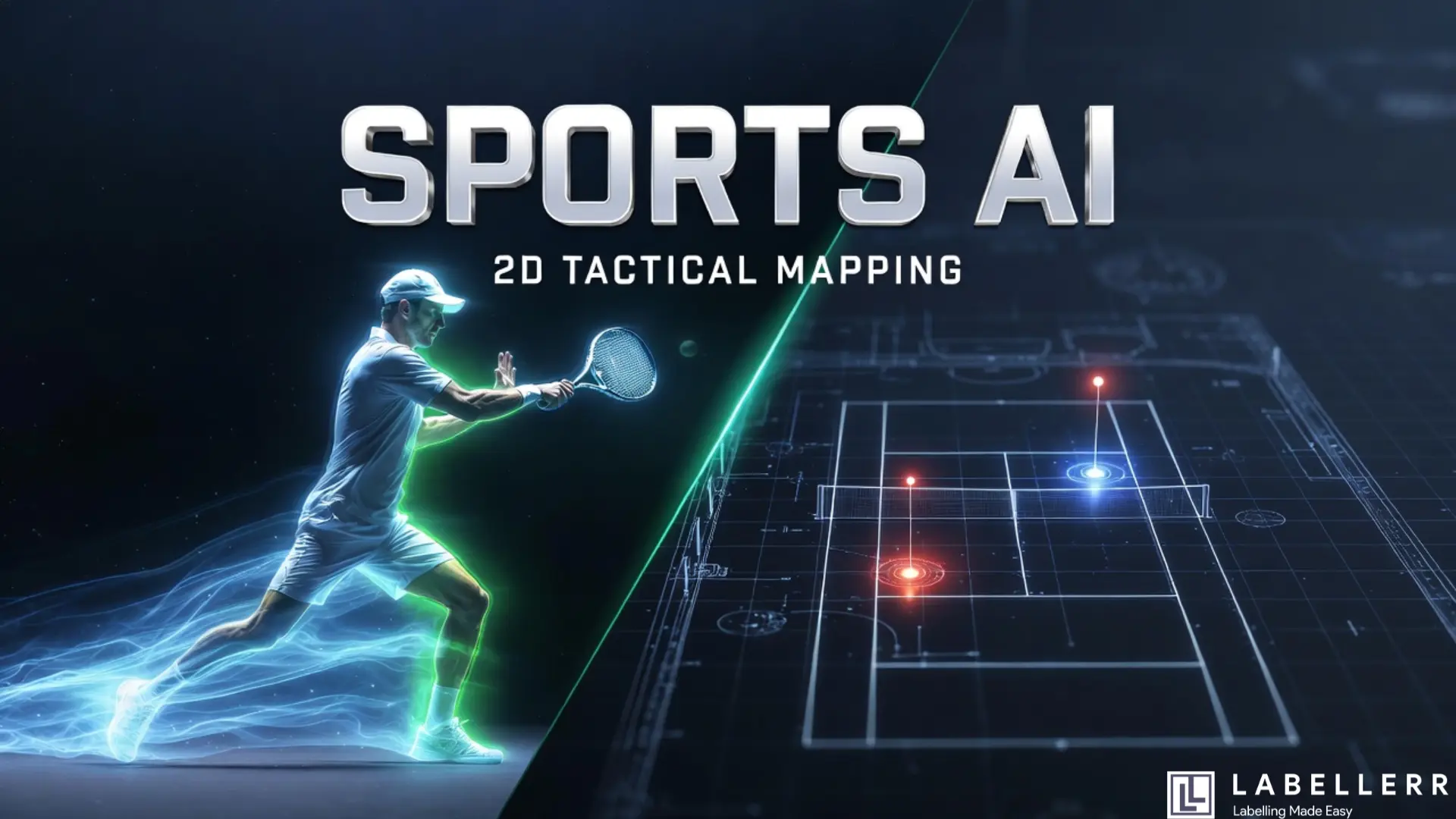
Modern sports broadcasting captures every high-speed moment, but it often struggles with perspective. A camera placed at a tilted angle makes it hard to judge exactly where a player is standing or how much court they are covering. Distant movements look smaller and slower than they actually are.
Tactical analysis requires a "true" view. Coaches and analysts need to see the game from a bird's-eye perspective to understand positioning and spacing. Doing this manually is slow and inaccurate.
It uses computer vision to "flatten" the game into a precise 2D tactical map. By using YOLO11 and mathematical mapping, it turns any standard video into a professional coaching tool.
In this blog, we explain how to build an AI-powered tactical mapping system. The system tracks players, projects their positions onto a miniature court, and smooths their movement for a realistic view.
What is 2D Tactical Mapping?
Tactical mapping means taking objects from a 3D camera view and placing them on a flat, 2D scale model. In tennis, this involves moving player positions from the tilted broadcast frame to a top-down diagram of the court.
This process removes "perspective distortion." It allows for a shared metric space where distances are consistent. Instead of guessing based on a camera angle, analysts can see the exact location of a player's feet relative to the lines.
AI-based mapping works continuously and accurately. It can handle fast rallies and sudden direction changes that human observers might miss.
Why Standard Video is Not Enough for Analysis
Standard sports cameras are designed for entertainment, not measurement. The "foreshortening" effect means that one meter near the camera looks much larger than one meter at the back of the court.
Manual tracking is too slow for real-time feedback. It takes hours to plot coordinates for a single match. Simple video overlays also fail because they do not account for the depth of the field.
This project overcomes these issues. It uses geometry to calculate real-world positions. This transforms a simple video into a data-rich tactical environment.
.webp)
2D Tactical Mapping
How the Tactical Mapping System Works
The system processes video through a specialized pipeline. It starts with a raw video feed and ends with a smooth, top-down tactical animation.
The system identifies players in every frame. These 2D pixel coordinates are then converted into "real-world" coordinates on a miniature court using a mathematical transform.
A smoothing logic is applied to the data. This ensures the player markers do not shake or jump, even if the camera feed has slight noise. The result is a clean, professional tactical map that mirrors the live action perfectly.
Main Stages of the Mapping Pipeline
The project is built using three main stages:
- Object Detection and Tracking
- Perspective Transformation (Homography)
- Data Smoothing and Visualization
.webp)
Project Workflow
Each stage is critical. A mistake in tracking leads to incorrect mapping on the 2D court.
Stage 1: Object Detection and Tracking
AI models need to identify players accurately before they can be mapped. We use YOLO11 for this task. It is the latest standard in object detection, offering high speed and precision.
The first step is identifying the players. The model draws bounding boxes or "masks" around them. For tactical mapping, the most important point is the player’s feet. This is the point where the player touches the court.
Next, the system assigns a unique ID to each player. This is "Object Tracking." It ensures that the system knows which dot on the 2D map belongs to which athlete throughout the entire rally.
Using high-resolution green outlines, the system follows every move. This provides the raw data needed for the next step.
Stage 2: Perspective Transformation (Homography)
Once we have the player's position in the video, we must move it to the 2D map. This is done using a technique called Homography.
Homography is a mathematical mapping between two planes. We define "source points" on the original video (the four corners of the tennis court) and "destination points" on a flat 2D grid.
The system calculates a transformation matrix. This matrix acts as a bridge. When a player moves in the video, the matrix calculates exactly where that movement corresponds on the flat miniature court.
This step effectively "un-distorts" the video. It places the players in a metric space where 10 pixels equals a specific distance in meters, regardless of where they are on the court.
Stage 3: Data Smoothing and Visualization
Raw AI detections can sometimes be "jittery." Small changes in lighting or player posture can cause the tracking point to bounce slightly. On a tactical map, this looks unprofessional.
We apply a smoothing algorithm to the coordinate data. This acts as a filter that removes sudden, unrealistic jumps while keeping the overall movement accurate.
The final stage is visualization. The system draws a miniature court on the screen and places colored dots (e.g., red and blue) to represent the players. Because of the smoothing, these dots glide across the map just like real athletes.
This creates a high-tech tactical tool. Coaches can now see court coverage and positioning in real-time.
Handling Real-World Challenges
Broadcast environments are complex. Players move quickly, cameras might zoom, and other objects can block the view.
Confidence thresholds are used to keep the map clean. If the AI is not sure about a detection, it ignores it rather than placing a wrong dot on the map. This prevents "ghost" players from appearing.
Tracking stability is also key. The system uses historical data to predict where a player should be if they are briefly hidden behind a net or another player.
With these optimizations, AI remains stable and reliable even during high-intensity matches.
Conclusion
This project provides a modern solution for sports tactical analysis. It replaces visual guesswork with precise 2D mapping and real-time tracking.
By combining YOLO11 detection with homography mapping, this project turns any sports video into a professional data source. It allows teams to visualize space and movement in a way that was previously only possible with expensive stadium hardware.
This system improves coaching insights, enhances sports broadcasts, and represents a significant step forward in sports technology.
FAQs
How does AI convert a tilted sports video into a flat 2D map?
The system uses a mathematical technique called Planar Homography. By identifying four fixed points on the court (like the corners), the AI creates a transformation matrix that maps coordinates from the 3D perspective of the camera onto a 2D top-down grid.
Is YOLO11 necessary for this project, or can older models be used?
While older models like YOLOv8 or YOLOv10 can work, YOLO11 is recommended because it offers superior speed and higher accuracy for tracking fast-moving athletes, ensuring the 2D markers on your map are precise and don't lag.
Can this system be applied to other sports like Football or Basketball?
Yes. The core logic of perspective transformation is universal. As long as the playing field has known dimensions and fixed boundaries, you can calibrate the system for any sport by adjusting the destination coordinate points in the code.

Simplify Your Data Annotation Workflow With Proven Strategies
.png)