AI Powered Patient Fall Detection
Protect high-risk patients with AI. This project uses YOLO11 and custom geofencing to monitor bed-rest safety in real-time. By tracking the patient’s center of mass, the system detects falls instantly, sending life-saving alerts to medical staff the moment a patient leaves their safe zone.
Falling in a hospital room is a major fear for patients and doctors alike. For people on strict bed rest, even a small movement out of bed can be very dangerous. In busy hospital wards, it is very hard for nurses to watch every single bed at every second. When humans try to monitor many rooms at once, they get tired, and mistakes happen. It is impossible for a person to sit and watch a screen for 24 hours without missing a single movement.
That is why I built the AI Powered Patient Fall Detection system. This project uses the latest Artificial Intelligence to watch video feeds of hospital beds. It can instantly identify the patient and the area around the bed. This system is different from basic motion sensors because it does more than just see movement. It uses Smart Geofence Tracking to know exactly when a patient’s body leaves the safe area. In this blog, we will look at how this system works, why it is better than old methods, and how it can be used in hospitals to keep people safe.
The Problem with Manual Monitoring
Most hospitals today rely on bed alarms or nurses doing rounds. Bed alarms often go off for the wrong reasons, like when a patient just shifts their weight. This leads to "alarm fatigue," where staff start to ignore the noise. On the other hand, if a nurse is in another room, they might not know a patient has fallen until it is too late. This is what we call the "Response Gap."
Imagine a patient who is confused and tries to get up in the middle of the night. A nurse at the front desk won't know there is a problem until the patient is already on the floor. Basic security cameras only record video; they don't provide data. They can't tell you that a patient is currently crossing the edge of the bed. This lack of detail makes it hard for hospitals to prevent accidents. Standard cameras simply don't provide the real-time intelligence needed for patient safety.
How the AI Fall Monitor Fixes This
To solve this dangerous problem, I designed a system that uses two main features: Interactive Polygon Mapping and Full Segmentation Alerts. By combining these two ideas, the AI stops just recording video and starts "protecting" the patient perfectly.
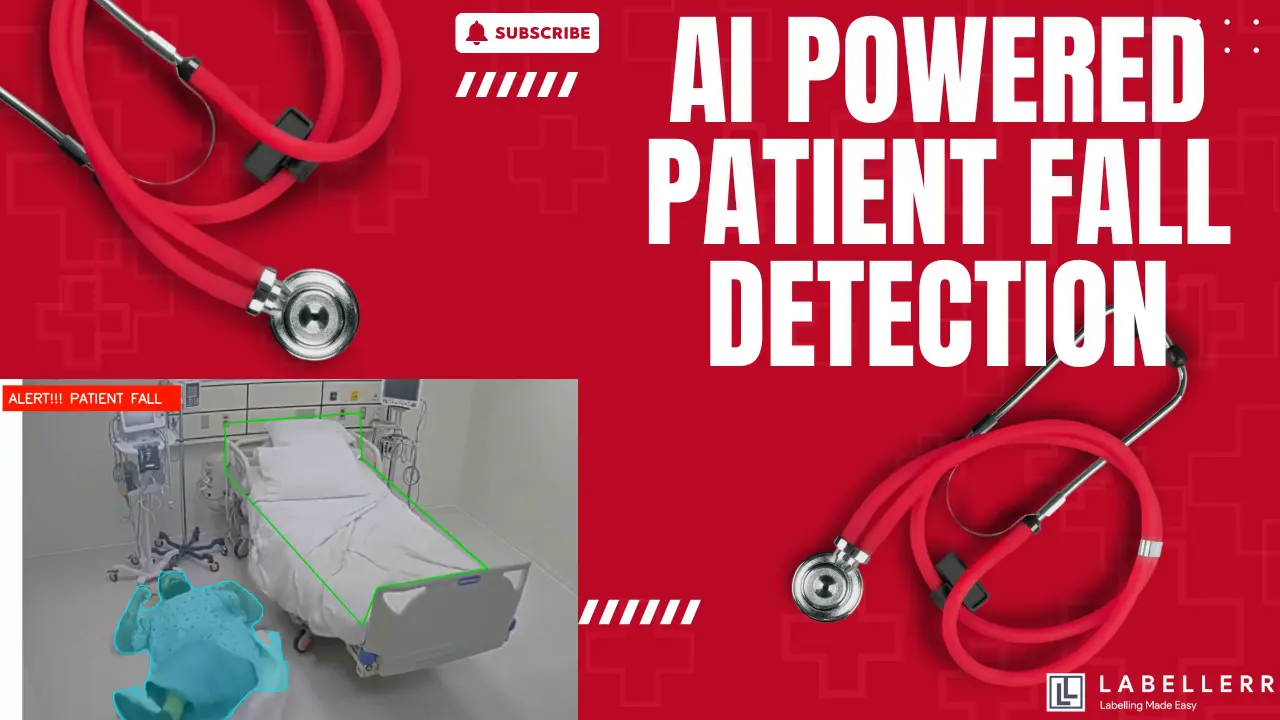
1. Interactive Polygon Mapping Instead of looking at the whole room, my system allows us to draw a custom "Safe Zone" around the bed. Because cameras are often at an angle, a simple box does not work. I used a 7-Point Polygon to match the exact shape of the bed on the floor. The AI uses YOLO11 to watch this specific spot. As soon as a patient’s "Center Point" exits that green zone, the system knows a potential fall is happening. This is the foundation of a precise and reliable safety system.
2. Full Shape Segmentation This is a very advanced part of the project. Instead of just drawing a square around a person, my system uses Instance Segmentation. This means the AI identifies every pixel that belongs to the patient’s body. On the screen, you see a cyan outline and a soft highlight over the patient. This allows the system to see the difference between a patient’s hand reaching out and their whole body leaving the bed. It makes the tracking much more accurate than old methods.
3. Real-Time Alert Overlay While the AI tracks the patient, it is constantly checking the mathematical boundary. If the patient moves into the "Fall Zone," the system reacts instantly. I built a high-visibility Red Alert Banner that appears at the top of the screen. It says "ALERT!!! PATIENT FALL" in large letters. This visual signal can be sent to a central monitor or a mobile app, so help can be sent within seconds.

Project Workflow
Real-World Applications
This technology is not just a coding experiment. It has massive value for hospitals, care homes, and families. Because it is reliable and provides fast alerts, it can be used to save lives every day.
Strict Bed Rest Enforcement In many cases, doctors order "strict bed rest" after a major surgery. If a patient gets up too soon, they could open their stitches or faint. This system acts as a 24-hour digital sitter. It alerts the staff the moment the patient tries to stand up, so the nurse can arrive before the patient even takes their first step.
Dementia and Memory Care Patients with dementia often get confused and try to leave their beds at night. They are at the highest risk for broken bones from falls. This AI provides a non-intrusive way to watch them. It does not require the patient to wear any sensors or buttons. It simply uses the camera to ensure they stay within the safe bed area, giving families peace of mind.
Industrial Hazard Zones The same technology can be moved from a hospital to a factory. Managers can draw a "Safe Zone" around a worker’s station. If the worker moves into a dangerous area near a moving machine, the AI can trigger an alarm or even stop the machine. This is called Dynamic Safety Geofencing.
Privacy-Friendly Monitoring Because the AI only cares about the "mask" and the "center point," the system can be set up to protect privacy. It can process the data and only show the alert and the outline to the staff, rather than a high-definition video of the patient. This helps hospitals follow privacy laws while still keeping patients safe.
Key Features of the System
To summarize why this project is a leader in its field, let’s look at the four pillars of its design:
- Centroid Logic: The alarm only triggers when the middle of the body exits the zone. This prevents false alarms if the patient just waves their hand or moves a pillow.
- Retina Masking: I used high-resolution segmentation masks. This ensures the AI sees the patient’s body clearly, even if the lighting in the room is dim.
- Custom Calibration: The tool includes a "Point-and-Click" setup. This means a technician can set up the safe zone for any bed in any room in just a few seconds.
- Persistent Tracking: The system gives the patient a unique ID. If a doctor walks into the frame, the AI is smart enough to keep tracking the patient separately without getting confused.
Conclusion
The AI Powered Patient Fall Detection system is a big step forward for smart healthcare. By combining high-speed tracking with custom digital zones, we have created a tool that actually protects vulnerable people. This project proves that Artificial Intelligence can do much more than just identify objects—it can act as a lifesaver.
Whether it is a large hospital or a small care home, this technology provides a reliable way to monitor safety. It removes the stress from nursing staff and provides a faster way to respond to emergencies. As we move into a future where "Smart Wards" are the standard, tools like this will be everywhere. Through the power of YOLO11 and smart logic, we are building a world where patients are never truly alone when they need help.
Frequently Asked Questions (FAQs)
How does the AI differentiate between a patient sitting up and an actual fall?
The system uses Centroid Logic and Instance Segmentation. Instead of triggering on any movement, the alert only activates when the mathematical center of the patient's body mass crosses the 7-point polygon boundary. Normal movements like sitting up or shifting pillows keep the centroid within the "Safe Zone," preventing false alarms.
Can this system work in low-light or dark hospital rooms?
Yes. By using YOLO11 with Retina Masking, the model is trained to recognize human shapes even in challenging lighting conditions. For total darkness, the system can be integrated with infrared (IR) cameras, as the AI processes the infrared feed the same way it handles standard video.
Does the system require the patient to wear any sensors or devices?
No. This is a non-intrusive computer vision solution. Unlike wearable pendants or pressure mats that can be uncomfortable or easily forgotten, this system relies entirely on the video feed to monitor safety, ensuring the patient remains unencumbered and comfortable.

Simplify Your Data Annotation Workflow With Proven Strategies
.png)