
AI-Powered Deadlift Form Analyser
Learn how to build an AI-powered deadlift analysis system using YOLO and computer vision. This guide covers tracking bar paths and biometric "power triangles" to provide real-time, data-driven feedback that prevents injury and optimizes lifting performance through technical precision.
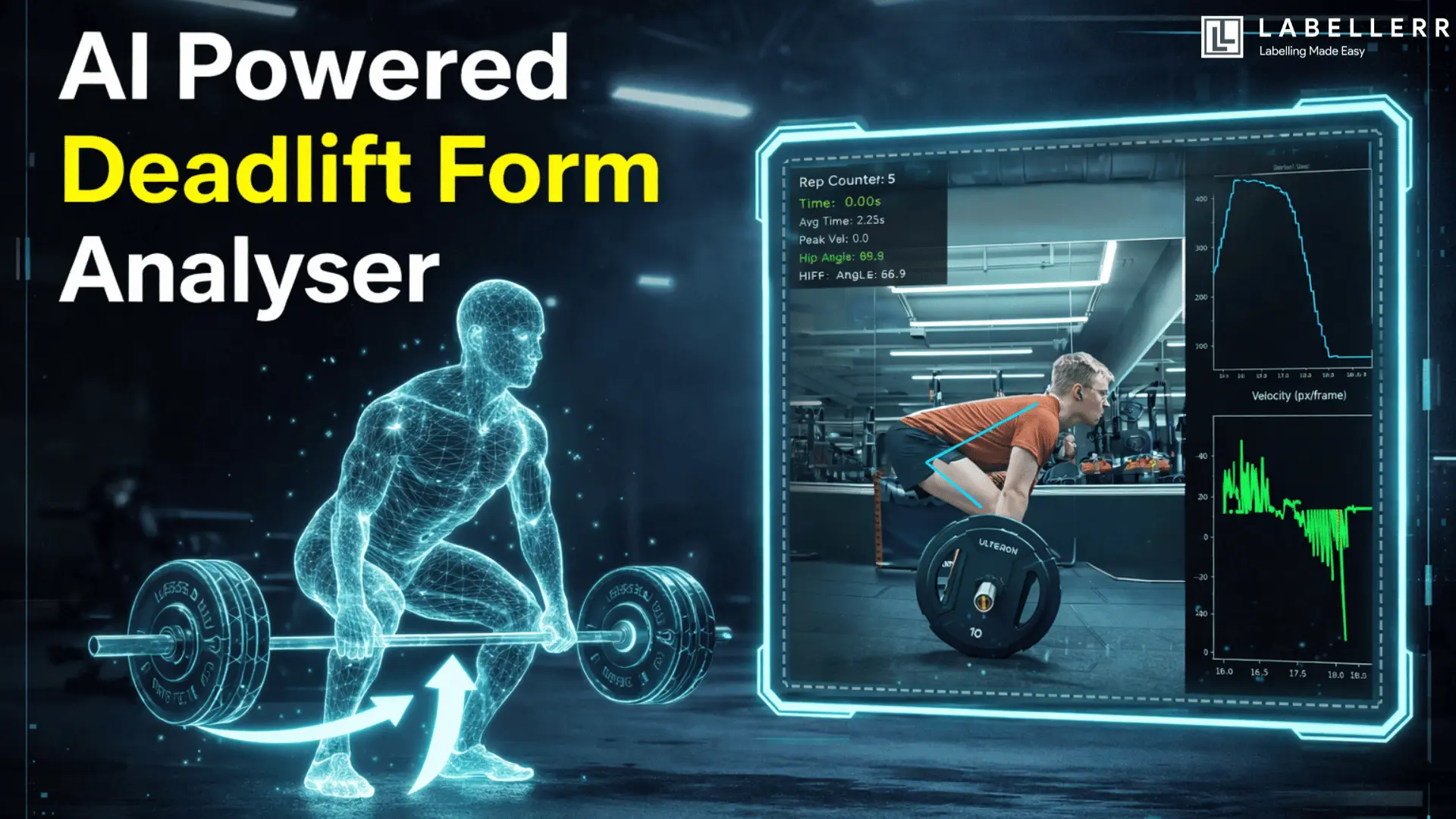
Effective strength training requires more than just heavy lifting. It requires technical precision. Among all compound movements, the deadlift is perhaps the most critical to perform correctly. A slight misalignment in the back or an improper hip hinge can lead to serious injury.
Traditionally, athletes rely on mirrors or human coaches to check their form. However, mirrors offer a limited perspective, and coaches cannot be present for every session.
AI-based form analysis provides a modern solution to this challenge. By utilizing custom-trained computer vision models, we can track both the equipment and the athlete in real time. This system provides consistent, data-driven feedback that manual observation simply cannot match. It transforms a standard gym video into a comprehensive biomechanical report.
In this blog, we explore how to build an end-to-end AI deadlift analysis system. We cover the integration of custom object detection for equipment and biometric point tracking for body mechanics.
What is AI-Based Form Analysis?
Form analysis in sports science involves measuring body angles, bar paths, and timing during an exercise. In a deadlift, the system must monitor the relationship between the barbell and the lifter’s joints.
An AI-powered system uses high-speed cameras and deep learning models to automate this observation. Instead of a coach guessing the back angle, the AI calculates it to the nearest degree. It identifies the exact moment the bar leaves the ground and tracks its vertical trajectory.
These systems provide objective results. They do not suffer from fatigue or bias. By applying the same rigorous standards to every rep, AI ensures that athletes maintain safe habits throughout their entire workout.
Why Manual Observation Falls Short
Many lifters record their sets on a smartphone to review later. While helpful, this method has significant limitations. It is difficult for the human eye to track the exact "bar path" or identify subtle "rounding" of the spine at the peak of a heavy lift.
Manual review is also time-consuming. An athlete must stop their workout, watch the footage, and try to interpret their own movement. This often leads to "analysis paralysis" or, worse, a misunderstanding of their own biomechanics.
Traditional sensor-based wearables also struggle here. While they can track heart rate or velocity, they cannot "see" the angle of your shins or the curvature of your back. AI-based computer vision overcomes these hurdles by seeing exactly what a professional coach sees only with mathematical precision.
How the Deadlift Analysis System Works
The system processes video input through a dual-task vision pipeline. A camera placed at a side-view angle captures the lifter's entire range of motion. This footage is then analyzed by two distinct neural network modules working in tandem.
.webp)
Deadlift
The first module is an object detection engine. It is trained to identify the barbell, the plates, and the rod. This allows the system to establish the "center of mass" for the equipment.
The second module is a biometric point engine. It maps the athlete’s skeletal structure, focusing on the shoulder, hip, and knee. By connecting these points, the system creates a digital overlay of the lifter’s posture.
The software then applies geometric logic to these detections. It calculates the hip hinge angle and the back's inclination. This entire process happens frame-by-frame, creating a real-time inference dashboard that highlights form errors as they happen.
Main Stages of the Development Pipeline
Building a robust sports analysis tool requires a structured approach. We have divided the development into three primary stages:
.webp)
Project Workflow
- System Configuration and Data Integration
- Custom Inference and Model Fusion
- Biometric Logic and Visual Feedback
Each stage is vital. The accuracy of the final feedback depends entirely on the quality of the detections in the earlier steps.
Stage 1: System Configuration and Data Integration
Every AI project begins with a clean environment. For this system, we utilize the YOLO (You Only Look Once) architecture due to its industry-leading speed. Real-time feedback requires low latency, and YOLO is optimized for this exact purpose.
The data integration phase involves preparing the model to recognize gym-specific equipment. In our environment, we define paths for the custom weights and the barbell dataset. We also ensure the system can handle standard MP4 video formats at various frame rates.
We initialize two "inference engines." One is dedicated to the physical objects (the weights), and the other is dedicated to the human biometrics (the pose). By separating these tasks, we ensure high precision for both the athlete and the iron.
Stage 2: Custom Inference and Model Fusion
Once the engines are initialized, the system begins the "Inference Loop." This is where the raw video frames are transformed into data points.
The object detection module scans the frame for the barbell. It places bounding boxes around the plates, allowing the system to track the "bar path." If the bar moves too far forward from the mid-foot, the system flags it as a technical error.
Simultaneously, the biometric module extracts keypoints. For the deadlift, we focus on index points 5 (Shoulder), 11 (Hip), and 13 (Knee). These three points form the "power triangle" of the lift. The model must be robust enough to track these points even when the athlete is moving quickly or wearing loose clothing.
We fuse the data from both modules into a single "annotated frame." This creates a unified visual where the barbell and the skeletal map are displayed together, providing a complete picture of the lift's physics.
Stage 3: Biometric Logic and Visual Feedback
Detection is just the first step. The real value comes from the logic applied to those detections. In this stage, we program the system to act as a coach.
We draw a "Shoulder-to-Hip" line to monitor back alignment. If this line curves significantly, it indicates a rounded back. We also draw a "Hip-to-Knee" line. The angle between these two lines tells us if the lifter is "pulling" with their back or "pushing" with their legs.
We implement confidence thresholds for these points. If the camera angle is poor and a joint is hidden, the system acknowledges the uncertainty rather than giving false feedback. Finally, we output the processed video with a digital overlay. This dashboard shows the lift in slow motion, highlighting the bar path in one color and the body mechanics in another.
Handling Gym Conditions
Real-world gyms are difficult environments for AI. Lighting is often uneven, and other people may walk into the frame. Our system includes several safeguards to handle these conditions.
We use "Spatial Filtering" to ensure the system stays focused on the primary lifter. By defining a region of interest, we ignore background movement. We also use temporal smoothing; if a keypoint disappears for a single frame due to a shadow, the system predicts its location based on previous frames to maintain a steady line.
These optimizations ensure that the analysis remains stable, whether you are in a brightly lit professional facility or a dimly lit garage gym.
Conclusion
AI-powered deadlift analysis represents a major leap forward in personalized fitness. By combining custom object detection with real-time biometric tracking, we provide athletes with a level of insight that was previously reserved for elite professionals.
This system does more than just count reps. It monitors the "why" behind the movement. It ensures that the bar path is vertical, the back is flat, and the hip hinge is timed perfectly. As computer vision continues to evolve, these tools will become an essential part of every athlete's toolkit.
By following this structured pipeline from data integration to biometric logic manufacturers and developers can create smarter, safer, and more effective training environments for everyone.
FAQs
How does AI identify "bad" deadlift form specifically?
The system uses geometric logic to compare your real-time joint angles against biomechanical safety standards. For example, if your hips rise faster than your shoulders (the "stripper deadlift") or your spine curvature exceeds a set threshold, the AI flags the movement as an error.
Can this system handle different styles like Sumo or Romanian deadlifts?
Yes. While the tracking points (Shoulder, Hip, Knee) remain the same, the underlying logic is adjusted for different mechanical requirements. The AI can be programmed to recognize the wider stance of a Sumo deadlift or the specific hip-hinge depth of an RDL.
Is high-end hardware required to run this analysis?
While training happens on powerful GPUs, the final inference models are optimized for speed. Using the YOLO architecture and a streamlined biometric map, the system is designed to run on consumer-grade hardware and eventually mobile devices at 30+ FPS.

Simplify Your Data Annotation Workflow With Proven Strategies
.png)