
AI Conveyor Belt Counter: Real-Time Dual-Lane Monitoring
Learn how to build a high-precision dual-lane conveyor counter using YOLO11 and ByteTrack. This guide covers how to eliminate manual counting errors, implement spatial partitioning, and use trigger-zone logic to achieve 100% accuracy in high-speed industrial environments.
The modern world moves on conveyor belts. Experts say that global manufacturing output will continue to rise as more people join the middle class. This rapid growth creates a massive challenge for the people who manage our factories. We call these people production managers. Their job is to make sure facilities run smoothly and hit their daily targets. But they must also keep costs low and data accurate.
How do we move thousands of items every hour while keeping a perfect count? In the past, this was a very slow and manual process. Managers had to rely on staff standing by the belt with clickers or clipboards. Today, that is changing. The answer lies in computer vision. By combining overhead cameras with Artificial Intelligence (AI), we can now monitor entire production lines in real-time. This technology doesn't just record video; it understands every object that passes by.
The Problem with Old Sensors
To understand why AI is so important, we first have to look at how industrial counting used to work. For decades, factories relied on physical infrared sensors. These sensors work by breaking a beam of light every time an object passes. As you can imagine, this system has many flaws. If two lemons pass the beam at the exact same time, the sensor only counts one. This is a common error called clumping.
Manual counting is even worse because humans get tired. A person cannot watch a fast-moving belt for eight hours without losing focus. It also costs a lot of labor money that could be used for better tasks. Satellite-style overhead views helped for a while, but simple motion sensors are easily confused by shadows or mechanical vibrations. By the time a shift ends, the manual log and the physical inventory often do not match.
This delay makes it hard to catch production problems. For example, many facilities have "dual-lane" belts to move more products at once. Managers need to know exactly how much volume is coming from Belt A versus Belt B. This helps them find which machine is slow or which lane is causing a bottleneck. But without quick, smart mapping, it is easy to miss these trends until the end of the day when it is too late to fix them.
How the AI Pipeline Works
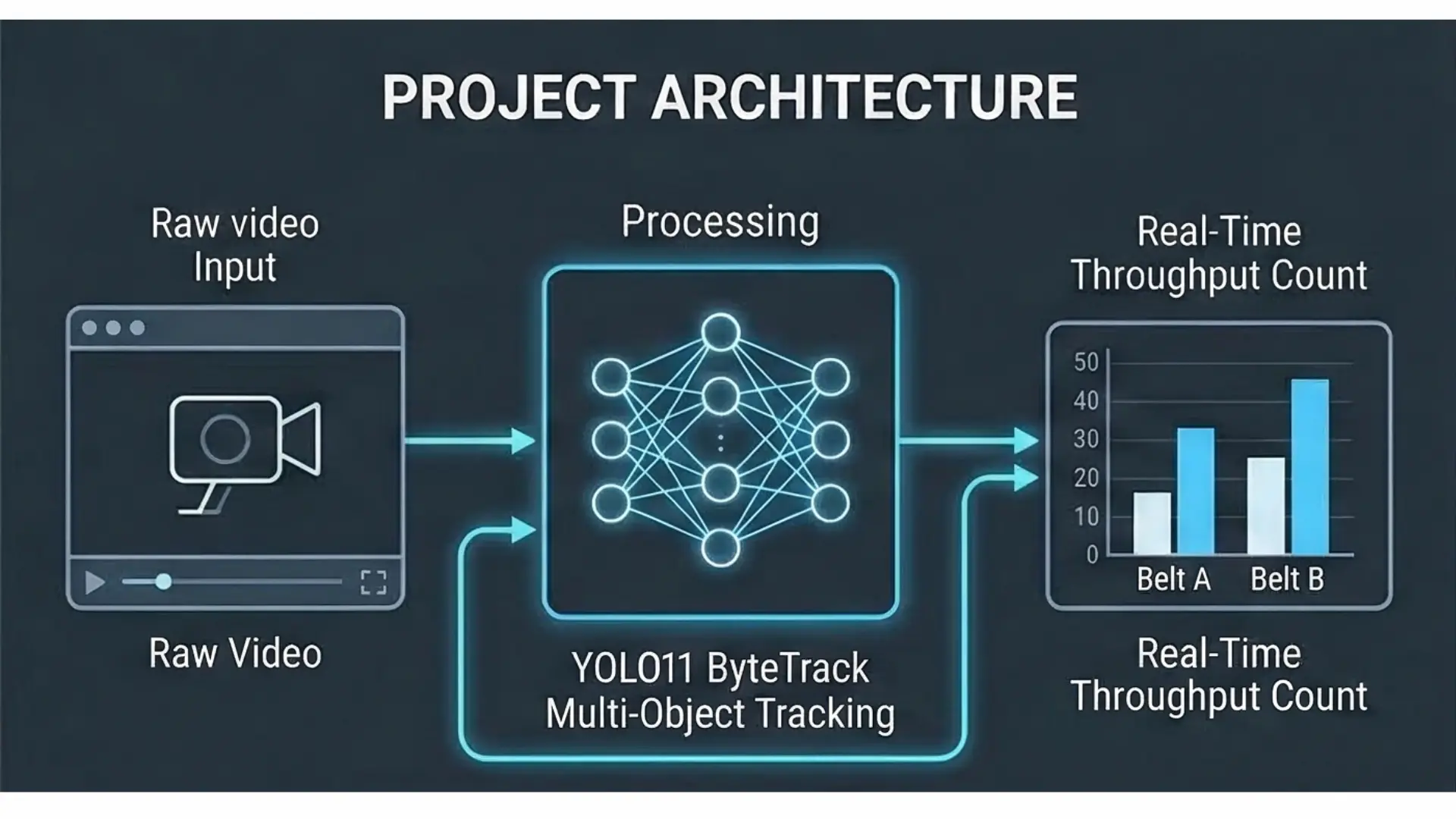
Project Architecture
The new solution uses a powerful AI system called YOLO 11. YOLO stands for "You Only Look Once." It is a type of computer brain designed to see objects and their boundaries very quickly. When a camera watches a conveyor belt, this AI looks at the video feed in real-time. It doesn't just see a picture; it sees a stream of moving data.
The AI instantly identifies the objects and applies a digital identity to them. To make these counts professional and accurate, the system uses two main technologies:
- Instance Segmentation: This draws a pixel-perfect mask over every lemon, allowing the AI to tell them apart even if they are touching.
- ByteTrack: This is a persistent tracking brain. It assigns a Unique ID to every lemon so the system remembers it from the top of the screen to the bottom.
The final result is what we call a "Pure Count." It is a clean, color-coded view of the production line. It shows exactly how many items have passed through each lane. It looks like a high-tech dashboard that a plant manager or a data scientist would use to present to the CEO.
Why Throughput Accuracy Matters
You might wonder why we care so much about counting every single piece of fruit. It turns out that throughput data is vital for a healthy business. If a factory overcounts, they promise customers products they don't have. If they undercount, they leave money on the table. We call this the "Inventory Gap." Accurate AI data acts like a natural audit for the entire facility.
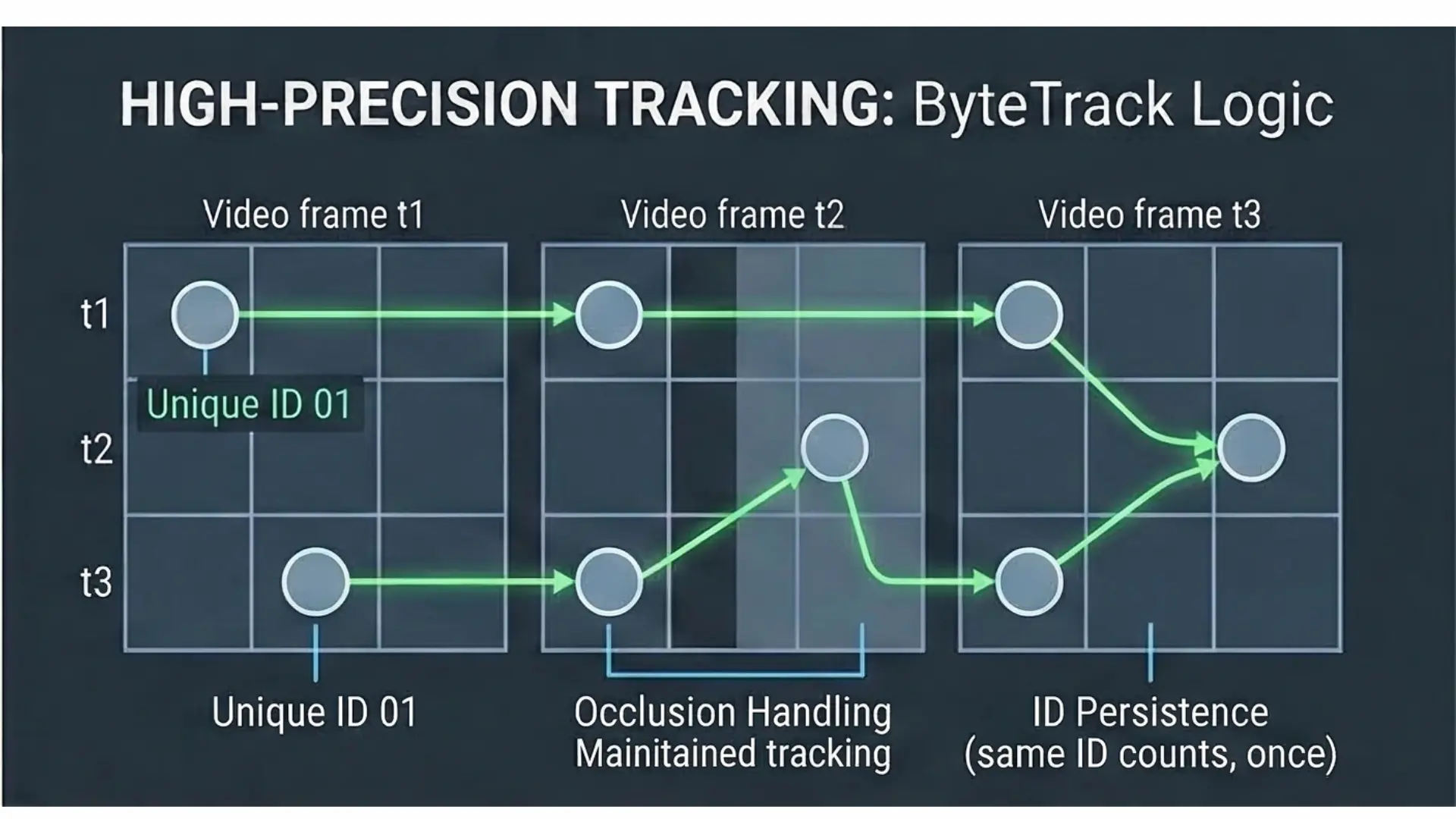
High Precision Tracking
Reliable counts also help with mechanical health. When a belt has a smooth flow, the machines last longer. If the AI shows that one lane is constantly clumping or moving slower than the other, it is a signal that a motor might be failing. This allows for "Predictive Maintenance," where a team fixes a machine before it actually breaks and stops the whole line.
By using AI cameras, production leaders can see a "Flow Score" for every shift. They can see which hours are the most productive and which belts are performing the best. This helps them decide exactly where to put their best workers and how to schedule their maintenance to help the company grow.
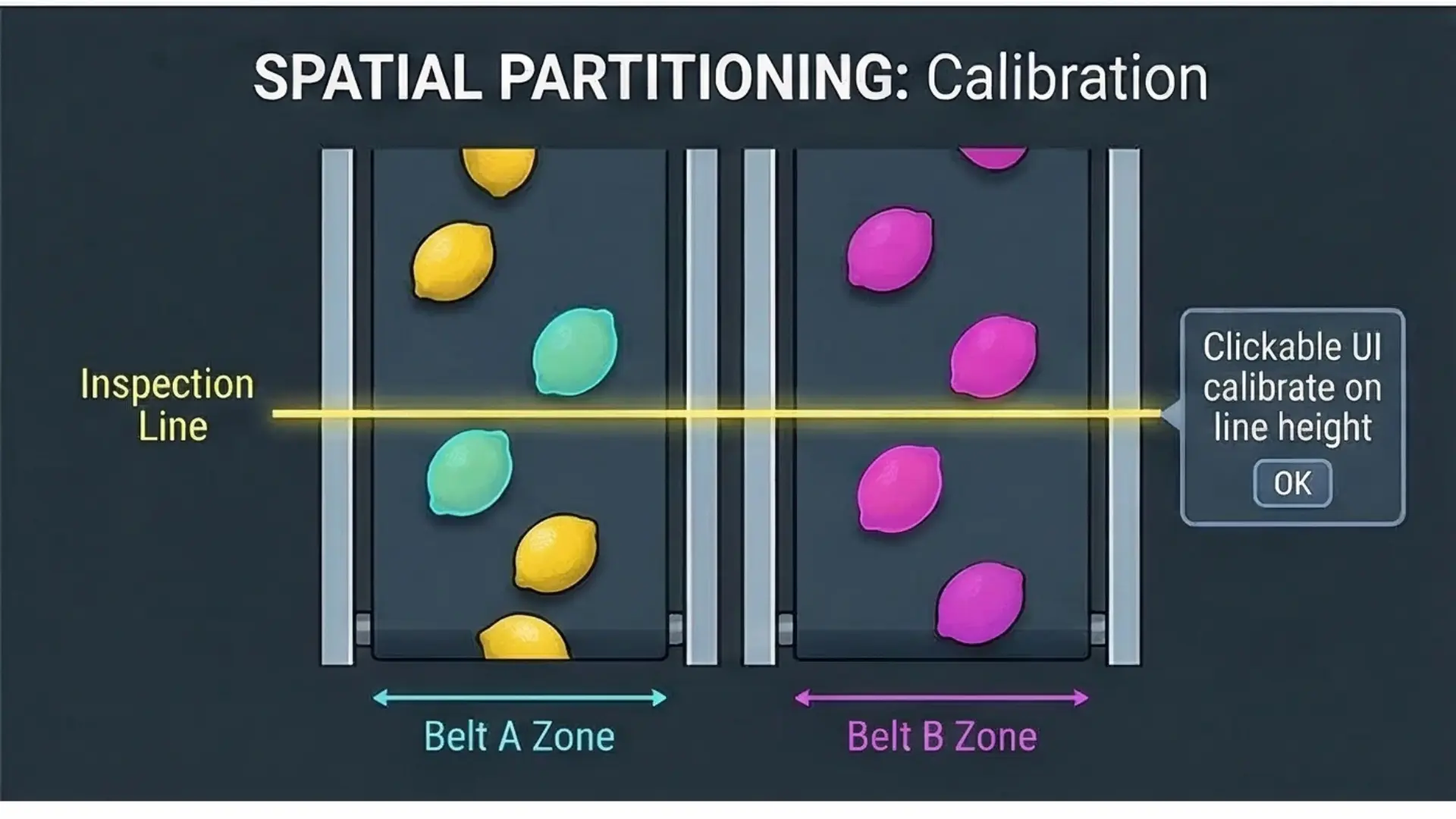
Spatial Partitioning
Planning the Smart Factory
This technology is also a game-changer for building brand-new "Smart Factories" from scratch. These are facilities designed to be efficient and data-driven from day one. When engineers start a new project, they need to know the belt speeds and lane capacities perfectly. They need to know where the bottlenecks will happen before they even buy the machines.
The AI system can scan a digital twin of the factory or a test run in a single afternoon. With this data, planners can place conveyors in the best spots to avoid traffic. They can design the layout in ways that maximize every square foot of the floor. It allows them to balance infrastructure with production volume before the first machine is even bolted down. This saves a lot of money because they don't have to fix expensive layout mistakes later.
Industrial Accountability
One of the most exciting parts of this project is accountability. In a big plant, it is hard to watch every single lane at once. Some shifts might run the machines too fast to hit targets, which can damage the product. Other shifts might move too slow when the supervisor isn't looking.
With an AI camera, the management can perform a "digital audit" from the office. They can check the logs once an hour and see the live visual proof. The AI will tell them instantly if the production speed is dropping. It provides proof that cannot be argued with. This helps ensure that everyone follows the standard operating procedures to keep the facility profitable for everyone.
The Benefits of Fast Data
In the world of manufacturing, speed is everything. Because this AI works so fast, the production data is always fresh. This allows for "Proactive Management." Instead of reacting to a low count at the end of the week, managers can see the problem coming in the first ten minutes of a shift.
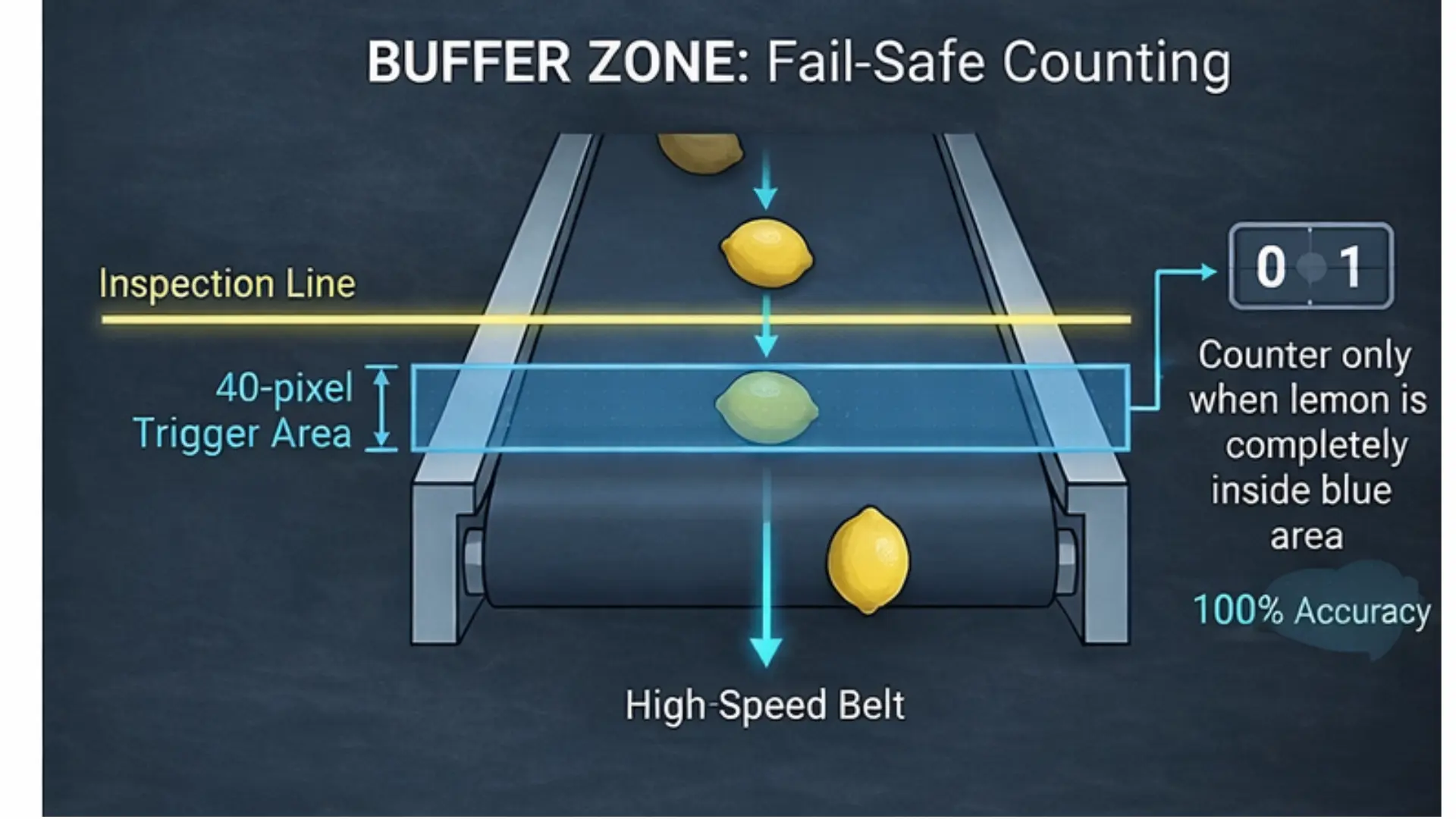
Buffer Zone
For example, if the AI shows that Belt B is moving 20% slower than Belt A, the team can step in immediately. They don't have to wait for a person to notice the pile-up. The AI acts like a 24/7 watchman for the production line. This keeps the warehouse moving and ensures that the trucks are always loaded on time.
A Path to a More Efficient Future
Using AI for industrial counting is about more than just cool gadgets. It is about a new way of thinking. For a long time, people thought that "faster production" had to mean "more mistakes." We thought you could have a high-speed belt or a perfect count, but not both.
This technology proves that we can have both. When we have accurate data, we can make smarter choices. We can find the perfect balance. We can build factories that are incredibly fast but also perfectly organized. This tool turns a simple camera into a powerful plan for the future. It gives industrial leaders the facts they need to build a better world. By using AI, we are moving from a world of guessing to a world of knowing.
Summary of Impact
To wrap things up, let’s look at the three biggest wins this technology provides:
- Efficiency: Counting that used to take hours of manual labor now happens in real-time.
- Accuracy: We get pixel-perfect data on exactly how much product is moving through each lane.
- Stability: We can finally protect our production targets with real, unarguable evidence.
The next time you see a camera above a conveyor belt, remember that it is doing more than just recording. It is helping to run the very factory that makes the products you use every day. AI is making our manufacturing more transparent and our supply chains more stable, one count at a time.
FAQs
How does the system handle lemons that are touching or overlapping on the conveyor?
The system uses YOLOv11 instance segmentation to draw precise, pixel-level masks around each object. Unlike standard bounding boxes that often overlap and cause counting errors, these masks allow the AI to identify individual boundaries, ensuring each lemon is counted separately even when "clumping" occurs.
Will the system double-count a lemon if it briefly disappears due to a shadow or occlusion?
No. By implementing ByteTrack for persistent ID tracking, the system assigns a unique digital signature to every detected object. This "memory" allows the AI to maintain the same ID for a lemon throughout its entire path, preventing it from being registered as a new item if the tracking is momentarily interrupted.
Can this system be integrated into existing factory setups without specialized cameras?
Yes. The pipeline is designed to be hardware-agnostic and memory-efficient. It processes standard video feeds frame-by-frame (streaming) to prevent RAM crashes, meaning it can run on most industrial PCs using existing overhead camera infrastructure without requiring expensive high-end GPUs.

Simplify Your Data Annotation Workflow With Proven Strategies
.png)